Sign in. It’s quick, free and it’s up to you.
An account is an optional way to support the work we do. Find out more.
Sign in. It’s quick, free and it’s up to you.
An account is an optional way to support the work we do. Find out more.
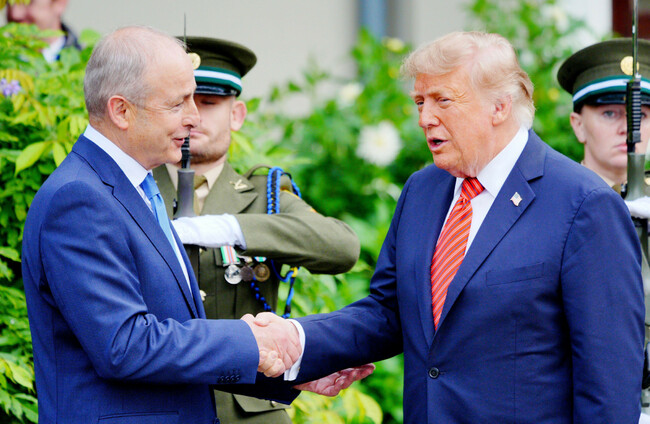
TAOISEACH MICHEÁL MARTIN has said that Donald Trump’s support for Irish unity “should be no surprise” to unionists.
The Fianna Fáil leader said he had discussed the possibility of a united Ireland with the US president “anytime” they have spoken about Northern Ireland in the past.
His comments come after Trump told reporters several times during his two-day visit to Ireland over the weekend that he would “love to see” a unified Ireland, describing it as “one of the naturals of all time”.
The unexpected remarks caused raised eyebrows north and south of the border in Ireland, and in Britain, as well as backlash from conservatives and unionists.
DUP leader Gavin Robinson said Northern Ireland’s constitutional future would be decided by its people, not by commentary in Washington, adding that unionists were “not interested in the destruction of our country by joining with the Irish republic”.
Speaking on RTÉ’s Today with David McCullagh, Martin said he felt there was an overreaction from “some unionist politicians”.
“Using language like ‘a united Ireland would bring about the destruction of Northern Ireland’, I wouldn’t agree with Gavin Robinson on that,” he said, adding that the comments “should be no surprise to them”.
“Anytime I spoke to President Trump about Northern Ireland, he asks the question, ‘Do you think there will be a merger anytime soon?’”.
Martin said he had explained to Trump the peace process that led to the Good Friday Agreement and that working in lockstep with the British government, “which was the underpinning of that agreement, is necessary in terms of the next stages”.
“We had a good discussion yesterday about it,” he said. “[Trump] recalled the murder of Lord Mountbatten during our conversation at lunch. His view and recollection is of a very vicious and terrible conflict in Northern Ireland.”
Martin said that dealing with the issues of legacy would be “the most significant breakthrough” for the victims and families of victims who were murdered during the Troubles, and would mean there would be an obligation on everybody to cooperate with the new Northern Ireland Human Rights Commission.
“In my view, I would say in terms of any future on the island of Ireland, it has to be founded on the three sets of relationships that gave rise to the Good Friday Agreement: the British-Irish, the North-South, and the two traditions within Northern Ireland.”
He said a devolved administration in the six counties is “open for discussion” but that he believes it would be required. “That’s one view, and my party supports Irish unity, but I do believe a lot has to happen in terms of reconciliation on the island.”
His comments come as Northern Ireland first minister Michelle O’Neill travelled to Cardiff today to sign a memorandum of understanding with her Scottish and Welsh counterparts pushing for constitutional change.
The leaders called on the British government to “prepare for, plan and facilitate constitutional change”.
Speaking to McCullagh earlier, Sinn Féin leader Mary Lou McDonald that the Irish government ”needs to be very front-footed from here on in, in shaping and clearing the space for that democratic conversation”.
Martin rejected the idea that everyone seemed to be talking about a united Ireland but him, telling McCullagh that he got involved in politics because of Northern Ireland.
“I grew up at a time when the violence was rife, particularly in the 1970s. The early violence of the British government at the time and so on, internment, Bloody Sunday, all of that. I never actually thought we’d get peace,” he said.
“I’m not into simplistic rhetoric. I’m not into timelines. I’m not into sort of saying we’ll do it all next week and it’ll be simple.”
Without being specific, Martin said he worried about some of the rhetoric from Sinn Féin at times, describing it as “harking back to the 1970s” and “digging trenches”.
I don’t sense that generosity of spirit. I don’t sense it on legacy. I’ve never sensed it from Sinn Féin on legacy. They’ve been poor at giving closure to families who their predecessors would have murdered.
When McCullagh put it to him that Sinn Féin would say they are not responsible for the actions of the IRA, Martin said: “Are you serious? No one takes that seriously. They’re indistinguishable from each other. They’re one movement. Danny Morrison said it. They all said it, for God’s sake. They’re interchangeable.”
Danny Morrison was Sinn Féin’s national director of publicity in the 1980s. He proposed what became known as the armalite and ballot box strategy adopted by the republican movement at the time. It saw Sinn Féin contest elections north and south while the IRA continued its campaign at the same time.
Martin said the party need to do something on legacy and “stop pretending it was a great sort of war that was justified and everything else like that”.
“I think the Kenova Report illustrates the devastating impact that the Provisional IRA had on their own community.”
Martin reflected being at Fleadh Cheoil na hÉireann and seeing loyalist pipe bands and Ulster Scots dancers participating. “If you had said to me 10 or 15 years ago that I would be doing that, I would have not believed it.
“I believe in Irish unity. I’ve said that repeatedly, but I want an Irish unity that works, and that takes hard work.”
The Taoiseach said he would meet with British prime minister Andy Burnham this week, where they would discuss legacy and the Northern Ireland Assembly.
Burnham drew backlash from Sinn Féin during a visit to Belfast last month when he told reporters a referendum on a united Ireland is “off the table”.
Asked if they would be discussing Trump’s remarks, Martin said they would be discussing “a wide range of issues”.
“This is my first meeting with Andy in his capacity as British Prime Minister. I’d met him obviously previously in his capacity as mayor [of Manchester], and we’ve a good relationship already.
“I think we’ll have a wide-ranging discussion in terms of the British-Irish relationship and everything that that entails.”

To embed this post, copy the code below on your site













have your say