Sign in. It’s quick, free and it’s up to you.
An account is an optional way to support the work we do. Find out more.
Sign in. It’s quick, free and it’s up to you.
An account is an optional way to support the work we do. Find out more.
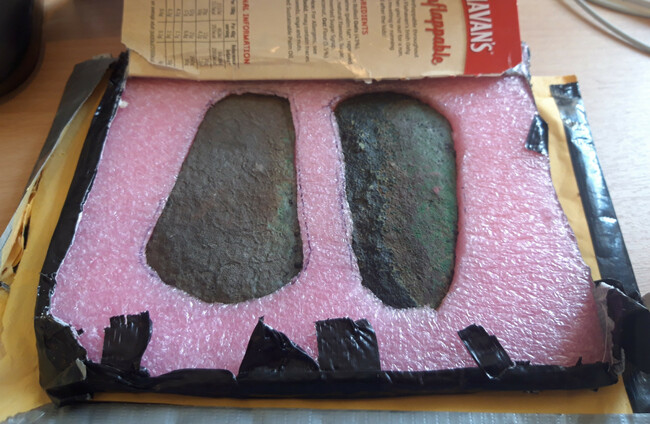
THE NATIONAL MUSEUM of Ireland has appealed for information after two 4000-year-old Early Bronze Age axeheads were sent to the museum anonymously at the end of June.
The museum said the axeheads were accompanied by a letter stating that they were discovered in the Westmeath area using a metal detector.
The axeheads have been dated to around 2150-2000 BC.
The sender said they wanted the artefacts to be conserved by the museum, but did not provide any contact details or further information.
The museum said the axeheads were “thoughtfully packed in foam cut-outs and cardboard, ensuring their safe arrival”.
“Our experts at the NMI have identified these items as flat axeheads from the Early Bronze Age, a significant archaeological find that offers a glimpse into Ireland’s distant past,” the museum said.
We are appealing to members of the public to provide information about 2 Early Bronze Age axeheads (2150-2000 BC) posted anonymously to the Museum in June. Found in Westmeath, their location is crucial for archaeological context.https://t.co/PywTU7YEwl pic.twitter.com/iY5LLcmjUC
— National Museum of Ireland (@NMIreland) July 12, 2024
It said that in order to fully understand and appreciate the artefacts, it was crucial to know the exact location where they were found.
“The context of such discoveries helps archaeologists piece together ancient settlement patterns and cultural practices,” it said, adding that collections of objects were often deliberately placed in specific locations for reasons that could range from ritualistic to supernatural.
“With this in mind, we are appealing to the person who sent these axeheads to reach out to us.
“Any information about their discovery will be treated with the utmost confidentiality and used solely to verify the find location and its circumstances.”
Matt Seaver, assistant keeper of Irish antiquities at the museum, said: “We are thrilled about the discovery of these Early Bronze Age axeheads, but to truly understand their significance, we need to know where they were found.
“It is our legal duty to report the discovery of archaeological objects. The NMI’s role is to preserve these treasures for everyone in the State, ensuring they are available for future generations. We rely on the public’s support to achieve this,” Seaver said.
It is against the law to use a metal detector to search for archaeological objects in Ireland unless you have written consent from the Government.
Anyone found in breach of this law could be fined up to €63,486 or be sentenced to up to three months in prison.
Seaver said: “We also wish to remind everyone about the regulations surrounding the use of metal detectors for searching archaeological objects.
“Archaeological finds without a known owner are the property of the state and are preserved as part of our collective heritage in national and designated museums.”

To embed this post, copy the code below on your site














have your say