Sign in. It’s quick, free and it’s up to you.
An account is an optional way to support the work we do. Find out more.
Sign in. It’s quick, free and it’s up to you.
An account is an optional way to support the work we do. Find out more.
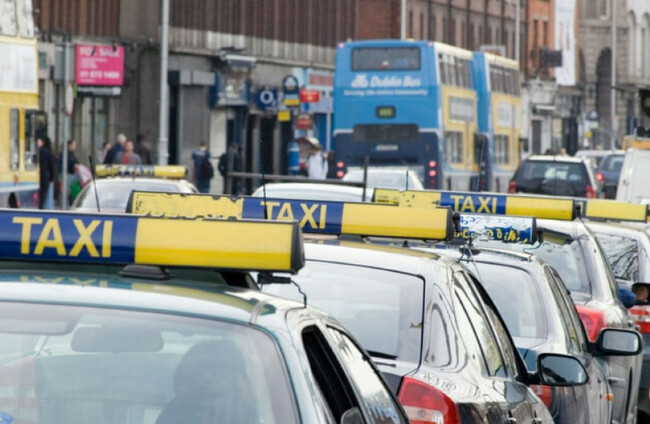
THE NATIONAL TRANSPORT Authority (NTA) has said fixed fares are “a good thing” for passengers, and told taxi drivers and ride-hailing apps to work out any issues.
Drivers took issue with Uber’s introduction of fixed fares last year, prompting go slow protests in Dublin city centre.
They accused Uber of undermining the regulated taxi fare structure set by the NTA, while Uber said the pricing model ensures passengers aren’t surprised by a higher price due to traffic or route changes.
Taxi drivers claimed it amounts to “predatory pricing” and leaves drivers earning less, particularly during traffic delays.
Speaking at the NTA headquarters in Dublin today, Kevin O’Brien, director of transport regulation, said that it is reviewing rules for ride-hailing apps. However, there likely won’t be a clampdown on fixed fares.
“Our framework is that if you get into a taxi, you should know that there’s a maximum that can be charged. But through Uber or through Free Now or through engagement with the taxi driver, it’s fine to be charged less,” said O’Brien.
“Fixed fares have always been an element of the marketplace down the years.
“So while it’s one of the things we’ll consider in our review, fundamentally we think discounts for passengers are a good thing.”
He added that if taxi drivers have an issue, they should work it out with the companies involved.
Despite tension in the industry, it’s attracting the highest number of new drivers on record in 10 years.
A total of 1,893 licences were issued last year, bringing the total to 27,891.
Meanwhile, there has been a decrease in the amount of drivers using apps. Since February 2024, it’s gone from 66% to 57%.
Free Now continues to be the most popular app for drivers, with 82% using it. Two in five use Uber, 13% use Bolt and 4% use Lyft. Many taxi drivers use multiple apps.
When surveyed by the NTA, half of drivers who choose not to use apps said they preferred street work, while 22% said the fees on apps were too high.
Earlier this year, the Consumer and Competition Protection Commission (CCPC) called for increased access to ride-hailing apps on the Irish market due to a taxi supply shortage.
Four in 10 people who tried to get a taxi in December 2025 reported difficulties doing so, while almost half of taxi users want the choice of ride-hailing.
In Ireland, to provide taxi services you must get a Small Public Service Vehicle (SPSV) driver licence from the NTA. This requires having a valid driving licence for 12 months, passing a two-part exam, completing disability awareness training, passing garda vetting and paying a €250 application fee.
To become an Uber driver in the UK, applicants must be 21, have a valid UK driver licence, get a private-hire licence from a council that Uber is licensed by and complete a pre-boarding course. There are also vehicle requirements that differ by location.
Uber does operate in Ireland, but doesn’t provide the same ride-sharing service as it does in the UK. In Ireland, it acts solely as a broker allowing customers to book trips with regulated taxi drivers who have an SPSV licence.
“The model where anyone with a private car (not licensed as a Small Public Service Vehicle) and an App can provide taxi services does not exist in Ireland,” Transport Minister Darragh O’Brien said.
He said the government has “no intention” of changing this.

To embed this post, copy the code below on your site











have your say