Sign in. It’s quick, free and it’s up to you.
An account is an optional way to support the work we do. Find out more.
Sign in. It’s quick, free and it’s up to you.
An account is an optional way to support the work we do. Find out more.
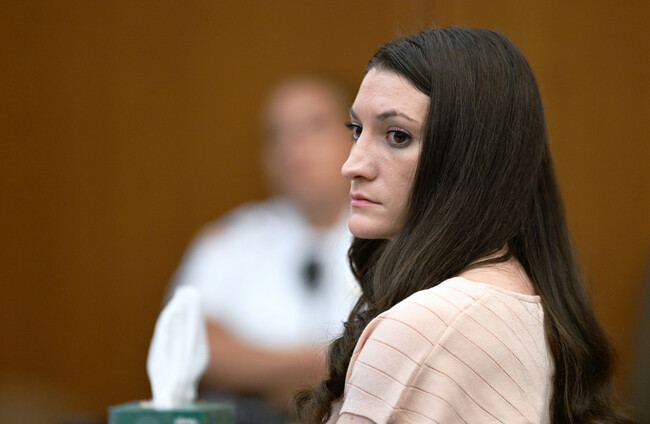

ON 24 JANUARY 2023, Lindsay Clancy fatally strangled her three children in her home in the US state of Massachusetts while her husband Patrick was running an errand.
Her live-streamed trial has been ongoing since the end of July and has gripped social media users who have pored over hours of testimony in search of clues about what happened that night.
The basic facts of the case are not in dispute.
Clancy does not dispute that she killed her children, but her defence argues that she was not criminally responsible because she suffered from postpartum psychosis at the time.
That has not prevented an army of social media sleuths from interpreting testimony and evidence heard during her trial to present a series of alternative theories, which are entirely unsupported by facts.
It’s the latest high-profile case to be transformed into a social-media whodunnit, as amateur detectives piece together their own version of events in ways that generate harmful levels of suspicion.
Lindsay Clancy (36) is on trial for the murder of her 8-month-old baby Callan, her three-year-old son Dawson, and her five-year-old daughter Cora.
She does not dispute that she strangled the children, before attempting to take her own life by jumping from a window of her home, leaving her paralysed from the waist down.
Instead, her lawyers say she cannot be found guilty of murder by the jury due to her mental state because she suffered from delusions and hallucinations that prevented her from understanding the nature or wrongfulness of her actions.
Postpartum psychosis is a rare condition estimated to affect one or two people in every 1,000 after giving birth, during which a person experiences a loss of contact with reality, such as delusions, hallucinations or severe confusion.
It differs from the more commonly known postpartum depression, which is a mood disorder that is mainly marked by persistent sadness, anxiety and difficulty functioning.
Clancy could be found not guilty by reason of insanity.
A diagnosis alone would not determine the verdict, and the jury must decide whether a mental disease or defect left Clancy without the substantial capacity to appreciate the criminality or wrongfulness of her actions at the time of the killings.
Massachusetts prosecutors claim that Clancy deliberately planned the killings and that she understood that what she was doing was wrong, and that she tried to conceal her actions by faking her suicide attempt.
Her former husband Patrick, who has publicly said that he forgives her, has not been accused of involvement by prosecutors or implicated in the deaths in any way.
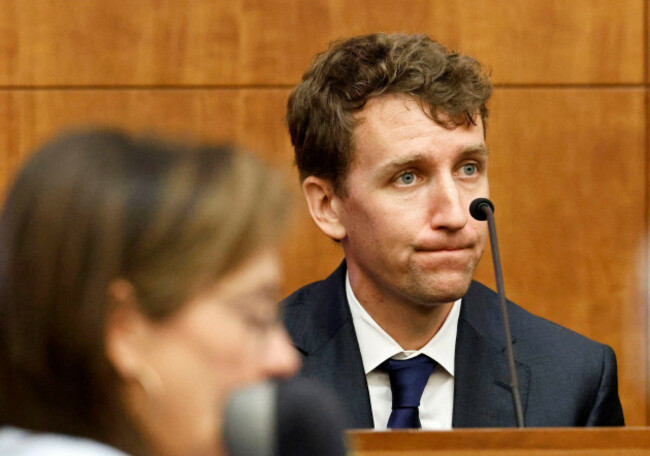
That has not prevented Patrick from being named as a possible suspect by some of those following the trial on social media.
Some of that suspicion draws on the well-documented prevalence of male intimate-partner violence, and high-profile cases in which men have killed their families.
The trial has also exposed legitimate questions about the medical care, medication and support Lindsay received before the killings.
But neither population-level patterns nor possible failures in her treatment provide evidence that Patrick killed his children.
Instead, they are being used to bridge an information gap between what has been heard in court and an alternative story that is developing online.
In the Clancy case, people who believe Lindsay did not kill her children have examined Patrick’s behaviour in the aftermath and during the trial and judged him for it.
On TikTok and Instagram in particular, some creators have leaned into this by taking fragments of information presented during the trial and assembling various alternative theories around what happened to Lindsay Clancy and her children.
They have asked why Patrick went to help Lindsay after he found her injured outside the house (after she jumped from a window) instead of immediately checking on the well-being of his children.
Others have scrutinised his account of the evening the children were killed, his demeanour while he has given evidence in court, and the fact that he remarried three years after the murders.
One viral TikTok video using Bratz dolls – which has since been deleted, but whose claims have been repeated in other videos – incorrectly suggested that Lindsay’s bedroom was “staged” after she jumped from the window.
Occasionally, theories have been presented to social media users the same way as conspiracy theorists allude to their claims without presenting facts, by ‘just asking questions’.
Another trend has looked at data from Lindsay Clancy’s smartwatch as a potential smoking gun, with users suggesting her recorded heart rate was not consistent with the physical exertion it would take to strangle three children.
One version of this on Instagram presents events from the evening of 24 January in an AI-generated timeline graphic, asking: “What happened between 5.15 and 5.38pm? 23 minutes. Multiple data points. A lot of questions.”
This type of sleuthing has led a large cohort of social media users to an alternative conclusion: that Patrick, rather than his wife, is responsible for the children’s deaths.
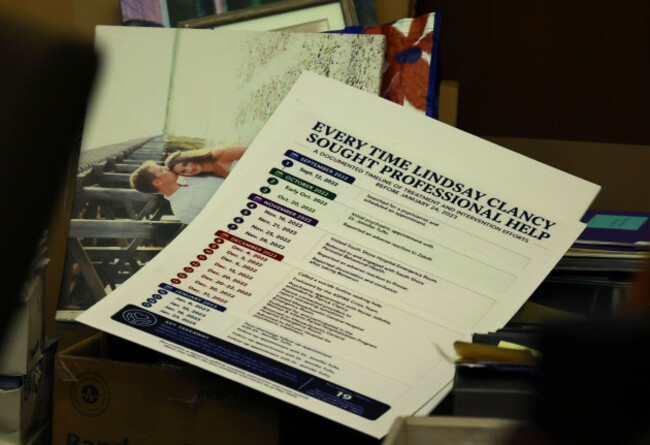
Short-form video is particularly effective at turning these isolated details into a seemingly coherent case.
Each day of testimony supplies creators new evidence and footage that can be turned into perceived inconsistencies to examine.
When these videos are delivered consecutively by recommendation systems on TikTok and Instagram, they can come across as layers of cumulative evidence.
Users on the platforms reflect this by flocking to comment about what they think really happened.
“That fact that no one investigated the husband prior to this trial is wild!! Just shows how men are favoured and just believed and women are ‘irrational’ and ‘emotional’,” a comment on one TikTok video seen by The Journal this week said.
“It’s the body temp for me,” a comment on another TikTok video seen this week said, referencing Clancy’s 82.1 Fahrenheit body temperature when she was admitted to hospital as evidence that her husband tried to kill her as well.
This is despite no evidence being presented at trial to support the conclusion, and the fact that the theories are based on evidence being taken out of context and confirmation bias that follows the presumption of guilt when reading into Patrick’s behaviour.
Lindsay has repeatedly said that she killed her three children and her defence has not argued otherwise or made any attempt to implicate her former husband.
Prosecutors have neither accused him of involvement nor suggested that another person was present when the children died.
Lindsay Clancy did not give evidence herself, but her lawyers have agreed to the central facts of the case, including that she killed her three children.
The agreement meant prosecutors did not have to prove every element of the basic account of the case by presenting all of their underlying evidence in court.
It has meant that some of the gaps in the public record are being filled by competing interpretations of why she did it.
The influence of TikTok on the case has not been confined to online commentary, and content produced around the trial at one point threatened to become part of the legal proceedings.
During the trial, defence lawyer Kevin Reddington sought to call Emily Thorndike, a former employee of McLean Hospital, the mental health facility where Clancy received psychiatric treatment in the weeks before she killed her three children.
Thorndike came to the attention of the defence after she posted a video challenging testimony heard during the trial about the care that Clancy had received at the hospital.
In a 10-minute video, she suggested that Clancy had not received consistent access to doctors during her time at the hospital and was only seen by her assigned doctor once over a long holiday weekend.
Thorndike also said that Clancy was likely offered “check-ins” by “unlicensed individuals” instead of one-on-one therapy sessions as the prosecution had claimed.
Thorndike appeared in court last week and was examined without the jury present.
Although the judge found her credible, she had left McLean in 2021 and therefore had no direct knowledge of Clancy’s admission approximately a year later.
He ruled that her evidence had “limited materiality” but permitted the defence to introduce hospital records concerning staffing levels and the services available to patients instead.
Dr Cian O’Mahony, a lecturer and researcher in University College Cork’s School of Applied Psychology, suggests that alternative theories like these can occur when people follow their natural inclination to fill gaps in their knowledge with speculation.
“Crime is essentially a mystery. It’s kind of like a puzzle inviting itself to be solved,” he said, adding that examples of genuine institutional failures can make people more receptive to alternative explanations.
Social media can intensify this process by turning real cases into stories that resemble entertainment or that can be seen as a moment of collective problem-solving.
“People kind of engage in these things as if it’s like a work of fiction, in the same way you would kind of like a movie with a fan theory,” O’Mahony said, warning that users can become detached from the fact that they are discussing real victims and cases.

To embed this post, copy the code below on your site















have your say