Sign in. It’s quick, free and it’s up to you.
An account is an optional way to support the work we do. Find out more.
Sign in. It’s quick, free and it’s up to you.
An account is an optional way to support the work we do. Find out more.
LAST UPDATE | 25 Jun
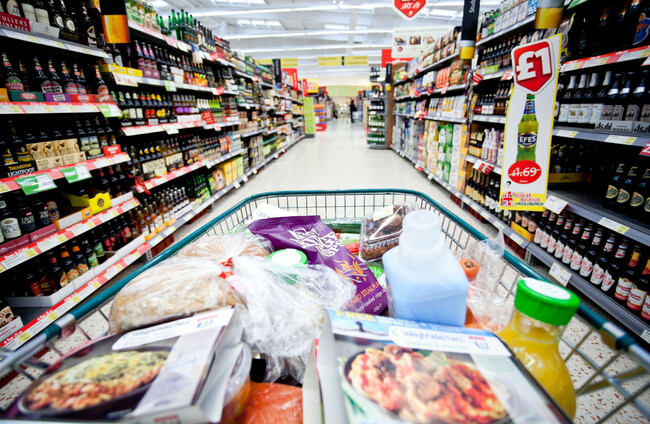
HIGHER FOOD PRICES are expected in the coming months due to the closure of the Strait of Hormuz, researchers from the Economic and Social Research Institute (ESRI) said.
The research institute published its analysis of the domestic economy and inflationary pressures in today’s Quarterly Economic Commentary.
It has urged policymakers to “closely monitor” food prices in the months ahead because input costs – such as fertiliser – are increasing sharply due to the US-Iran war, with consumers “likely to face higher prices in the coming months” as a result.
Added to this, the ESRI said, is that Irish and UK grocery markets are linked, and industry forecasts for grocery prices in Britain estimate a 9% increase for this year.
It warned this will particularly impact for lower and middle income households, as food makes up almost 15% of total expenditure.
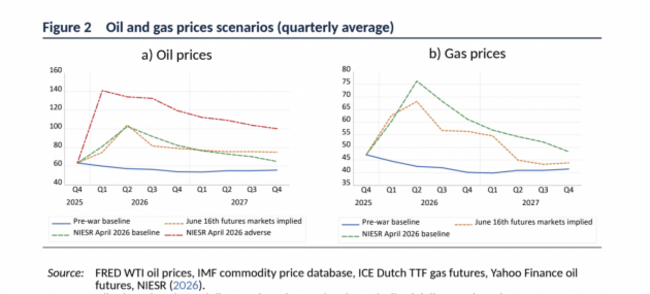
Oil prices are also expected to remain “well above” those before the war in Iran throughout the rest of 2026 and 2027.
This means that although so far price increases have been concentrated on energy, second-hand effects are expected to be felt across the rest of the year – such as rising food prices.
“The impact of the war on food prices will come at both ends of the production process, and affect both domestic production and imports,” the ESRI said.
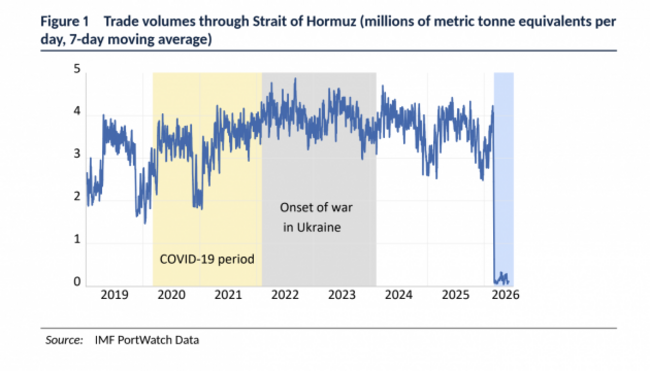
The future of the Strait of Hormuz, a vital route for energy shipments that was locked down by Iran during the war, is a key sticking point in negotiations between Tehran and Washington.
Tehran has said it plans to impose what it calls maritime service fees, as opposed to tolls, while the United States argues it is an international waterway and therefore should not be charged.
Among other observations, there was a focus on how sustained high oil prices could further affect the rate of inflation. The ESRI revised its forecasted annual rate of inflation for the remainder of the year to 3.7%, and 3.1% for 2027.
The consequences of the closure of the Strait of Hormuz continue to impact the global economy.
Irish drivers have been relatively cushioned from the realities of increased fuel prices in recent months due to the government’s intervention, and the pressure is on for the fuel support package keeping costs lower to be extended.
Due to expire on 31 July, the government is set to make a decision next week on a potential extension.
The ESRI drew on research and date by financial markets to project energy prices in Ireland. It forecast that if the current ceasefire in place in Iran holds, the price of a barrel of oil will slowly trend downwards over time – but that it would still not meet the pre-war baseline by the end of 2027.
Research professor at the institute Alan Barrett said the forecast inflation will be most keenly felt by those on fixed incomes – like rates of social welfare and minimum wage that were decided in October’s Budget for 2026 when the rate of inflation was forecast to be lower.
It also would be felt by those on fixed annual salaries who do not have leverage or grounds for increases.
For many people in the economy, however, their wages will track inflation. Barrett also pointed to positives in the report: low unemployment and strong investment.
The ESRI’s revising of the inflation rate comes after the European Central Bank (ECB) hiked its interest rates for the first time since 2023. The ECB also pointed to volatility in global energy markets and unrest in the Middle East as its reasoning behind raising inflation rates.
Barrett said: “While the headline public finances figures look strong, we remain concerned about potential vulnerabilities.”
He also said an “apparent ready availability of revenues” to the government may be leading to “suboptimal policy”, referencing the fuel package as evidence of a lack of targeted measures.
“It is important that the upcoming public sector pay talks are based on a clear understanding of the public finances vulnerabilities.”
With reporting by Eoghan Dalton

To embed this post, copy the code below on your site













have your say