Sign in. It’s quick, free and it’s up to you.
An account is an optional way to support the work we do. Find out more.
Sign in. It’s quick, free and it’s up to you.
An account is an optional way to support the work we do. Find out more.
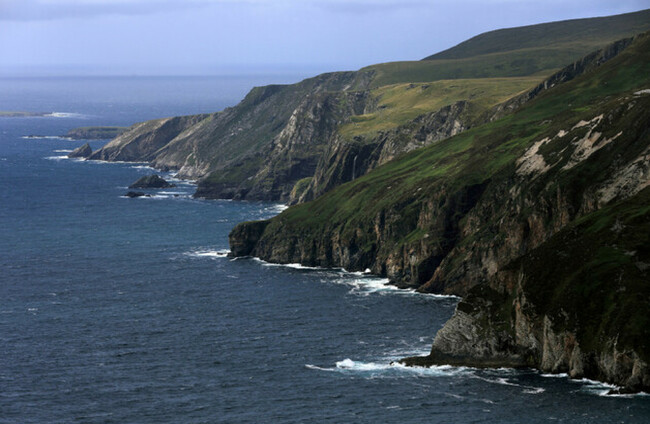
TWO FORMER LOVERS who beat another man to death before throwing his body over the highest cliffs in Ireland at Sliabh Liag in Donegal have argued that their murder convictions should be overturned.
Alan Vial (41) and Nikita Burns (25) were convicted last year following a trial at the Central Criminal Court of the murder of 66-year-old Robert ‘Robin’ Wilkin.
The trial heard that the three had been drinking together on 25 June 2023 in various places around Donegal before a row broke out as Alan Vial drove them along a country road towards where they were living in Killybegs.
Wilkin suffered two blows to the back of the head with a rock that either killed him or knocked him unconscious. Vial and Burns then drove him to the top of the cliffs and threw his body over the edge.
Gardaí became suspicious when Vial and Burns later crashed the car which, despite their efforts to clean it, had blood stains all over the roof.
Gardaí arrested Vial for drink-driving and seized the car. Burns, meanwhile, went to a friend’s house where she told several people that she and Vial had “battered” a man with a rock and threw him over the cliffs.
Chris Quinn told the trial that Burns arrived at his door late that night looking “panicky and deranged” and he thought she was “off her head”. He recalled her saying she had murdered a man and that she had “battered the fella until his face was out the back of his head”.
Burns later spoke on the phone to Sharon O’Dowd, who recorded the conversation. The recording revealed Burns saying that they had “beat some man’s head in” and that Vial had dragged him out of the car and “started caving his head in”.
Shane Costelloe SC, for Vial, today told the three-judge Court of Appeal that his client was prejudiced in the eyes of the jury when they heard the various admissions that Burns made during that time. He said the pair should have been tried separately so that the jury would not have heard her blaming Vial for the fatal blows.
Costelloe accepted that the trial judge, Mr Justice Paul McDermott, had been careful to warn the jury that they were not allowed to use the statements of one accused as evidence against the other.
However, counsel said in this case the jury would have been “overwhelmed” by the “sheer emotional negativity” of the prejudicial material put before them.
Costelloe said his client accepted he was present when Wilkin was killed and that he helped to put him over the cliffs. However, he said Vial denied striking Wilkin and there was no independent evidence beyond the statements of his co-accused that he was responsible.
Eoin Lawlor SC, for Burns, said the statements made by his client incriminating herself were not voluntary and should not have been heard by the jury. She was, he said, intoxicated at the time and there was a question over whether she was in her rational mind.
Bernard Condon SC, for the Director of Public Prosecutions, said for Vial’s appeal to be successful, he would have to show that the refusal to hold separate trials had amounted to a miscarriage of justice. There was, he said, ample evidence to prove Vial’s guilt regardless of anything his co-accused said.
Condon said the appellant had failed to prove there was a miscarriage of justice and he described the judge’s charge to the jury as “impeccable”. It is, he said, a straightforward proposition for a jury to ignore anything Burns said when considering their verdict in relation to Vial.
In relation to Burns, counsel said statements made by accused people to other private citizens are always relevant and admissible.
The law, he said, allows for involuntary statements to be ruled inadmissible to protect people from the power of the State. No such protection exists for people engaged in conversations in the private sphere, he said.
Burns, of Carrick, Co Donegal and Vial of Drumanoo Head, Killybegs, were present in court for today’s hearing.
Mr Justice Patrick McCarthy, sitting with Ms Justice Tara Burns and Mr Justice Charles Meenan, reserved judgment.
The Irish Coast Guard recovered Wilkin’s body from the sea eight days after Vial and Burns threw him over the cliffs. Due to predator damage and decomposition, State Pathologist Dr Margaret Bolster was unable to identify a cause of death.
She noted multiple fractures to Wilkin’s face but could not say which had been caused by the fall from the cliff and which related to a prior assault.
However, she did identify two fractures to the back of his head which were not consistent with a fall down a cliff but were “entirely consistent” with a blow from a bloody rock found by gardaí at the top of the cliffs.
DNA testing showed blood and hairs on the rock belonged to Wilkin.
At the trial, Vial took the stand to blame his co-accused for inflicting the two blows to the back of Wilkin’s head. He claimed he had failed to tell gardaí about what his co-accused did because he had feelings for her.
In her garda interviews, Burns blamed Vial and denied striking Wilkin. She said her admissions to Quinn and others were “exaggeration” and said she had not wanted Vial to take all the blame.
However, the jury accepted the prosecution’s case that they were part of a joint enterprise to cause serious injury to Wilkin and therefore were both guilty of murder.
To embed this post, copy the code below on your site













have your say