Sign in. It’s quick, free and it’s up to you.
An account is an optional way to support the work we do. Find out more.
Sign in. It’s quick, free and it’s up to you.
An account is an optional way to support the work we do. Find out more.
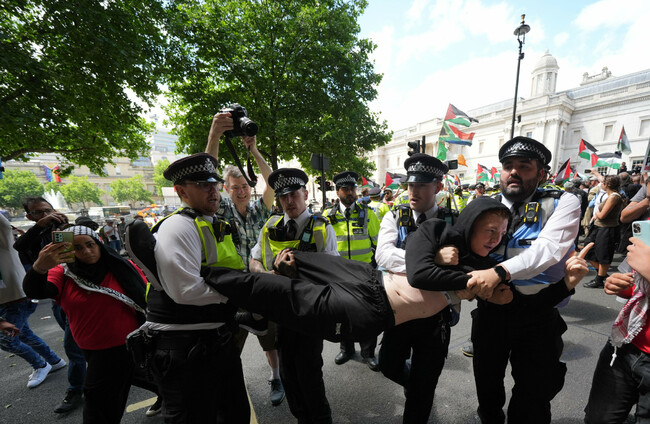
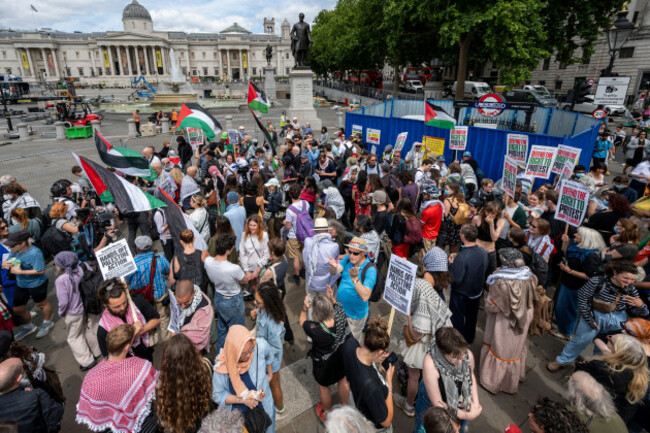
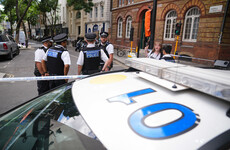
THOUSANDS GATHERED IN Trafalgar Square, London today in a strong show of support for protest group Palestine Action. Thirteen were arrested.
Next week, gatherings like this could become illegal.
The UK government is expected to officially ban Palestine Action, a direct-action protest group known for its high-profile campaigns against global participation in Israel’s actions in Gaza and the West Bank.
The group’s direct-action tactics, including its recent infiltration of an RAF airbase, have prompted UK Home Secretary Yvette Cooper to begin the process of proscribing it under the Terrorism Act — a move that would make it illegal to support, fund, or be a member of the organisation.
Cooper’s move comes less than a week after Kneecap member Mo Chara (Liam Óg Ó hAnnaidh) appeared in a London court facing terror-related charges.
The Northern Irish rapper’s case has further heightened tensions around what constitutes legitimate protest and the boundaries of activism, adding another layer of complexity to the UK government’s crackdown on politically motivated groups.
Critics of the plan to ban Palestine Action say free speech and the right to protest are under threat in the UK.
So why is Prime Minister Keir Starmer’s government coming down so hard on Palestine Action?
Founded in 2020 by activists Huda Ammori and Richard Barnard, Palestine Action is a UK-based protest collective focused on targeting “British complicity” in Israel’s military operations – particularly through its campaign against Elbit Systems, Israel’s largest arms manufacturer.
The group accuses Elbit of supplying weapons and surveillance technology used against Palestinians in Gaza and the West Bank.
Palestine Action is known for its disruptive, direct-action tactics, including occupations, vandalism, and blockades.
Did you know there is a weapons factory in Newcastle which is owned by the Israeli government, headed up by a wanted war criminal? pic.twitter.com/pqF6Bsr0XL
— Palestine Action (@Pal_action) May 27, 2025
Activists have thrown red paint over factory premises, defacing military property, and temporarily shut down operations at several Elbit-linked sites across the UK.
The group has since evolved, and branches in other countries have formed – including Palestine Action Éire, who last month claimed responsibility for crashing a van through the perimeter fence of Shannon Airport.
The group made national headlines again this month after members gained access to a Royal Air Force (RAF) base in Oxfordshire, sprayed red paint on two military aircraft, and left the scene on e-scooters.
BREAKING: Palestine Action break into RAF Brize Norton and damage two military aircrafts.
— Palestine Action (@Pal_action) June 20, 2025
Flights depart daily from the base to RAF Akrotiri in Cyprus.
From Cyprus, British planes collect intelligence, refuel fighter jets and transport weapons to commit genocide in Gaza. pic.twitter.com/zzmFqGKW8N
The incident prompted an immediate counter-terrorism investigation and heightened calls from officials to crack down on what they describe as increasingly dangerous and unlawful actions.
This has led the Home Office to begin considering a proscription order, which would place Palestine Action in the same legal category as armed groups like al-Qaeda or the IRA.
If enacted, even verbal or symbolic support for the group could be punishable by up to 14 years in prison.
UK Prime Minister Keir Starmer described the vandalism as “outrageous”.
In a written statement today, UK Home Secretary Yvette Cooper said the vandalism by Palestine Action activists was “disgraceful” and the group had a “long history of unacceptable criminal damage”.
“I have decided to proscribe Palestine Action under section 3 of the Terrorism Act 2000,” Cooper said.
The Home Secretary claimed that the group’s actions do not represent “legitimate or peaceful protest”.
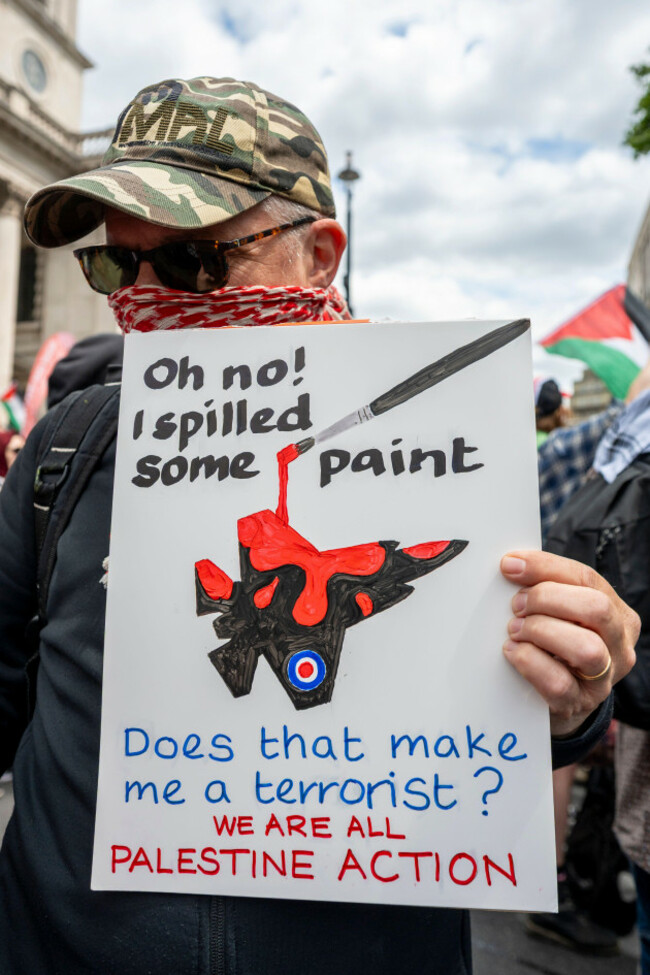
“Regardless of whether [the RAF base protest] itself amounts to terrorism, such activity is clearly intimidatory and unacceptable.
“It is one that has been repeated many times by this organisation at sites the length and breadth of the UK,” she added.
A draft proscription order will be formally presented to parliament by Cooper next Monday. If passed, it will make it illegal to be a member of, or invite support for, Palestine Action.
Cooper is not isolated in her views. Met Police chief Mark Rowley said he was “shocked and frustrated” by the plans for a protest in support of Palestine Action in central London today. The commissioner added that he believed the demostration in support of Palestine Action went “beyond what most would see as legitimate protest.”
The government’s move has ignited significant legal and political debate. Critics argue that the group, while clearly engaging in unlawful activity, has not carried out violent attacks and does not pose a threat to public safety.
A number of public figures and previous UK ministers, including former Secretary of State for Justice Charlie Falconer, have questioned whether its actions meet the legal threshold for terrorism.
Former Scottish First Minister Humza Yousaf has also condemned the government’s decision to ban Palestine Action.
“If the UK Government believes those protesting against the atrocities in Gaza are terrorists, but those killing children should be supported and provided with weapons, then this Government has not only lost its way, it has lost its conscience,” Yousaf said in a statement.
Author Sally Rooney is among a number of prominent public figures defending the group.
In a recent article, she drew a stark contrast between the government’s reaction to Palestine Action and its response to the killing of 23 Palestinians by Israeli forces at an aid site — an event that took place on the same day as the RAF protest.
Rooney argued that while Palestine Action’s methods involve property damage, they pose no risk to life, and banning the group would set a dangerous precedent for free expression in the UK.
“Palestine Action is not an armed group,” Rooney wrote.
“It has never been responsible for any fatalities and does not pose any risk to the public… I admire and support Palestine Action wholeheartedly — and I will continue to, whether that becomes a terrorist offence or not.”
Former Labour leader Jeremy Corbyn similarly said the UK government decision is “as absurd as it is authoritarian”.
“It represents a draconian assault on the democratic right to protest – and is a disgraceful attempt to hide the real meaning of violence: the mass murder of Palestinians,” he added.
If the group is proscribed as a terror organisation, it would mark the first time a UK-based protest movement focused on Palestine has been banned under terrorism legislation.
Supporters of the group argue that the proposed ban reflects a broader attempt to silence dissent against British foreign policy.
Palestine Action, for its part, has said it will not be deterred.
“We will not be intimidated into silence,” the group wrote in a recent statement.
“Our work will continue for as long as Britain supports Israel’s war machine.”

To embed this post, copy the code below on your site







have your say