Sign in. It’s quick, free and it’s up to you.
An account is an optional way to support the work we do. Find out more.
Sign in. It’s quick, free and it’s up to you.
An account is an optional way to support the work we do. Find out more.
 GE2024not easy being green
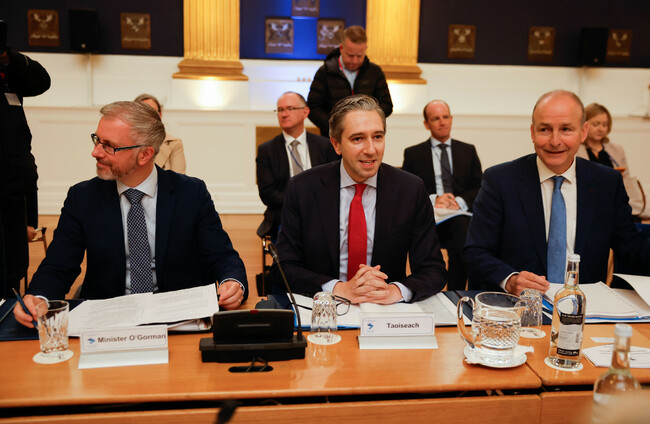
GREEN PARTY LEADER Roderic O’Gorman has said he is concerned that new polling suggests Fianna Fáil and Fine Gael could form a government without his party.
Ahead of the upcoming General Election, the latest Business Post/Red C poll shows that Fianna Fáil is up three percentage points to 21% while Fine Gael has dropped by a point to 22%.
Meanwhile, Sinn Féin dropped by one point in the last month to 17%. This is down ten percentage points from where the party was six months ago.
The poll puts support for the Social Democrats down by one point to 5% while the Green Party has also dropped one point to 3%.
Labour remains unchanged on 4%, and support for independents remains unchanged at 15%, with support for Independent Ireland increasing one point to 5%.
People Before Profit-Solidarity remains on 3%, while Aontú has dropped one point to 3%.
The poll was conducted between 18 and 23 October 2024 and is based on online interviews with a random sample of 1,003 adults. The margin of error is 3%.
Speaking on RTÉ’s This Week, when asked if he would be concerned at the latest polling, Roderic O’Gorman said: “I would.”
He said he believed the three-party coalition had been “a good government”.
“It’s provided stability and really good policies over the last four-and-a-half years. But I think it’s been a good government because of the Green Party’s participation within it.”
The Minister for Children said he did not believe the country would have seen a reduction in emissions, cuts in public transport fares and new bus services had the Green Party not been in office.
“It will be my job and my colleagues’ job to speak to people over the coming five weeks, and say, if you want a stable government, but a government that does advance progressive policies, giving the Green Party the number one vote is really important.”
Taoiseach Simon Harris has confirmed that the election will take place on a Friday and that the possible dates are within a “pretty narrow window”.
The likeliest date for the country to go to the polls is 29 November, the date O’Gorman has already stated is his preferred date. It’s also understood this date is favoured by other senior government ministers.
When asked about the possibility of forming a left alliance with other parties, O’Gorman said this was something he had proposed while he was seeking to be the leader of the Greens, adding that he will look to engage with other parties after the election.
The Green Party will be going into this election to seek our own mandate. As party leader, I’ll be fighting for every vote, for every seat.
“That may involve fighting with my existing coalition partners as well, but I think it is so important to have a strong Green Party presence within the next Dáil.”
He said his party wanted to “continue to deliver” on reducing emissions and childcare costs, “but we’ll need those number one votes from the public in order to be able to do that.”
Asked if he was concerned about the prospect of aggression being directed at public representatives while canvassing, O’Gorman said he had had abuse shouted at him four times in the last week while he was canvassing.
“It is concerning,” he said.
“I personally have always tried to just focus on the job at hand, focus on talking about what the Green Party will do in the next government, and focus on engaging with my own constituents.
“But I do think we are going to have to have a discussion about what is acceptable in our political dialog.”
O’Gorman said he also believes that politicians must be mindful of what they say in the Dáil, adding that he had heard rhetoric being “stirred up” during the debate on the hate crime legislation last week.
“Some of the language that’s used there, and some of the implications of it, you’re for this or against this, where you stand in Irish society, is quite troubling,” he continued.
“I’d call on all politicians to consider the level of rhetoric they use in the course of this campaign, and particularly the level of rhetoric they use against people who are running against them in their own constituency.”

To embed this post, copy the code below on your site


















have your say