Sign in. It’s quick, free and it’s up to you.
An account is an optional way to support the work we do. Find out more.
Sign in. It’s quick, free and it’s up to you.
An account is an optional way to support the work we do. Find out more.
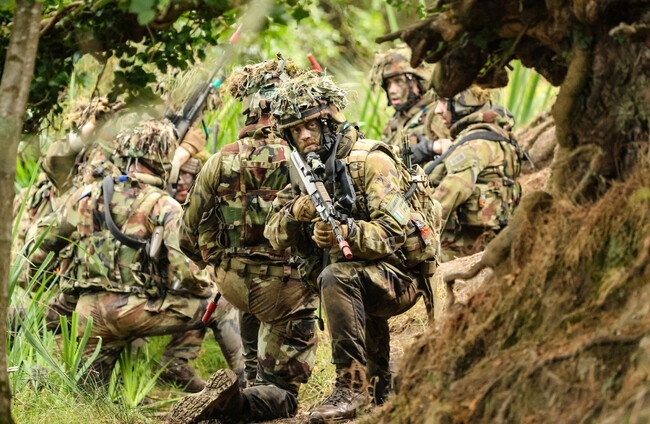

A GROUP REPRESENTING military officers has said that leaders of the operation to protect the EU Presidency are not being paid adequately for working 24-hour duties.
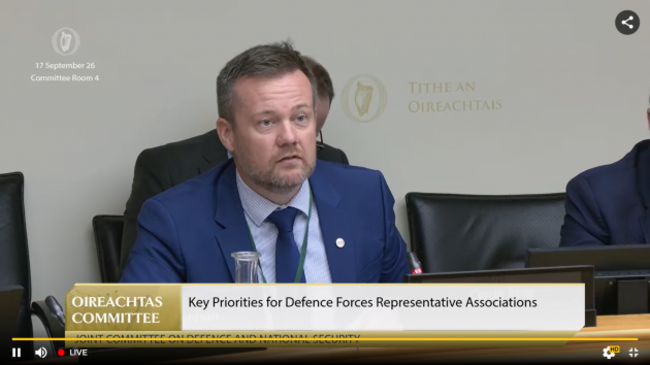
Lieutenant Colonel Conor King, General Secretary of the Representative Association of Commissioned Officers (RACO), made the comments at the Oireachtas committee on Defence and National Security this morning.
The meeting was also attended by members of Permanent Defence Force Other Ranks Representative Association (PDFORRA) which represents rank and file personnel and the Reserve Defence Forces Representative Association (RDFRA).
During the meeting concerns over retention of staff, pay and other issues were spoken about.
There were concerns raised about the problem of critical low staff numbers in the Irish Air Corps and how a lack of aircraft maintenance technicians was causing significant issues.
King outlined, however, the stark reality for the senior planners and officers leading Ireland’s security operation to secure major events for the six months of the Presidency of the Council of the EU.
That is despite previous Defence Forces press office claims that there was no issue.
He said that he recognised the “scale and importance” of the operation, particularly for the military members who are part of the Joint Task Force which manages the mission.
However, King strongly criticised what he said was the government’s abandoning of staffing levels in units to facilitate the security operation.
He added that every officer and non-commissioned officer deployed on Operation Fianna is one less on already stretched units across the country.
King explained that at a time when there are ever-increasing calls for oversight, key experienced people are being taken away from “mentoring, supervision or governance”.
“Worse, within that Task Force, senior officers responsible for planning, coordination and delivery, regularly briefing political and media stakeholders on land, air and maritime components of the operation, are not receiving the basic allowance that more junior personnel working alongside them do.
“That is, separately, part of a wider pattern: the Minister, the Chief of Staff and the Department are knowingly overseeing the rostering of senior officers on 24-hour duties, for example maritime patrols, counter-UAS operations, engineer searches and
security tasks in the full knowledge, at the point the roster is set, that they will not be paid for it.
“This is blatant exploitation of our members loyalty and sends exactly the wrong message to the very people Government is relying on to lead this operation. It truly represents Defence on the cheap,” he said.
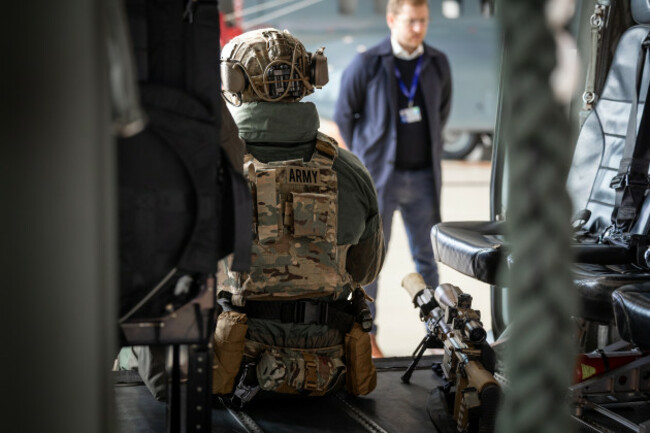
Ger Guinan, General Secretary of PDFORRA, raised significant issues about personnel levels in the Air Corps. He said that there is a safety problem and risk factor created by a shortage of skilled technicians.
He also explained that the only way his representative body can help its members is to take court action against the State they serve.
Their requests for adjudication on matters impacting their members are being ignored, Guinan explained.
“In the absence of an adjudicator, PDFORRA is litigious. We’ve had to take numerous legal actions over the years,” he said.
“We don’t want to be taking legal actions. I would implore you, if you have any sort of ability at all, to say, go and talk to these people, and appoint an adjudicator. We’re willing to discuss it before we go to court at an expense to the State. It’s not good enough, to be honest.”
For the RDFRA, Neil Richardson, its General Secretary, said that there is a substantial issue where promises of increased capability are not being met.
Richardson said that the key issue is centred around a “glacial pace” in which changes are happening to improve the lot of Reservists, who he said offer a key way to increase personnel levels.
He accused the drafters of a Detailed Implementation Plan of stating that modernisation projects were completed when in fact they were not.
“The RDFRA is greatly concerned about the growing elevation of process over productivity.
“Seemingly endless amounts of business cases, proposals, advice papers, and follow-on requests for information are asked for [and] when provided, one would expect that these might clarify issues and help speed up the implementation of resolutions.
“Instead, lengthy delays crop up again and again, often with only vague explanations provided as to why this has happened,” he explained.
Richardson added that a figure of 11,500 members needed only takes account of the forces without inclusion of the projected membership of the reserve which would bring the military up to 16,000.
“Whenever we see that figure appear in print in an official report, we know we’ve been forgotten about,” he said.
In a statement requested by The Journal the Irish Defence Forces Press office claimed that Operation Fianna has been a success and that allowances were paid to members.
“The Joint Task Force (JTF) is the main effort for the Defence Forces in its support to An Garda Síochána during the EU Presidency, and its establishment has only had positive effects on the capability development of the Defence Forces.
“All personnel are in receipt of allowances that are agreed through the relevant C&A processes. There are also arrangements in place to provide personnel with compensatory time off, known as Time off In Lieu, of their respective commitments to Operation Fianna,” a spokesman said.

To embed this post, copy the code below on your site












have your say