Sign in. It’s quick, free and it’s up to you.
An account is an optional way to support the work we do. Find out more.
Sign in. It’s quick, free and it’s up to you.
An account is an optional way to support the work we do. Find out more.
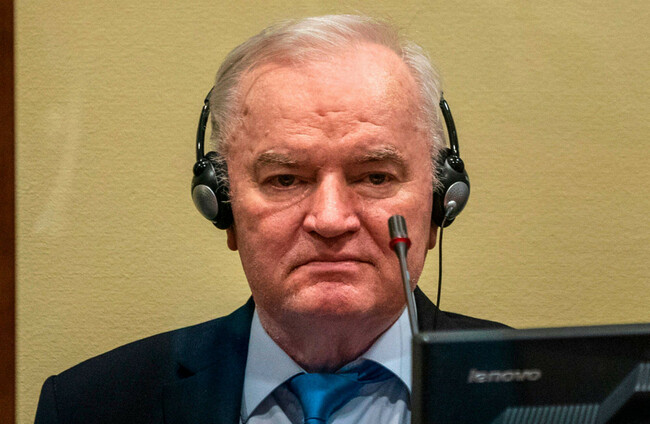
RATKO MLADIĆ, THE former Bosnian Serb military chief dubbed the “Butcher of Bosnia” for his role in the 1995 Srebrenica massacre, has died at the age of 84.
Serbian state broadcaster RTS reported Mladić died in the Hague, where he was serving a life sentence for genocide, war crimes, and crimes against humanity after overseeing the Srebrenica slaughter, Europe’s worst act of bloodshed since World War Two.
He had suffered several strokes in recent months.
Serbian state officials and Mladić’s family had appealed for his release due to his failing health, but those calls were rejected by the Hague tribunal.
Mladić was the military face of a brutal trio, led on the political side by ex-Yugoslav president Slobodan Milosevic and former Bosnian Serb leader Radovan Karadzic, as the former Yugoslavia descended into carnage after the fall of communism.
The 1992-1995 war left around 100,000 people dead and 2.2 million displaced.
The most infamous atrocity was committed in Srebrenica, where Serb forces under Mladić’s command executed 8,000 Bosnian Muslim men and boys who had sought shelter in what was meant to be a UN-protected enclave.
The mainly Muslim town in eastern Bosnia fell to Bosnian Serb troops shortly after the start of the siege of the capital Sarajevo at the beginning of the Bosnian war in April 1992.
Driven out under a policy dubbed “ethnic cleansing”, Bosnian Muslim forces retook the enclave. But at the end of the year it was again targeted by the Serbs, who cut off road access.
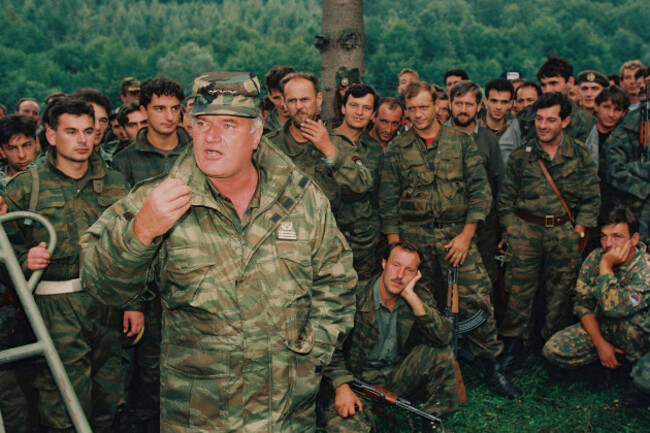
Between March and April 1993 some 8,000 people were evacuated from the increasingly embattled enclave while dozens were killed in bombardments by Bosnian Serb forces.
On 16 April, as the town came under fire from tanks and artillery, the UN Security Council declared Srebrenica a “safe area” under the protection of UN and Nato forces.
A ceasefire and demilitarisation accord was signed the next day in Sarajevo under UN auspices, but it was never respected, and 450 UN peacekeepers were deployed to the enclave.
In early July 1995, the Bosnian Serb forces attacked Muslim government positions to the south, east and north of the enclave. They overran the peacekeepers’ positions on 9 July after taking some 30 hostage.
On 11 July, Nato carried out airstrikes on two Serbian tanks on the outskirts of Srebrenica.
However, that same day the Bosnian Serb army led by Mladić overran Srebrenica, causing tens of thousands of refugees to flee to the Dutch force’s compound at Potocari on the hilly town’s outskirts.
The peacekeepers and thousands of refugees, mostly women and children, retreated into the UN base, while thousands of others gathered outside.
With Srebrenica taken, Mladić ordered the evacuation of all civilians, including women, children and the elderly, while all men of fighting age were taken prisoner.
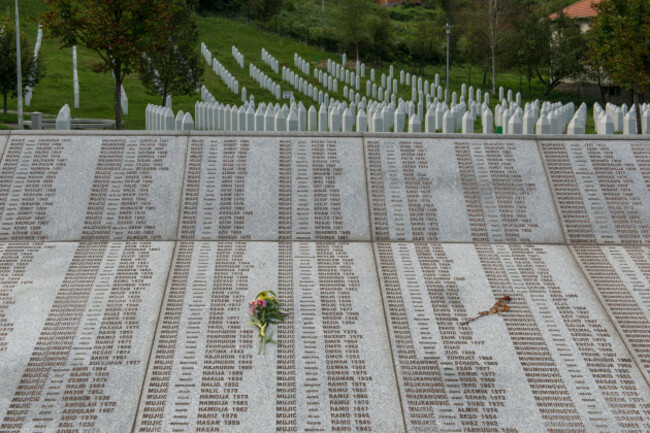
In the following days, more than 8,000 Muslim men and boys were systematically butchered by the Bosnian Serb forces and their bodies dumped in mass graves. The Serbs later dug many back up and reburied them in other graves to try to hide the evidence.
Witness accounts emerged from 17 July, with those who escaped telling harrowing tales of murder, torture and rape by the Bosnian Serb forces.
On 24 July and 16 November respectively, Bosnian Serb political leader Radovan Karadzic and Mladić were indicted by the International Criminal Tribunal for the Former Yugoslavia for genocide, crimes against humanity and war crimes.
Karadzic was arrested in 2008 and charged with war crimes and crimes against humanity. In 2016, he was found guilty of the genocide in Srebrenica, war crimes and crimes against humanity and sentenced to 40 years’ imprisonment.
After appealing his sentence in 2019, it was increased to life imprisonment.
Mladić was arrested in 2011 after a decade on the run. In 2017, a UN tribunal sentenced him to life imprisonment for genocide and war crimes that the tribunal said at the time were “amongst the most heinous known to humankind”.
He was also found guilty of orchestrating a wider campaign of “ethnic cleansing” to drive Muslims and Bosnians out of key areas to create a Greater Serbia.
Former UN rights chief Zeid Ra’ad al Hussein described him as “the epitome of evil” after his conviction.
Mladić’s appeal was rejected by the UN tribunal in 2021.
To date, 6,880 victims of the Srebrenica massacre have been identified and buried – 6,643 in Potocari’s memorial centre and 237 in other cemeteries.
With reporting from © AFP 2026

To embed this post, copy the code below on your site












have your say