Sign in. It’s quick, free and it’s up to you.
An account is an optional way to support the work we do. Find out more.
Sign in. It’s quick, free and it’s up to you.
An account is an optional way to support the work we do. Find out more.

SOUTHIE. DORCHESTER (WHERE I was baptised). West Roxbury. Quincy. Milton (where I grew up). Braintree. Norwood. Weymouth. To many readers, these Boston city neighbourhoods and nearby suburbs are familiar. You may have lived there in the 1980s and 1990s; you may have American cousins in one or more of them and visit the territory regularly; or you may have resisted the allure of the Celtic Tiger and stayed, following in the footsteps of the now elderly emigrants who arrived in the 1950s and 1960s.
This Irishness, though not as omnipresent as it was, is prevalent and visible in my home turf. And it is here where a congressional primary can be seen, in some ways, as a microcosm of the much-heralded divisions within the Democratic Party. Voters will make their choice on Tuesday, 1 September.
The internal wrangling is often cast as the “establishment” vs the progressives. The latter grouping is fuelled by righteous anger at President Donald Trump’s policies and persona. They reject central tenets of hyper-capitalism in the United States, which has engendered extraordinary income inequality. They have come to resent seasoned stalwarts, such as the Clintons, Joe Biden and Nancy Pelosi, who have long controlled the party and are perceived to have veered in a corporatist direction in pursuit of campaign cash.
This is an oversimplification of the state of play. In truth, grassroots Democrats would equally support and have reservations about aspects of what both rough factions have to say. With most primaries having transpired at this stage, the party’s task in the weeks ahead is to unite around one goal: getting as many Americans as possible to vote for their standard-bearers in the midterms.
While nominating some individuals with ideological outlooks that are out of the mainstream in battlegrounds has made that mission more complicated, opposition to President Trump is growing rapidly as the harsh consequences of his foolish attack on Iran are felt and as a trade war on Canada is set to commence. Also, history is on the Democrats’ side.
Returning to eastern Massachusetts, Stephen Lynch, who grew up in public housing in South Boston, is seeking re-election to a seat he has held since 2001. He began his political career with an insurgent bid for state representative during which he was known as the “conservative candidate” against a slightly more liberal incumbent. Lynch won. Prior to that, he was a union ironworker. He put himself through law school and, as an attorney, advocated for tenants of the projects he grew up in and for blue-collar workers.
The district has changed considerably in the last quarter-century. Many born and raised in the area, who reliably and proudly ticked the box next to Congressman Lynch because he was “one of us,” have sadly died or departed in the wake of gentrification and an explosion in property prices. They suddenly owned homes that were worth a significant multiple of what they had paid for them, and offers too good to refuse were on the table.
Hence, office-holders like Steve Lynch cannot count on being “sure things” as they invariably were in the past. Indeed, a number of his ilk have already been defeated by challengers from their left and from beyond the environs of Boston. Lynch has been cognisant of the shifting demographics and has adapted. Yet while he has jettisoned, for instance, his prior broadly anti-abortion stance, he is still regarded as the most conservative member of the state’s congressional delegation.
Enter Patrick Roath, a 39-year-old transplant, albeit with local ties, who wants to replace Lynch. Roath is an articulate, intelligent, manifestly capable lawyer who has worked on voting rights and for ex-Massachusetts governor Deval Patrick. He is unapologetically of the left and has assailed Lynch over his mixed voting record on immigration. To Roath’s credit, he has run an excellent campaign with the aid of hundreds of committed backers. And he seems to be a thoroughly decent man who is in it for the right reasons.
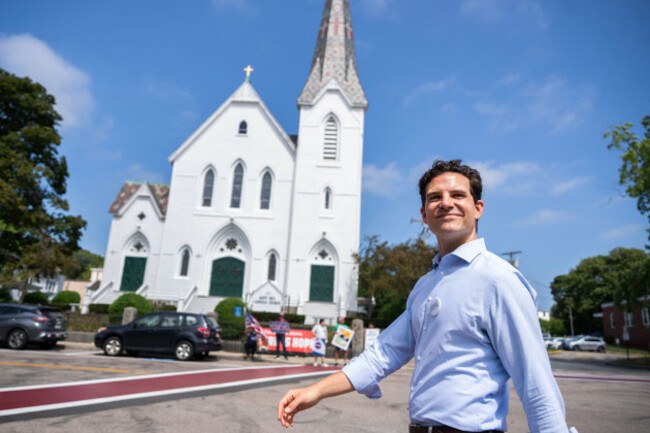
The polls show a tight contest. Sources on the ground tell me that Roath has a real chance. Congressman Lynch is clearly taking it very seriously, judging by his expenditures on advertising and the flurry of activity on his behalf by labour unions who are solidly in his corner. My own guess is that he will hang on. Simultaneously, my sense is that he is on borrowed time.
I have a vested interest in this. I spent the month of August 2001 volunteering for Steve Lynch when he was attempting to succeed the late Congressman Joe Moakley. I was drawn to Lynch because his story was the quintessential story of the raison d’etre for the Democratic Party that I was reared on: a “regular guy” who worked with his hands for a living, lived pay cheque to pay cheque and climbed the ladder. His moderate, “truth is somewhere in the middle” approach to complex topics was appealing, too.
To plenty of us Boston area natives, he was relatable. And herein I think lies a genuine crisis for my party. Progressive activists – whether officially in the Democratic Socialists of America movement or not a million miles away – are overwhelmingly white, affluent, highly educated and strident in their views.
Yes, the initiatives they champion would benefit their fellow citizens who are struggling mightily. Those who are hurting evidently cannot relate to them personally, however. That helps explain why, at least to date, working-class whites and communities of colour aren’t buying what they’re selling. Remember: politics is a human enterprise and a numbers game.
The culture wars in the US are bigger than heated debates over the hot-button issues that the GOP will endeavour to exploit from here until November. They extend to the profound differences between “old Boston” Lynch voters, who prefer to drink beer in Irish pubs or American Legion posts, and young, typically left, Roath-leaning professionals, who frequent upscale wine bars where they quaff $20 (€17) cocktails. Similar cultural contrasts can be utilised to illustrate this point across the country.
In an objectively crazy two-party system for approximately 350,000,000 diverse people, each entity should strive to be a big tent. Republicans are arguably doing a better job than Democrats on this front. The most popular governor in America is the Trump-disdaining liberal Republican Phil Scott in bluer-than-blue Vermont. There is just one legitimately conservative Democrat on Capitol Hill in 2026, Congressman Henry Cuellar of Texas. And there have been repeated efforts to “primary” him.
If Patrick Roath manages to beat Steve Lynch, he will be deserving of congratulations. I have no doubt he would serve our district honourably. But undeniably, it would send yet another signal to millions of Democrats like me: we are on the outskirts of a shrinking tent, increasingly unheard, relics of a bygone era.
Larry Donnelly is a Boston lawyer, a Law Lecturer at the University of Galway and a political columnist with TheJournal.ie. He is also a co-director of this weekend’s Kennedy Summer School in New Ross (www.kennedysummerchool.ie).
To embed this post, copy the code below on your site















have your say