Sign in. It’s quick, free and it’s up to you.
An account is an optional way to support the work we do. Find out more.
Sign in. It’s quick, free and it’s up to you.
An account is an optional way to support the work we do. Find out more.

“DO YOU KNOW what it’s like to represent a billion human beings every day you walk out of your house? To be looked at as the representative of an entire world religion?
“A world religion?
“Do you know what that’s like?
“It’s exhausting. And it can feel so heavy.
“Sometimes it makes me angry.
“And sometimes… I’m just tired of it.”
- Hijabi Monologue, ‘I’m Tired’
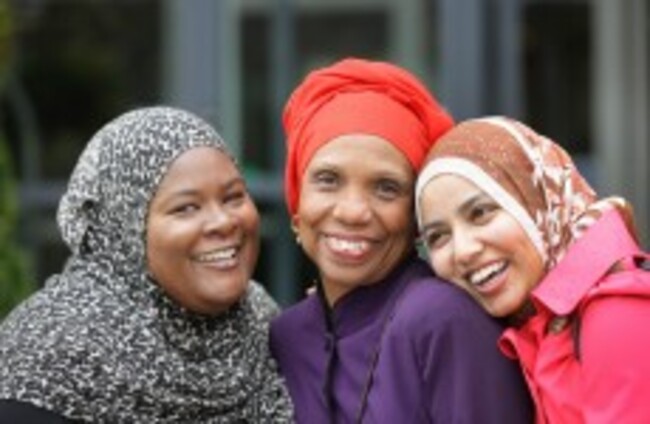
Many Muslim women share this experience – the experience of facing an entire set of assumptions about their faith, politics, preferences, education and class – based on whether or not they choose to wear a headscarf.
Last weekend, I asked this same question – Do you know what it’s like to represent a billion human beings every day – which Hijabi Monologues performers have asked thousands of Americans.
As usual, I noticed from the stage a number of heads nod and collectively sigh in agreement.
This time, however, I was in Ireland.
The burden of representation minorities carry in North America and Europe can be a heavy one.
Muslim women – like all people – have diverse identities; diverse beliefs; diverse views. We are not a homogenous group that can be conveniently labelled. At the same time, it is safer to assume that a Muslim woman more likely thinks about whether her scarf matches her blouse rather than about civilisational clashes first thing in the morning.
This idea – and the multiplicity of voices and experiences – is at the heart of The Hijabi Monologues, a play and project I co-founded in 2006. The play had its European premiere in Dublin last week, and we’re hoping to see it performed by Irish women – and tailored to Irish audiences – over the next couple of years.
The project came about because some of my Muslim friends and I used to tell stories about our day-to-day experiences, when one day our classmate Dan Morrison joked, ‘You know what? We need a Hijabi Monologues.’
At that moment, we laughed. A few months later, I began writing.
Six years later, with a wonderful producer and talented storytellers, ‘The Hijabi Monologues’ has been performed for thousands across North America and now Europe; and we continue to collect stories by Muslim women through story contests and refine them for sharing on stage with the core stories.
In America, the word ‘hijabi’ was coined in recent years to refer to the Muslim woman who wears a headscarf – popularly referred to as a ‘hijab’. Like most American slang, you won’t find ‘hijabi’ in an Arabic dictionary.
The name of our project is a nod towards Eve Ensler’s famous production, The Vagina Monologues. Whereas Ensler’s play personifies an often private aspect of women’s lives by giving it a public voice, The Hijabi Monologues takes something public – the headscarf – which everyone seems to have an opinion about and gives it a personal voice.
Our stories cover a range of experiences, from the funny to the poignant. One monologue tells the story of a mother losing her son in a car accident; another focuses on the pick-up tactics used by men who hit on hijab-wearing women. A recent contest-winner explores an individual’s relationship with her alter-ego.
Last Friday, the Peacock Theatre in Dublin hosted the European premiere. After the show, the Hijabi Monologues team spent the entire weekend working with women from Ireland and across the EU – both Muslims and non-Muslims – to share their stories and experiences, explore how the Hijabi Monologues model developed in the US, and discuss the ways it could be replicated in their own communities.
Our visit to Ireland was organised by the Immigrant Council of Ireland and the British Council (Ireland), and grew out of the British Council’s Transatlantic Network 2020 (TN2020) programme, which works to strengthen ties between Europe and North America.
During my time in Dublin, I met amazing women who deeply care about their communities. I learned that the Muslim community in Ireland – currently a small community of 40,000 – is one of the most diverse in Europe. I also was reminded that Ireland is uniquely positioned to host the European premiere – unlike the historical relationships European Muslim minorities have had with other EU nations and colonialism, Ireland does not have the same history with its Muslim communities and new immigrants.
.
The Hijabi Monologues project aims to give Muslim women a theatre platform to share their stories. I am hopeful that new stories – based on Irish and European Muslim women’s experiences – will be added to our repertoire over the coming months and years and, even more excitingly, that The Hijabi Monologues will be performed again in Ireland with an Irish cast.
The Hijabi Monologues is all about storytelling and, ultimately, story-telling is the beginning of a deeper conversation. Through the power of storytelling, generalisation and categorisation are challenged. And, most importantly, the story-teller – in this case, the Muslim woman – becomes a complex human being, rather than a one-dimensional caricature.
Sahar Ishtiaque Ullah is a founder, writer and the creative director for the ‘Hijabi Monologues’ project. Born and raised in Florida. She currently is working in New York City with a cast of women who will be performing The Hijabi Monologues at New York University in April 2012.
Byline photo by Conor Ó Mearáin.
To embed this post, copy the code below on your site















have your say