Sign in. It’s quick, free and it’s up to you.
An account is an optional way to support the work we do. Find out more.
Sign in. It’s quick, free and it’s up to you.
An account is an optional way to support the work we do. Find out more.
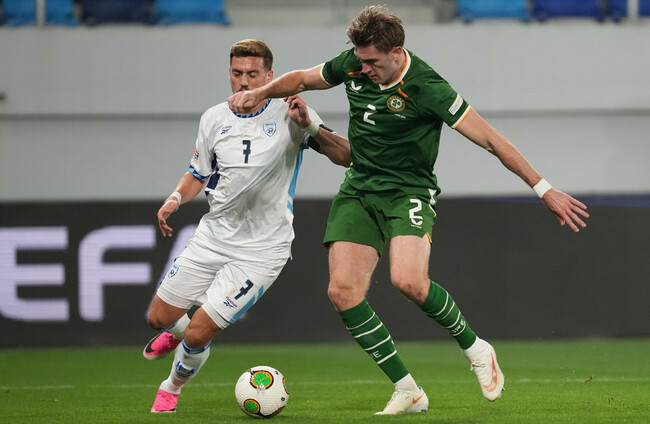

THE FAI IS no stranger to public criticism. In many ways, firefighting has been a defining trait of the association for much of the past quarter-century.
Its catalogue of controversies and missteps is well documented, but this month’s Uefa Nations League double header against Israel presented the Association with a predicament of a vastly different scale; reaching far beyond the sports pages, and placing it under an international diplomacy microscope like never before.
Ultimately, after months of heated speculation leading up to the first fixture, the FAI board decided that the game would proceed, and we’re all familiar with the chaos and fallout that ensued.
For a variety of moral, political and administrative reasons, many would argue the fixture should not have gone ahead. The most compelling of those is the FAI’s argument that the Israeli FA (IFA) was in breach of the Uefa statutes in the first place, by allowing settlement clubs to compete in IFA organised matches in occupied territory, without the required approval from the Palestinian Football Association.
By failing to sanction or suspend the Israeli FA from international competition, Uefa had arguably failed to enforce its own rules. The FAI lodged a well-argued motion with Uefa on these specific grounds in November 2025, but nearly 12 months later, the European governing body remains unswayed.
According to FAI CEO David Courell, Uefa “recognise the strength of conviction from the FAI” but “equally have to consider the sentiment of 54 other nations. And unfortunately, it’s not universal.” In effect, its response amounted to ‘your feedback has been noted.’
For those close to the detail, they’ll be aware of Uefa’s failure to act. However, the majority of the Irish public are not across the finer points of Uefa’s voting structures or its administrative rule book, and therefore the FAI – rightly or wrongly – became the lightning rod for public anger.
Knowing this, could the FAI have done more to proactively demonstrate to Irish audiences its efforts to compel Uefa into action, and by extension, communicate the roadblocks it was encountering along the way?
A sustained public information effort in this context required briefing in media and political stakeholders on a consistent basis on progress, or lack thereof. Admittedly, this typically requires a degree of two-way trust between the relevant parties that may not currently exist. But, if the FAI is not out making its case publicly, other voices fill the vacuum. By taking steps to publicly hold Uefa accountable, the FAI had an opportunity to potentially channel the public’s anger toward the European governing body, and at the very least, demonstrate to domestic audiences the Association’s sustained efforts to see Israeli football held accountable.
Instead, as the fixtures drew closer, Uefa’s inaction somehow appeared to fall off the public agenda; which inadvertently resulted in the focus shifting, to the FAI, and then the players.
Why does this matter? The result was that the Ireland vs Israel games, and the FAI’s decision to let them go ahead, became the public battleground, while Uefa’s failure to enforce its own rulebook became the footnote in the wider debate.
At last week’s Oireachtas Sports Committee, Courell belatedly suggested that “north of 20” discussions between the FAI and Uefa had taken place in the preceding months. Why did the FAI wait until an Oireachtas Sports Committee to share this information?
Some of this lack of appetite to pick a fight can possibly be attributed to the FAI’s institutional history. The Association still bears the scars of an entity afraid to put a foot wrong, as opposed to one seeking to lead – or take the fight to the powers-that-be. This scar tissue is a thread through so much of its decision-making and communication.
To the FAI’s credit, it has made significant strides in improving its communication, and while most of us maintain that in this instance, it ultimately made the wrong decision, its current senior executive, led by David Courell, did at least try to engage with its critics and publicly own its unpopular decisions, an attribute lacking from regimes that have gone before.
This was particularly apparent in David Courell’s media engagements with RTÉ and Joe Molloy on the Indo Sports podcast on the 17 September and again at the Oireachtas Sports Committee, where he acquitted himself well under what was at times performative examination. He and others may not have persuaded critics that the decision to play the games was the correct one, but they certainly came away with a better understanding of how and why the decision was reached.
We may never know the contents of the FAI’s correspondence with Uefa, nor were any of us in the room to witness the tone of these engagements. However, had the FAI taken a more public and sustained approach to challenging Uefa to enforce its own rulebook, it might have rightly shifted some of the calls for action and accountability toward the European governing body. None of this absolves the FAI of responsibility for its own decision-making. But Uefa’s role should not have been allowed to disappear so easily from the debate.
Paddy O’Dea is a director at communications and public affairs firm Fenton Fitzwilliam.
To embed this post, copy the code below on your site
















have your say