Sign in. It’s quick, free and it’s up to you.
An account is an optional way to support the work we do. Find out more.
Sign in. It’s quick, free and it’s up to you.
An account is an optional way to support the work we do. Find out more.
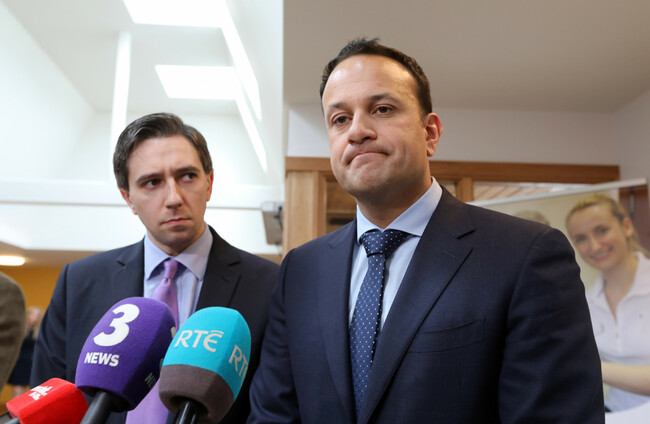

LEO VARADKAR IS full of sorrow and very angry. Simon Harris is mad as hell. Regina Doherty wants Tony O’Brien put up in stocks. Kate O’Connell wants him to know it isn’t about him and his feelings.
The ongoing political contest to see who can look the most outraged does a great disservice to the women, and men, of Ireland who rely on our healthcare systems and particularly its screening services.
I watched the Dáil committee on Wednesday. Some of the politicians engaged in informed, forensic lines of questioning, grilling the witnesses on relevant facts and figures. Others were in full on stern vice-principal admonishing errant schoolkids mode, clearly more engaged in being the soundbite on the 9 o’clock news than shedding any light on this sorry episode.
It’s not about your rage or sorrow, deputies. It’s about what we do next.
We don’t take healthcare seriously
Ultimately, at heart, we need to face the fact that as a society we don’t take healthcare particularly seriously. We don’t let it influence our voting patterns in anything more than parochial concerns (in Dublin as much as the rest of the country). It doesn’t frame our electoral debates in the way it does in the UK and the US.
We don’t make an effort to make people literate about what healthcare can and can’t deliver. We have great plans, some envied the world over, with awful implementation.
Culturally, we do not seem to be geared towards the sort of meticulous attention to detail it takes to do 21st century healthcare properly. That’s a problem that senior people within the service, like me, need to recognise, own and solve. Cultures can, and must change.
Tokenistic regulatory oversight
We have tokenistic regulatory oversight of the institutions and systems that provide care. Stringent regulation of individual nurses, therapists and doctors is a poor substitute for that level of oversight.
A personal anecdote: When I was a senior registrar in a Dublin hospital I was about to perform an emergency endoscopy on a very ill patient in the 30th hour of a 32-hour in-house shift without rest.
My then girlfriend, now wife, who also worked in the hospital brought some food to me as she was leaving. This caused mass panic in the unit as inspectors from HIQA were in town and seemingly the possibility of them discovering a renegade ham and egg sandwich in the registrar’s office was of greater concern than the fact that a very sick man was about to undergo a potentially lifesaving procedure being done by an unsupervised trainee who had been working continuously for 30 hours.
Regulation in an Irish hospital can feel like the equivalent of having your tax and insurance checked by a Garda on a road outside your house as you watch it being ransacked by burglars. How many times in their existence have our three national screening programmes (Cervical Check, BreastCheck and BowelScreen) undergone comprehensive external, independent audit?
The commentariat’s role
The commentariat play a role too. Think of all the programmes you’ve heard this week. The same hands being wrung. The same heads being ruefully shaken and eyebrows furrowed. It’s a comfort zone. The same management consultants praying the same litanies to structures and accountability.
I’m sure at some point this week the same medical talking heads will be telling us about the same phones that go unanswered and how the same private sector can fix it all. We get nowhere.
I have 3 questions:
Indiscriminate rage
A lot of the commentary about the Cervical Check scandal now is indiscriminate rage. I want more from elected legislators. Their feelings are no more or less relevant to me than Tony O’Brien’s.
The only feelings I am interested in, the only feelings that really matter in this entire sorry farrago, are those felt by Vicky Phelan, who is a national heroine, and her family, and the other women affected by it.
If we really want it to be, this can be a watershed for the health debate. It shouldn’t take someone coming along with the unique fortitude of a Vicky Phelan, a Rebecca O’Malley or a Bridget McCole to shine a light in the darkest corners. We need an honest conversation about what the service can and can’t do.
We need the media to move us out of their comfort zone in how the debate is framed. Those of us who work in the system need to realise how important attention to detail is. Politicians and talking heads need to realise the only person whose righteous indignation matters is the patient’s.
We need every last one of us to reflect on this moment and ask what are we going to do using the levers at our disposal as individuals, politicians, managers, doctors, nurses, technicians and voters to fix it? Or else this will be the tip of a very large iceberg.
Anthony O’Connor MD, MRCPI is a Consultant Gastroenterologist at Tallaght Hospital.
To embed this post, copy the code below on your site














have your say