Sign in. It’s quick, free and it’s up to you.
An account is an optional way to support the work we do. Find out more.
Sign in. It’s quick, free and it’s up to you.
An account is an optional way to support the work we do. Find out more.


I AM NOT a great fan of making jams and marmalades – there’s all that “subjectiveness” around the setting point and it all just seems a bit fussy and precise for my liking.
With chutney however, you just chop a load of veggies, bung them on the stove top, add a few spices, some sugar and vinegar, simmer it for a few hours and throw it in jars. It’s slapdash. I like that.
“Chutnyising” your veggies (there, I just made up a new word) allows you to enjoy your produce for months or even years on end. The chutney season will certainly see you through the winter months and beyond the hungry gap months of March and April, right through until the new season crops start to arrive next year. And is there anything tastier than some cold meats or cheese served with some crusty bread and a big dollop of chutney?
Not surprisingly, the veggies that are most generally used for chutneys and pickles (runner and French beans, tomatoes, cucumbers, cauliflower and courgettes) are the same ones that GIYers tend to have major gluts of. One suspects that’s not an accident.
Indian origins
Chutneys originated in India – in fact, the word “chutney” derives from the Hindu word chatni which means to “ground to a pulp”. Chutneys were popularised during the colonial era in the 18th century, and known in England as “Major Grey’s Chutney”. Not surprisingly the popularity of chutneys then extended to other British colonies such as the Caribbean and South Africa.
Indian chutneys were generally made using uncooked fruit and served fresh – it was the British who adapted the recipes to use them for preserving food (mainly vegetables), by cooking the vegetables or fruit in vinegar and adding sugar. Traditionally, spices were used to add flavour but also to prevent the growth of bad bacteria – mustard and turmeric are popular chutney spices.
Chutneys are generally allowed to sit for a few months so that the flavours can blend and develop – this is no bad thing either, since there is still plenty of fresh produce coming from the veg patch that should be used up first.
So what are our favourite chutneys?
Well, I’ve included a recipe here before for our favourite cucumber pickle which is on the “must make” list every year. I also make a piccalilli using cauliflower, green beans, courgettes and cucumbers. I am the only one that likes it in our house – so there are quite a few jars of it lurking in the back of a press somewhere. I can also highly recommend the Green Tomato Sour recipe below – it is a delicious way to use up the end-of-season tomatoes that won’t ripen up.
Before we finish, let me make one other point. There is unquestionably, quite a deal of work involved in making a chutney. I think if you embrace all the peeling, chopping, slicing or shelling in the right frame of mind, then it can be incredibly satisfying late evening autumn work. And of course, it’s wonderful to stand looking at a row of jars and get that smug sense of satisfaction that you’ve stored your crop for months to come.
The Basics – Autumn Sowing
It’s not too late to sow:
Recipe of the Week – Green Tomato Sour
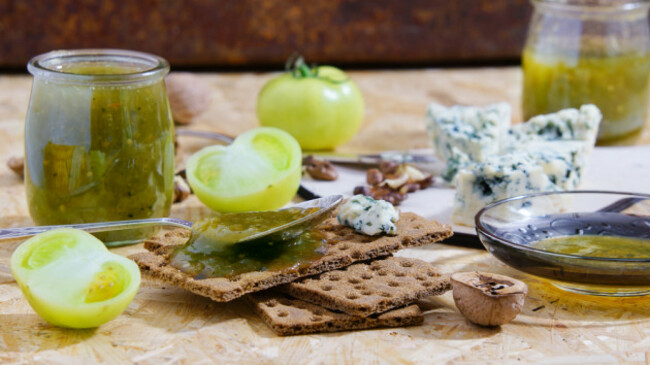
Despite its name, green tomato sour is not at all sour but quite sweet, with an interesting mellow flavour. This recipe from The Conran Cookbook makes 3.6kg / 8 lb of chutney.
Ingredients
Directions
Layer the tomatoes and onions in a large earthenware bowl, sprinkling each layer with salt. Let them stand overnight. Drain off the liquid, and put the tomatoes and onions in a preserving pan.
Add the green peppers, sugar, spices and vinegar. The vinegar should barely cover the vegetables, so add more or less as necessary. Simmer for 2 hours. Pour the mixture into the earthenware bowl and allow to stand overnight.
The next day simmer the chutney for about half an hour or until there is just enough thickish liquid to cover the vegetables when they are packed together. Ladle the chutney into heated clean, dry jars. Keep for at least 3 weeks before opening.
Michael Kelly is founder of GIY and GROW HQ.
To embed this post, copy the code below on your site













have your say