Sign in. It’s quick, free and it’s up to you.
An account is an optional way to support the work we do. Find out more.
Sign in. It’s quick, free and it’s up to you.
An account is an optional way to support the work we do. Find out more.
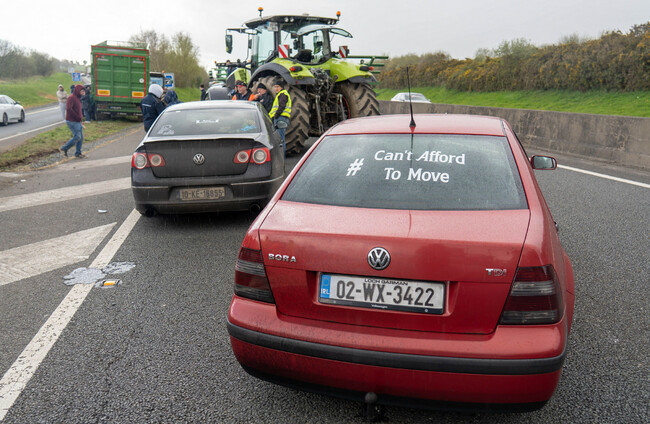

YOU’LL HAVE SEEN it outside your own local school. A line of cars idling bumper to bumper, sometimes within sight of a bus stop that runs a service twice an hour.
It’s not that the bus doesn’t exist. It’s that nobody quite trusts it to turn up, or to get the kids there on time if it does.
That, more than anything, is the real story of Irish car dependency.
We get accused of being in love with our cars, but the numbers don’t back that up.
Ireland actually has one of the lower rates of car ownership in the EU. Eurostat’s latest figures put us at 475 cars per 1,000 people, 23rd out of the 27 member states, against an EU average of 584. Italy tops the table at 709, with Finland, Cyprus, Luxembourg and Poland all well ahead of us too.
We’re not the country with the most cars. We’re the country where, outside Dublin, roughly three in every four journeys are made by car, not because people love driving, but because there’s often nothing else worth taking.
Researchers have a name for it: forced car ownership, where a household ends up needing a second or third car not out of preference but because the alternative simply doesn’t exist where they live.
So the question isn’t really why Irish people love driving so much. It’s why we haven’t built anything else people can rely on.
You’d think, given how much the government talks about getting us out of cars, that public transport would be getting cheaper to make the switch easier. Instead, it’s about to get dearer.
The National Transport Authority confirmed this week that bus and rail fares will rise by an average of 15% from January, the first general increase in almost a decade.
The Journal’s Valerie Flynn covered the fallout this week, and the reaction she gathered was telling. Dubliner Toni Kelly noted that while she herself can avail of free travel, plenty of others will just have to absorb the increase and cut back somewhere else. A Galway campaigner put the contradiction even more sharply, saying the government is “penalising commuters who are trying to do the right thing… while spending hundreds of millions subsidising fossil fuels through excise reductions”.
Trinity’s Brian Caulfield made much the same point: funding could be found to keep petrol and diesel under €2 a litre during the spring crisis, but apparently not to hold fares where they were.
Minister for Transport Darragh O’Brien pushed back on that framing when he spoke to David McCullagh on RTÉ Radio One this week. His case was that even with the rise, fares will still sit about 8% below where they were in 2022, and that the extra revenue will fund roughly 140 additional bus and rail services from 2027, on top of a network that carried a record 365 million journeys last year.
About a quarter of the population, he pointed out, already travels for free. Asked directly whether it made sense to raise fares while cutting fuel excise, he didn’t really answer, pivoting instead to the wider bill: public transport now costs close to €1.6 billion a year to run, split between fares and direct Exchequer funding through the Public Service Obligation.
Asked the same question a different way, the Taoiseach’s answer amounted to “nothing ever stands still”. Not exactly reassuring for the kitchen table.
Part of the reason fares are rising is that they were never covering the real cost to begin with. Fare revenue meets only about 38% of what it costs to run our buses and trains. The Exchequer picks up the rest, close to €1 billion last year.
A 90-minute Leap fare in Dublin will go from €2 to €2.30, and a monthly pass here already ranks as the second most expensive in the world, behind only London and ahead of New York.
Subsidising transport heavily isn’t unusual by European standards, plenty of cities do it, but it does mean the sums are exposed every time the government needs to find savings, or every time fuel prices push up the cost of running the fleet.
Some countries have gone the other way entirely. Luxembourg made all public transport free back in 2020, becoming the first country in the world to do it. Ticket sales weren’t even covering 10% of running costs, so the government reasoned it may as well drop fares altogether and fund it through general taxation, about €41 million a year. Car use there fell 11% and ridership rose 25%.
Malta followed with free transport for residents from October 2022, and Tallinn in Estonia has run a free scheme for registered residents since 2013, backed by a local referendum and costing the city around €70 million a year through municipal taxes and EU support.
None of these are huge countries, and none are trying to cover Ireland’s spread of rural towns and scattered villages, but they show the model can work when the political will and the funding line up, rather than pulling against each other the way ours currently does.
The NTA has actually costed this. A report it commissioned from EY in 2022 put the price of making all PSO bus and rail fares free at around €545 million a year, plus a smaller amount if you extend it to commercial bus operators too, so realistically €600 to €700 million in today’s money.
Compare that with what the State has spent this year just keeping petrol and diesel cheaper: an initial €505 million package in April, rising to about €750 million by August, with a further extension since adding another €400 million or so. All told, that’s over €1.1 billion in less than a year.
We could very nearly make public transport free for what we’re currently spending to keep it cheap to drive.
Which brings us to where our own road-related money actually goes. Motor tax used to feed the Local Government Fund, which channelled over €1 billion a year into local authority roads spending.
Since 1 January 2018, that link has been cut.
All motor tax revenue now goes straight into the Central Fund, the general Exchequer, rather than to local authorities.
Fuel excise duty works the same way. It brought in over €2 billion in 2025 from petrol, diesel and green diesel alone, and none of it is ring-fenced for roads or public transport.
It’s general tax revenue, spent according to whatever the priorities of the year happen to be. So the money we hand over every time we tax the car or fill the tank isn’t quietly building the bus and rail network that might eventually let us use the car less. It goes into the same pot as everything else.
On fuel prices themselves, there’s a genuine surprise buried in the latest EU Weekly Oil Bulletin. After the spring’s forecourt chaos, with terminal blockades and pump prices past €2.05 for petrol and €2.35 for diesel, you’d assume Irish drivers are being fleeced compared with the rest of Europe. We’re not. Once tax is added, Ireland’s pump price for both petrol and diesel comes in below the EU27 average, cheaper than France, Germany, Portugal and the Netherlands.
Our pre-tax diesel price is the second lowest in the EU, and our pre-tax petrol price is the fifth lowest. It’s our relatively lighter tax take (for now), not our raw fuel cost, that keeps us mid-table rather than at the cheap end.
There is one place the picture looks genuinely encouraging for climate change at least, and it’s in the numbers we track ourselves at DoneDeal Cars.
Searches for electric cars are up 40% so far this year, while diesel searches have fallen 22%. During the worst of the spring fuel crisis, electric searches nearly doubled year-on-year, suggesting plenty of people did the maths on running costs for the first time.
More encouragingly, the shift is no longer a Dublin story. Wicklow now has the highest EV uptake of any county at 39.3% of new cars, ahead of Kildare and Meath, while Roscommon, Cavan and Clare have all more than doubled their electric registrations.
Dublin’s share of the national EV total has fallen from 46.5% to 38.3% as the rest of the country catches up. The transition is working. Whether it keeps working depends on Budget 2027, with VRT relief due to end in December, the SEAI grant cap already cut once this year, and the Benefit-in-Kind threshold for company cars set to halve.
A scrappage pilot offering €5,000 towards an EV was fully subscribed within 75 minutes of opening in July. There’s clearly demand. Whether the supports survive to meet it is another matter.
We’re not car mad. We’re car dependent, because the buses and trains too often don’t show up on time or at all, because the tax we pay to drive was never really ring-fenced to build something better than driving, and because, until public transport becomes something people can actually plan their lives around, the car will keep winning by default rather than by choice.
Paddy Comyn is the head of automotive content and communications with DoneDeal Cars. He has been involved in the Irish motor industry for more than 25 years.
Journal Media Ltd has shareholders in common with DoneDeal Ltd.
To embed this post, copy the code below on your site












have your say