Sign in. It’s quick, free and it’s up to you.
An account is an optional way to support the work we do. Find out more.
Sign in. It’s quick, free and it’s up to you.
An account is an optional way to support the work we do. Find out more.

“I’m 55. I’ve one final run left in me.”
A CLIENT SAID that to me recently. She wasn’t questioning whether she could do the job. She’d spent years building a stellar career. Sundays in the office. Leading teams through change. Exercising the sort of judgment that only comes with experience.
What she doubted was whether anyone would give her another chance.
I hear versions of that conversation almost every week – and some of them are from men and women well under 55.
People with long careers behind them send application after application into what feels like a black hole. At first, they blame the market and then after months of ghosting they start to wonder if they’re the problem.
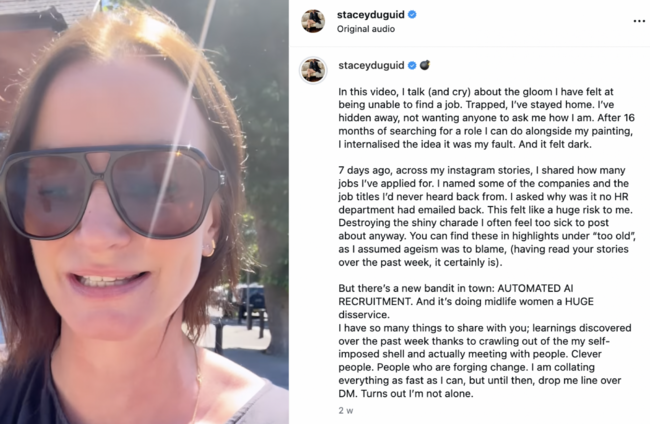
That’s why journalist Stacey Duguid’s account of spending 16 months looking for work went viral. On Instagram, the 52-year-old described convincing herself she had become unemployable.
“The money’s running out, and I’m frightened,” she said.
Thousands recognised themselves in her story.
Most won’t suddenly find themselves at the centre of a national conversation. They’ll just keep applying. And at some point, many begin editing themselves or “botoxing” their CVs.
Graduation dates disappear. Earlier roles are deleted. Twenty years of experience are compressed into 10 because experience has started to feel like something shameful.
For many applicants, that first reader isn’t a hiring manager. It’s an Applicant Tracking System (ATS), AI-assisted screening or an initial reviewer working through hundreds of CVs. So people are not trying to hide their experience. They’re trying to make sure someone actually gets to see it.
There’s nothing wrong with tailoring a CV. Everyone should do it. But there’s a difference between highlighting what’s relevant and feeling you have to hide part of your career to hide your age.
One executive said to me recently, “It feels like I’ve wasted the last 20 years.”
Of course, he hadn’t. Nothing had changed about his contribution, but what had changed was the way he thought it would be perceived.
Women often notice it first, particularly as menopause collides with caring for ageing parents and supporting teenage children.
But I hear the same from men who never imagined they’d struggle to find work after decades of experience.
Here’s the contradiction…
The idea of a job for life has largely disappeared. Most of us will change jobs, adapt to new technology, recover from redundancy or reinvent ourselves more than once before we retire. We’re also expected to work for longer.
We’re encouraged to adopt a growth mindset, never stop learning and embrace change.
Yet CVs that reflect exactly that are routinely ignored.
I hear employers describe the person they want: someone who can lead through change, exercise sound judgment, mentor colleagues, make tough decisions under pressure.
Then the conversation shifts.
The candidate is “overqualified” or “potentially too set in their ways.”
They’re just assumptions dressed up as recruitment decisions.
Instead of defining exactly what’s required of the right person for the job and asking what relevant experience this person could bring to the role, we assume they’ll expect too much money, won’t adapt to new technology or won’t want to report to someone younger.
Research from Dublin City University’s POWER Ageing project reflects what many candidates describe. It found persistent stereotypes that older workers are less adaptable, more expensive or less willing to learn, despite little evidence to support those assumptions.
That should concern all of us.
At a time when organisations talk about skills shortages, succession planning and long working lives, many experienced professionals feel they’re being edged out of the jobs market.
AI has added another layer of uncertainty. Every generation now has to adapt to new technology. But adapting to AI doesn’t make experience less valuable. If anything, it increases the value of human judgment and acquired wisdom.
The organisations that thrive know they won’t simply have the youngest workforce or the strongest technical skills. They’ll combine technical expertise with judgment, perspective and people who know how to navigate uncertainty.
We’re telling Gen Z that human skills will set them apart. But who’s going to teach them?
Those qualities rarely appear on a job description, yet anyone who lived through the financial crisis or Covid knows how valuable they are.
I’ve met senior leaders who wanted less travel, not more money. One wanted to mentor younger colleagues. Another stepped back from an executive role because they wanted work that fitted around caring responsibilities.
None of that was obvious from a CV.
Language deserves attention too. No organisation advertises for someone younger. Instead, we ask for “fresh energy”, “high potential” or “culture fit” in a “fast-paced environment”. Sometimes those phrases genuinely describe what’s needed. Sometimes they become shorthand for a particular type of candidate.
Candidates have responsibilities too. Experience should never become an excuse for standing still. Employers always want evidence that people are curious, learning and willing to adapt. A CV should explain the value you can add now, not simply list everything you’ve ever done.
For many people over 55, though, “overqualified” remains a familiar label. It became common after the financial crisis, when jobs were scarce, and it hasn’t disappeared.
That’s why networking matters more than ever. The strongest candidates of any age I meet do not rely solely on online applications. They build relationships, look for introductions and find ways to get their CV in front of the person making the hiring decision.
That’s very different from pretending part of your career never happened.
Competence is the point. Not age. If someone can prove they can do the job, they can do the job.
If we’re serious about longer working lives, recruitment has to catch up with that reality.
We can’t encourage people to build 50-year careers while making them feel they have to erase part of those careers to stay employable.
Age discrimination rarely appears in a job advert or a rejection email. More often, it hides behind assumptions about potential, energy, salary expectations or “culture fit”.
When experienced professionals believe their best chance of getting through the first round is to hide the very thing they’ve spent decades building, we’ve normalised a form of ageism that serves nobody – not employers, not candidates and not the economy.
Sarah Geraghty is the Head of Careers at The Communications Clinic.
To embed this post, copy the code below on your site














have your say