Sign in. It’s quick, free and it’s up to you.
An account is an optional way to support the work we do. Find out more.
Sign in. It’s quick, free and it’s up to you.
An account is an optional way to support the work we do. Find out more.


LAST UPDATE | 29 Jul
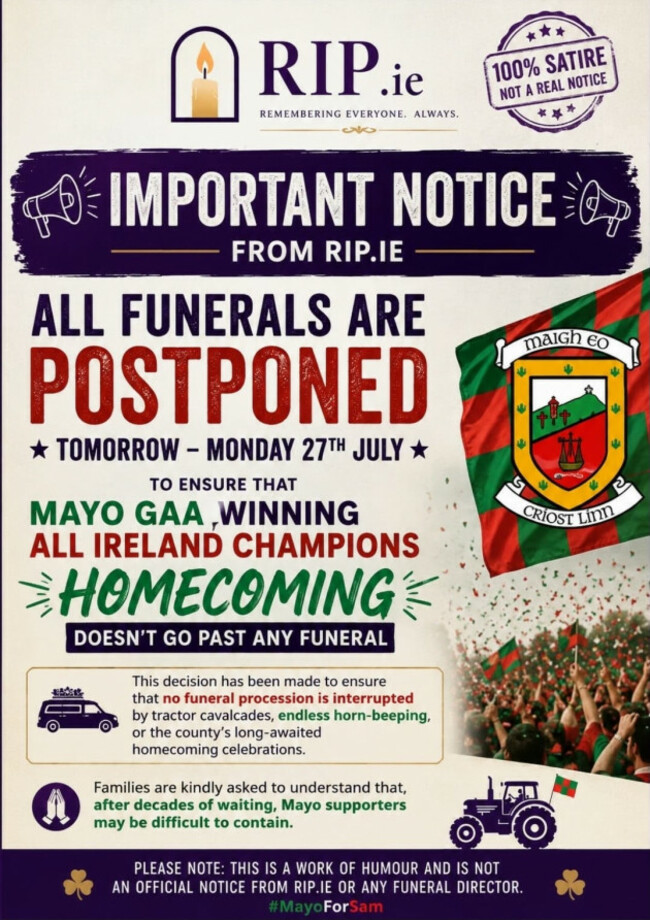
SAM HADN’T EVEN been hoisted into the sky over Croker by an ecstatic Captain Coyne on Sunday, when various versions of the same gag began whipping around Insta, Facebook and X.
“All funerals are postponed in Mayo on Monday to ensure the riotous returning heroes doesn’t cross paths with a cortège,” cackled the Irish internet.
No need for any explanation for the home crowd – even the dogs on the street could bark the story of how the victorious Mayo football team of 1951 failed to pay their respects to a funeral they passed through the village of Foxford when en route home to celebrate, prompting the enraged priest to unleash a fearsome curse: “For as long as ye all live, Mayo won’t win another All-Ireland.”
And so it came to pass. For 75 long years.
The curse was news, however, to most of the international media who were equally gripped by both electrifying clips of a thrilling sporting contest that appeared to be – as one US journalist bemusedly put it – “a hybrid of soccer, rugby and basketball”, and by the story of The Longest Curse.
The holy hex was invoked everywhere – Australian TV, the New York Times, the Taipei Times and the BBC.
All recounted how Mayo had made it to 11 All-Ireland finals since 1951, returning home empty-handed each time, and how this year was their first appearance in a final since Paddy Prendergast, the last member of that ill-fated team had died in September 2021. (Another squad member, Michael Loftus, died in 2023.)
Whether one believes that Jesus actually hailed from Galway and the curse was kosher, or that curses are superstitious tomfoolery and Mayo prevailed against every single bookies’ odds due to skill, tactics, talent and unshakeable self-belief, makes no difference at all.
The curse is forever stitched into the tapestry of Ireland’s magical stories and cannot now be unpicked, no matter how many of Mayo’s sons and daughters, delirious with relief and joy, roared “CURSE BE DAMNED” as the 70-minute hooter set off pandemonium at GAA HQ and far beyond it.
But maybe, just maybe, damning the curse into oblivion would be a grave national mistake. It could be time that Ireland embraces the C-word with gusto.
First of all, at a time when the government is flinging money at the tourism sector in order to try and lure visitors here all year round, curses could be a great help altogether.
Tourism Ireland, an organisation which rarely misses a trick, hit the tourism jackpot with the Wild Atlantic Way wheeze, and now there’s barely a network of boreens left in Ireland which hasn’t been saddled with some class of fancy-schmancy moniker such as the Midlands Mystical Maze.
Let’s face it – we’re a nation steeped in curses, hexes, spells, charms, superstitions and jinxes, and yet have so far signally failed to harness the money-spinning power of piseogs.
Irish people are widely hailed/castigated for our prodigious propensity for the other type of cursing (including the frequent deployment of the other more verboten c-word), but far fewer know how seriously we can take the piseog.
The piseog is a particularly malevolent act of ill-wishing, far more severe than run-of-the-mill begrudgery, and usually unleashed in disgruntlement against a neighbour in rural Ireland.
A common one involved the ill-wisher burying eggs on the land of the neighbour: as the eggs rotted so too did the dweller’s fortune. Or the more hair-raising piseog of stealing a farmer’s last sheaf of the harvest – itself believed to bring luck to the household – and using it in a voodoo-style ritual where it was given the name of its owner and “killed” by stabbing.
It was then buried and as it decayed, so too did its owner.
Our landscape fair bristles with untouchable fairy-forts and hawthorn trees left unbothered by builders or farmers for fear of supernatural repercussions, and also with cursing stones and haunted houses.
Likewise, our history is awash with wild stories of banshees, druids and witches, of the cursed swan-children of Lir, of Mad Sweeney, the king cursed by a Christian saint.
Sure, historical battlefields, ancient castles, sacred hills and neolithic passage tombs are big draws for visitors, but in a society regularly gripped by stories involving spells or the supernatural – just look at roaring successes such as Harry Potter and Stranger Things – Ireland is seriously missing a magic trick here.
Where is the Great Hibernia Hex Trail, where guides can scare the crap out of tourists while also planting the notion that we may be the land of a hundred thousand welcomes, but we can also jinx your arse and the arses of your descendants, should the mood take us?
And here lies the other reason for Ireland embracing the c-word. Not only could it be to our fiscal advantage, but also greatly benefit our defence capabilities in an increasingly belligerent world.
Much to the chagrin of our more hawkish European comrades, Ireland is a laggard in amassing fighter jets, warships and the like (though to be fair, it’s not unreasonable to think that an island nation in a strategically critical location would have at least one auld submarine at its disposal).
Instead, we could arm ourselves with curses to keep our enemies on their toes. We’ve been diplomatic for long enough, putting much stock in our ‘soft power’, our ability to forge networks and alliances to wield influence, and our expert use of plámás to get our way.
The European parliament could henceforth resound to war cries of “Go ndéana an diabhal dréimire do chnámh do dhroma” (that the Devil will make a ladder out of your spine), or a dozen of Ballyfree’s finest eggs could be quietly planted in the grounds of Vladimir Putin’s most palatial dacha.
If/when he accidentally and fatally hurtles from a high window in the Kremlin, then we can loudly claim credit for his demise.
And this is the secret sauce with hexes and curses – everyone eventually suffers a bit of bad luck or a setback, so they’ll work sooner or later.
And while it’s damn hard to prove a disaster was the result of an Irish spell-caster raining maledictions on you, it’s bloody impossible to prove that it wasn’t.
Say Donald Trump takes a figary some morning to slap punitive tariffs on Ireland for a perceived slight, a national casting of a curse that the presidential mickey will wither and disappear overnight would prompt a speedy TACO from the famously superstitious commander-in-chief.
And how could he prove it didn’t happen? Do a big reveal on Fox & Friends?
So, we have a window of opportunity right now, while the world’s gaze is fixed on the Mayo curse. Sure even our language is beautifully set up for cursing, both in terms of drama and grammar.
Wishing bad cess “on” someone just seems much worse. For instance, one which could be hurled at any irksome American right now with particular resonance is “Buinneach dhearg go dtigidh ort”, which translates as “that you may have red diarrhoea”.
And then just watch ‘em run.
Lise Hand is a journalist and writer. This column runs every Wednesday.
To embed this post, copy the code below on your site















have your say