Sign in. It’s quick, free and it’s up to you.
An account is an optional way to support the work we do. Find out more.
Sign in. It’s quick, free and it’s up to you.
An account is an optional way to support the work we do. Find out more.
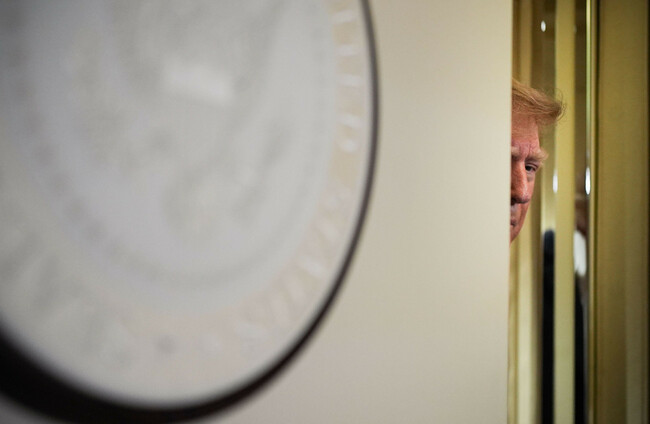

SPEND ENOUGH TIME in the United States, and you’re pretty much guaranteed to have the same experience that President Catherine Connolly had last week.
In her first public remarks since meeting her American counterpart Donald Trump, Connolly confirmed that the President had asked her what she thought about Irish reunification. It gave me a flashback to signing my first ever lease in New York City some 10 years ago, in the company of a young, brash, very Italian-American real estate broker who made pleasant and curious conversation as I read through the rental contract — itself probably at least a few pages longer than the Good Friday Agreement.
“So you guys are like two countries, huh? North Ireland, South Ireland… What’s the deal with that?” It was almost comforting to watch the very same scene play out between Donald Trump and Micheál Martin, at the highest levels of decision-making power, in front of dozens of television cameras. A universal Irish experience.
Donald Trump doesn’t know it, of course, but in many ways brokering a peaceful reunification of Ireland is a problem tailor-made for his own self-image. It’s a chance to go one better than his old enemy Bill Clinton, for starters. He’s also proven himself a totally busted flush when it comes to bringing about peace in Ukraine or the Middle East, so why not take on a conundrum where a lot of the hardest work has already been accomplished? Alas, Donald Trump’s only real gift is a seemingly innate knowledge of what will get a reaction. That, and no other reason, is why he found himself referring to the reunification as “one of the naturals of all time”.
And perhaps it’s only natural that Trump’s speculating as to the future of our island got people excited. Some people still seem to live in a world where the words spoken by the most powerful man in the world actually intersect with reality in some way. But despite the breathless reaction of media commentators in both Ireland and the United Kingdom, there was never any chance that this story was going anywhere. After all, what exactly were people expecting? Did we think Trump had brought some kind of gameplan with him, that there would be some kind of follow-up?
Literally two days before that the guy falsely claimed that he led a crew of a burly construction workers to the rubble of the World Trade Centre of 9/11 to pull people from the wreckage before being carried off to safety by two, presumably even burlier, firemen. He’s in the middle of literally trying to bribe his own people to vote Republican in the November midterms and threatening to raze the Kennedy Centre to the ground because his name isn’t on it. Did we believe in between all of this he’s been putting together plans for cross-border working groups on a united Ireland and setting up the volleyball nets at Camp David for mixed-doubles between Martin, Andy Burnham, Michelle O’Neill and Emma Little-Pengelly?
Coincidentally, Trump’s comments came just days before the first ministers of Northern Ireland, Scotland and Wales came together in their capacity as party leaders (for Sinn Féin, the SNP and Plaid Cymru, respectively). However, it was no more than a coincidence, and even the combination of Trump’s musings and the joint declaration has done little to keep the story in the news.
Now, in fairness to those who for some reason might have thought Trump remarks would mark a sea change in the tripartite relationship between Ireland, the US and the United Kingdom, they could have never foreseen the enormity of the week that would follow. After all, who could possibly keep their attention focused on a united Ireland when Ed Sheeran is in trouble?
This week, Sheeran’s carefully constructed facade of pleasant, apolitical benignancy came crashing down when he sold out Macklemore, his long-term friend and the musician who’d been opening for Sheeran on his stadium tour of North America. These days, Macklemore is almost as well known for his Palestinian activism as he is for his music, and it can have come as no surprise to anyone, including Sheeran, when Macklemore (real name Ben Haggerty) used the opportunity to repeat the same messages of solidarity he’s been espousing for three years now.
And yet, Sheeran seemed caught completely off-guard when multiple stadium owners, including New England Patriots owner, friend of Benjamin Netanyahu and Epstein files-appearer Robert Kraft told him that Macklemore would not be allowed to perform in their stadiums.
It is little exaggeration to say that this predicament gave Ed Sheeran perhaps the clearest opportunity yet for a profoundly wealthy, profoundly influential celebrity to make a choice to set principles such as human rights and freedom of speech above the interests of capitalism. Just thinking out loud. Instead, Sheeran declined, seemingly operating on the logic that hearing his supermarket aisle music live does more to ease the world’s burdens than sending the message that the entertainment business should not continue to function as usual while children in Palestine continue to die at the hands of a genocidal, aggressively expansionist regime.
“I am not complicit,” Sheeran said in one part of his very tetchy statement, which is both a low bar to set for oneself and also a really funny thing to imagine on the merchandise for his next tour. Elsewhere, Sheeran used the statement to wash his hands of responsibility for Macklemore being dropped from the tour, drew a false equivalency between Israel and Palestine when it comes to harms suffered, and even reassured his fans that while he does of course hold values and opinions, they are a secret. Somehow, this statement was not enough to prevent his other opening acts — including Irish support act Aaron Rowe and Sheeran’s long-time backing band Beoga — from following Macklemore out the door in solidarity.
In a seeming bid to save face, Sheeran has since donated money to an unnamed cause purportedly providing aid to Palestinians. Bob Kraft, on the other hand, has said that at Sheeran’s urging, he has donated $2 million (€1.74 million) to what he called “aid in the region”. Given Kraft’s well-known political affiliation with Israel, this euphemism is not exactly comforting. “Aid in the region” sounds less like giving money to a Palestinian charity and more like what the New York Times calls it when the US congress votes to send $2.8 billion (€2.44 billion) in military equipment to the IDF.
At the time of writing, Sheeran is set to continue his US tour without any opening acts, in front of uncertain crowds, under the shadow of a historical act of cowardice that will likely affect his reputation forever. His next show is in Philadelphia on Saturday, a city famed for both its Irish and Muslim populations. Sheeran is running out of time to embrace the Irish ancestry he touts as often as he can, and to join Macklemore, Aaron Rowe and Beoga in their stand with Palestine and against the pressure of stadium owners.
If he doesn’t figure it out quickly, let’s just say those supermarket aisles might be about to get a whole lot quieter.
To embed this post, copy the code below on your site











have your say