Sign in. It’s quick, free and it’s up to you.
An account is an optional way to support the work we do. Find out more.
Sign in. It’s quick, free and it’s up to you.
An account is an optional way to support the work we do. Find out more.
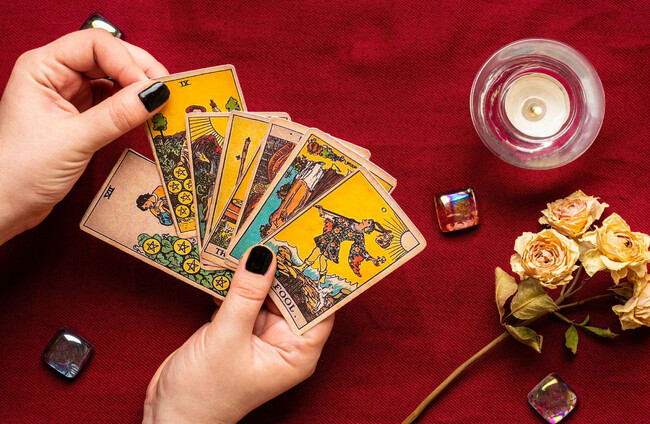

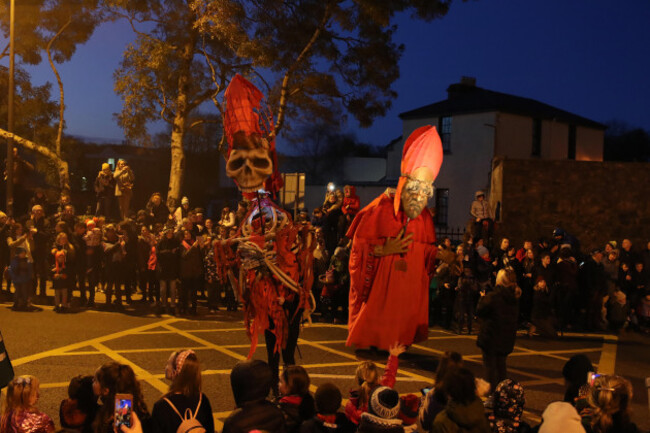
SAMHAIN IS A season that makes a particular invitation for magic, the supernatural and the dark; suburban streets full of eerie things, children’s painted faces, supermarkets full of pumpkins and sweets, the imported idea of trick and treat.
Yet, there was a time when an Irish Halloween offered up reasonably straightforward instructions for understanding magic and enacting prediction. The shape of the future arrived in small acts, peeling an apple in one continuous strip, then casting it over your shoulder and examining the letter it made upon landing.
It might be a J or an M, or a T, apparently the initials of the person you will surely end up marrying. My grandmother used to tell me that two nuts placed in a fire would most certainly reveal the fate of a romance; for a long time, I doubted her belief in this particular type of fortune-telling.
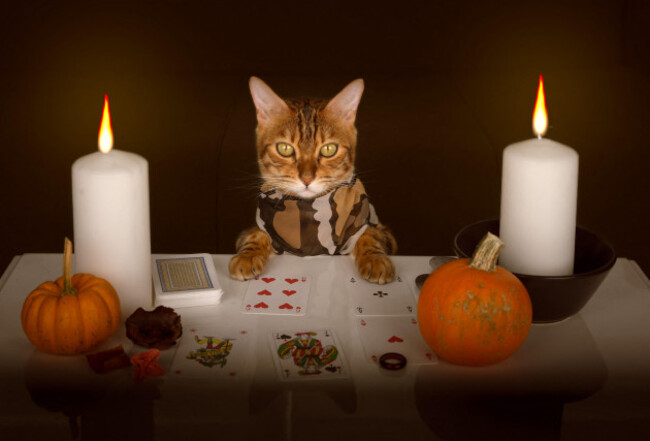
As children, we would exuberantly dig our way through the barmbrack-a ring for marriage, a coin for wealth, a rag for poverty, a pea for a life unmarried, or a stick for a life full of quarrels. We all wanted the coin, a life of wealth, its own particular yearning from the vantage of a rural Irish 1980s childhood; an occasional argument though would ensue about the ring, depending of course on its quality.
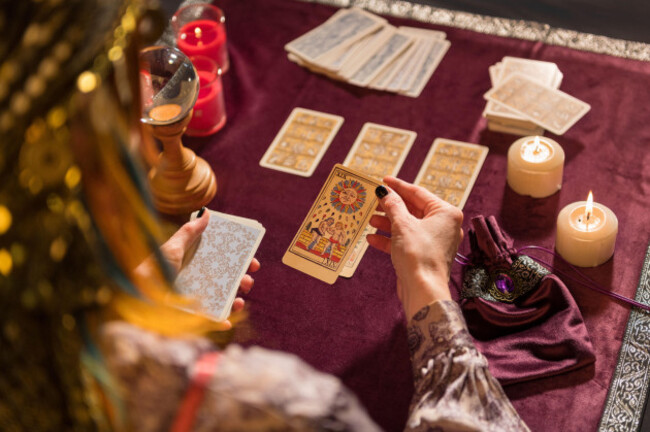
These old Irish rituals with their magic, prediction and unruly games seem increasingly distant from contemporary Halloween. The veil between the living and the dead still grows thin at this time of the year; the spirits wander, but very few children remain eager about bobbing for apples in an old kitchen basin full of water.
Instead, retailers remake magic and the supernatural into commercial opportunity and plastic skeletons and high-tech ghosts abound. Yet the appetite for magic has clearly survived, and the recent flourishing of tarot activities in Ireland shows that many of us still want a hand in the practice of turning over fortunes; we still, it seems, yearn for magic in our lives.
In many towns and cities in Ireland, it is possible to organise an entire social life around the tarot with beginner courses, tarot circles and weekly tarot meetups, tarot and matcha gatherings, yoga, sound baths and tarot sessions, tarot and art workshops and of course (most importantly) tarot and wine evenings. All manner of opportunities now exist to explore intuition, spiritual guidance, and psychic development with other people. Bookshops sell beautifully illustrated tarot and oracle cards aplenty, and witchtok and other forms of social media offer an endless procession of readers (some genuine, some clickbait) shuffling cards towards cameras whilst announcing that a particular message has found you just at the very moment you needed it.
While I would like to pretend that I have observed all of this from the objective distance of an anthropologist intrigued by how magic is replenishing many of us in this world on fire, the growing number of tarot and oracle decks in my own home would suggest otherwise.
I have been learning to read tarot myself for the past few years, though I still consider myself very much an apprentice, continually baffled and often amazed by the richness, depth, symbolism and unexpected associations that a tarot card can bring. Almost every morning, I draw three cards and carry their images and symbols with me through the day; it is an anchoring, grounding and intuitive practice of tarot that I, alongside many others, are learning to develop and practice-mostly to survive this world.
Much of the contemporary forms of tarot we see in Ireland and elsewhere today revolve around intuition, guidance, reflection, creative practice, meditation or simply a way of helping one another on the way to finding the answer to a difficult question.
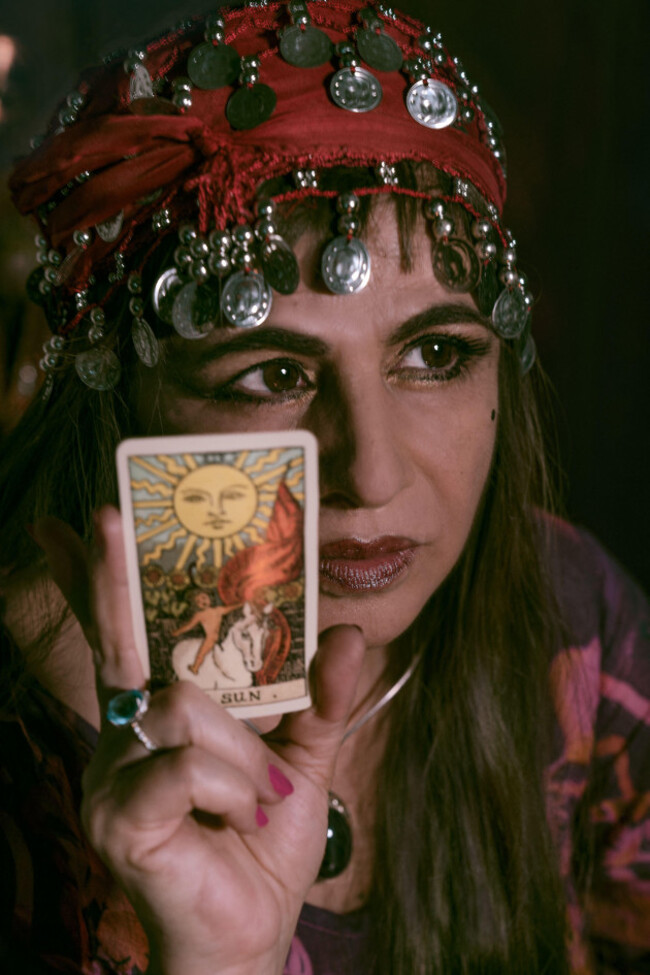
Before the cards reached my kitchen table, though, they travelled through many lives and misrepresentations. Tarot has moved through and survived empires, moral panics, occult revivals and now social media, AI and aggressive algorithms.
The first documented history of the tarot comes from its emergence as a card game in 15th-century Italy, where they were used as a game of tricks and trumps. Wealthy patrons commissioned artists to craft exquisite hand-painted decks, some of which survive today.
Many of the figures we consult today about our uncertainties and indecisions belong to a visual world familiar to Renaissance players, with its emperors and popes, celestial bodies and virtues, and reminders of the shape of death.
I often find myself drawn to that ordinary beginning, a game, a table with people gathered around it unaware of what would later be asked of the cards in their hands. The occult identity of the cards subsequently emerged much later in Italy and France and then the United Kingdom.
In 1781, the French scholar Antoine Court de Gebelin made the claim that tarot must have emerged from Egypt, a seductive theory that acquired legs but for which there was no historical foundation. Others followed with their elaborations and imaginings, and the cards acquired an increasingly complicated and intricate life in divination and esoteric thought.
When I turn over my cards in the morning, I am often looking at an image painted by Pamela Colman Smith. In 1909, she was commissioned by Arthur Edward Waite and the scenes she created continue to inspire countless contemporary decks. In her 78-card deck, she has figures who grieve, labour, love and set out into the unknown, leaving all sorts of things behind them.
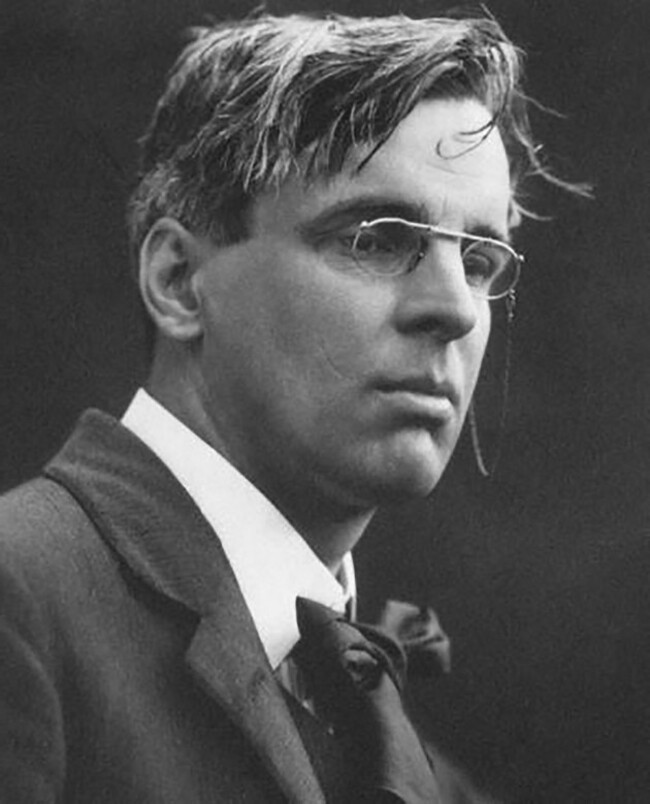
Smith’s labour, though, was invisibilised for years, with the deck being solely attributed to Waite, a misogynistic insult that has finally been repaired. If we follow Smith’s life, we come home to Ireland, and to her friendship with WB Yeats and his brother Jack. Colman Smith painted WB’s portrait and worked with Jack on an illustrated publication of poems and ballads. Yeats’ fascination with the tarot and the occult is well documented, and the National Library holds his occult papers and a notebook containing his studies of tarot and astrology.
That fascination with the tarot has also entered Irish artistic practice with Lorcan Walshe’s stunning paintings of the major arcana and, more recently, Lauren Conway’s exhibition Draw a Card at the RHA. There is something wryly fitting about this story, a poet whose meanings generations of Irish schoolchildren have struggled to decipher spent years studying tarot images that also refuse to yield a single, settled answer. Yet, while we put the poet on the school syllabus, the women shuffling these very same cards at their kitchen table are often met with mocking eye-rolls or perhaps, at last, a little less often?
As an anthropologist, I am of course interested in why tarot seems to be having such a moment. When I think of all the questions we carry through our everyday, tucked beneath the shopping list we can scarcely afford, the rent or mortgage payment that breaks us (if we are lucky enough to have housing) and the unanswered emails and work pressures, the appeal seems to be much clearer. The cost of living crisis comes to our kitchen tables through a hefty electricity bill, the price of butter or a conversation about money postponed because no one really has the stomach for it. On our devices, we scroll past images of genocide and conflict between adverts for stuff we simply cannot afford. We keep scrolling and scrolling, and then we wonder why we wake in the middle of the night, panic struck.
Social scientists, particularly anthropologists, have for a long time explored the rituals people make around uncertainty and now polycrisis, especially where the stakes are so high that their power to make change is so frustratingly small. Magic gives their apprehension a shape and form, something to do with the hands while the mind moves towards what scares it. This is the very impulse I recognise as I shuffle my tarot cards every morning.
Ireland is no stranger to the supernatural or to occult mysteries; in fact, we have an intricately complicated relationship to it. The history of Samhain (now being wholly re-embraced) was one of the most important seasonal thresholds of the year around which stories of the returning dead, the sidhe, and the dangers of encountering the otherworld gathered.
Candles, fires and household rituals offered ways of acknowledging the uncertainty that lay just beyond ordinary sight. From surviving folklore, we know how comfortable people were with stories of how the sacred and the mischievous occupied the same space. Later generations inherited their own elaborate relationships with the supernatural.
In fact, like many others, I grew up in a Catholic household, brought as a child to watch the now infamous moving statues of Ballinspittle, we visited holy wells and also believed that interfering with a fairy tree would bring all kinds of bad luck. Yet somehow, the mere mention of tarot or the Ouija board would invoke all sorts of castigations.
The authority of the Catholic Church in Ireland has undergone a profound reckoning with ongoing outrage about the sexual abuse of children, the incarceration and mistreatment of women and children in all sorts of institutions, and the institutional silencing of survivors. All of which have left wounds and intergenerational trauma deeply embedded across many homes and communities in Ireland.
A glance at the 2022 census shows declining religious affiliation with the Catholic Church, yet for many of those who have stepped away, the wish for ritual remains; still there is a need to mark loss and grief, to acknowledge change or even to feel accompanied through a significant life passage. It is unsurprising then that many turn to tarot as a space where a reading can open a little room for those needs. Someone asks a question and a tarot card is turned; suddenly there’s space for conversation and connection, even an answer; an image catches a feeling that an individual has struggled to name, and what has been for a long time silenced finds its way into speech.
Our hunger for answers also sustains newer oracles, whose authority deserves as much scrutiny as my deck of tarot cards. In the age of AI, algorithms anticipate our desires, some even make pretence to interpret the tarot; generative AI offers sycophantic counsel on love, work and loneliness with its fluent assurances delivered on a screen that conceals most of the material cost of that exchange.
“Stop asking ChatGPT and ask a baddie with tarot cards instead,” a meme that was circulated widely on social media in recent weeks is a joke that acquires a sharper edge in Ireland where data centres consumed 23% of Ireland’s metered electricity in 2025, compared with 28% consumed by households.
There is something deeply troubling about turning to these kinds of technologies for reassurance while they are fundamentally altering our communities. We are sleepwalking into a future that we have asked a few corporations to shape, all the while asking them to predict if all will be well.
Amidst the bluster of all of this technology, there is, for many, a comfort in turning to our tarot cards or in sitting across from a tarot reader seeking counsel. Much of this current tarot boom lives in that shared encounter, in the presence of someone who can offer a quiet space for questions whose ultimate meaning still rests entirely in your own hands.
So this Samhain, I will pull up my chair to my kitchen table and consult my cards, and maybe I will also cast an apple peel over my shoulder, bending down to glimpse the future. That humble fruit makes no great claims about precision, yet it possesses the grace to decay naturally, rather than requiring another power-hungry server facility to sustain its existence.
Dr Fiona Murphy is an anthropologist based in the School of Applied Language & Intercultural Studies at Dublin City University.
To embed this post, copy the code below on your site







have your say