Sign in. It’s quick, free and it’s up to you.
An account is an optional way to support the work we do. Find out more.
Sign in. It’s quick, free and it’s up to you.
An account is an optional way to support the work we do. Find out more.
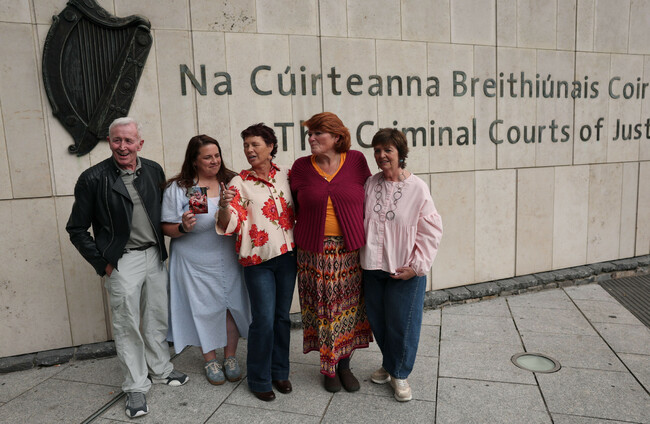

FOR MANY, THE summer of 2026 was glorious. For myself, other survivors of George Gibney and four very brave women, it was a summer of waiting. Waiting for Gibney’s trial.
Waiting six days for a verdict. Waiting two months for sentencing.
But we had a date, Monday, 12 October.
In the week leading up to it, I was a bag of nerves. What if the sentence was too light? How would I cope with my anger, if the four women did not get every minute they deserved?
By the Saturday night, before the trial, my thoughts and fears occupied every room in my house, my many self-taught coping measures of no help.
Desperate to escape, I walked out into the darkness, feet pounding off the pavement, as I struggled to regain some control. I had only left home a few minutes before I recognised the cause of my distress; the once vibrant, confident, innocent 13-year-old girl, who lives inside my soul, needed to be heard.
She wanted to cry for how hurt she was, scream about injustice and hit someone a slap for how angry she felt. Usually, I quieten and console her, tell her she is doing great.
However, as I walked that night, I could find no words to comfort or quieten her. In tears, I listened to her heartfelt rememberings; the darkness, the hurt, the isolation of her teenage years, the despair.
For over an hour she and I walked together. By the time we returned home I felt a sadness I’d not experienced for some time and I vowed to bring that hurt, but immeasurably strong, young girl to the court, to stare down Gibney and see some sort of justice done.
Walking towards the Central Criminal Court, flanked by my family, under scrutiny by the press, it felt as if I were watching myself on the news. Once inside, our tribe gathered, heartfelt hugs injecting one another with courage and strength. Alongside us was Orla Poole, one of the extraordinary four women who had decided to speak with the gardaí.
A single moment in her company was enough to reassure us, she was strong and she was ready. The waiting was over.
The courtroom was not large. I chose to sit near the front, between my fellow survivor and soulmate, Ber Carley and Mark Horgan, from the podcast, Where is George Gibney. I had reluctantly trusted him with my story six years ago, and he now ranks as one of my greatest friends.
Around us sat our families, fellow survivors and the four extraordinary women, two via video link. There was hushed chatter and nods of recognition but inside, my every muscle was primed, watching the closed door, waiting for Gibney to be wheeled out.
I cannot remember if the court quietened as he appeared, or if Ber, Mark and I held hands, for at that moment it was just me and him.
Some have commented how he cut a pathetic sight, an old man in a wheelchair, hair dishevelled, teeth missing. Yet, all I saw was evil.
The next thirty or forty minutes were a see-saw of hope and despair.
The judge was strong in his summary of Gibney, and we nodded in the hope this would guide his sentence, only to hear in the next breath, ‘mitigating factors’. Enraged, I heard his sentence would be in line with the time of his offending, significantly less than if he committed those crimes today.
I feared I had been right not to expect too much. But then the judge’s voice filtered through, speaking of ‘a headline sentence’ of 12 years for attempted rape, reduced to 10. The double digits I’d hoped for, followed by consecutive sentences for each of the four women.
My mind went blank. Was consecutive the good one? Yes, it was. We had a sentence of fifteen-and-a-half years.
Stunned and relieved, we stood and embraced one another. There were no whoops of joy, no shouts of anger, only a collective silence, as we witnessed Gibney’s removal from our world. Turning to my family, my husband, my children, I was struck by the pride I saw on their faces.
As I walked towards my husband Eamonn, he put his arms out and I walked into them. For just a moment I crumbled, as years of hurt, injustice and sadness poured out. Composing myself I turned to see my family lined up, one after another, with smiles, tears and hugs. Lots of hugs.
Once outside in the lobby, survivors looked for one another. Every embrace had a new feeling. Love, for Chalkie, who took the first step. Gratitude, to Johnny Watterson, who as a young reporter told the world Gibney was a child, sex abuser. Sadness for Louise, whose mom, Loraine, had come forward thirty years ago but had sadly not lived to be with us. And pride and celebration with Orla, who with the other three women had told their truth.
All that was left to do, was to stand behind Orla on the steps as she faced a wall of media. There we listened to her powerful statement, faultlessly delivered. As she finished, she turned and embraced Ber and me, in the greatest hug of all. No words needed. The watching crowd forgotten.
With the day’s formal events over, we gathered to take photographs of every combination of group we could think of. As we did, Louise held up a photo of her mother, Loraine, and I thought of my own daughter Naoise, who had stood beside me in every courtroom, but who had to share this final moment from her new adventure in Australia.
I also thought of the photo I too had brought to court, of my smiling Mum and Dad, and I knew they would be so proud.
Getting justice after all these years was a relief, but in truth, it is even more important to find peace. If you have a secret, tell someone who will listen. Find peace.
Tric Kearney is a writer of short stories and the author of Above Water, a memoir.
To embed this post, copy the code below on your site
















have your say