Sign in. It’s quick, free and it’s up to you.
An account is an optional way to support the work we do. Find out more.
Sign in. It’s quick, free and it’s up to you.
An account is an optional way to support the work we do. Find out more.
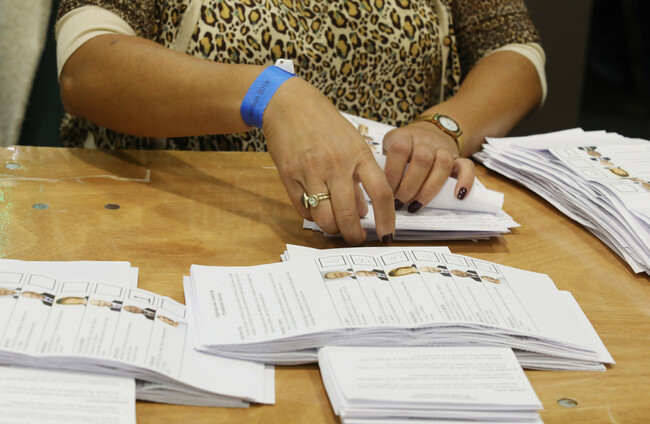
AN INCREASE IN spoiled ballots could “considerably” slow down the counting process in the presidential election.
In the 2011 presidential election, some 18,676 votes were spoiled, which equalled around 1% of the total votes cast.
There was a similar number of spoiled votes in 2018, with 18,438 opting to spoil their vote, some 1.2% of all votes cast.
This time around though, there is a concerted to spoil the vote effort.
A recent Ipsos/B&A poll showed that a significant 6% of voters plan to spoil their vote.
Some 55% of respondents to the Ipsos/B&A poll also said they favour a change to the constitution to make it easier to get on the ballot.
Only three candidates made it onto the ballot this time around – the fewest since 1990.
Speaking on RTÉ’s Late Debate, Theresa Reidy, a political scientist at University College Cork, noted that should the poll results come to fruition, 6% of the ballots being spoiled would be “very high” compared to previous elections.
While she said the spoil the vote campaign is “vocal”, she added that it “remains to be seen” how active it will be tomorrow on polling day.
“We would certainly expect it to be higher than it is at usual elections,” she added, “but how high remains to be determined”.
She added that should there be a “large surge in spoiled votes” it would impact upon the counting process and “likely slow it down considerably”.
She noted that each spoiled ballot must be adjudicated individually and that even a doubling, or a tripling, of the number of spoiled ballots could slow down the count.
“Each one of them has to be examined individually, and so that has consequences in terms of the counting process,” said Reidy.
In 2018, the results of the first count came in at around 7.45pm, while it was around 9.10pm in the 2011 election before the public knew the results from the first count.
Businessman and former European election candidate Declan Ganley is one of the figures behind a campaign encouraging people to spoil their vote – he said he’ll write in “1 Maria Steen” on his ballot.
When asked what changes could be made to the process of getting on the ballot, he suggested that getting the signatures of between 10,000 and 20,000 people should be enough.
He also suggested that local authorities should not be allowed to block votes on potentially backing a candidate.
Ireland uses the PR-STV system, in which voters indicate who they would like to see elected in order of preference.
When the counting starts, staff will tally the first preference votes for each candidate, which can take some time.
Spoiled votes will also be placed to one side and tallied.
The results of the first count from centres across the country are sent to the Presidential Returns Officer (PRO) in Dublin Castle, using a standardised format that includes total poll, spoilt votes, total valid poll and first preference count.
The results are checked and verified in Dublin Castle.
The quota, or the number of votes required to be elected president, is 50% of the total valid poll plus one vote.
Each “doubtful” vote has to be independently verified by the returning officer and adjudicated upon as either a valid or invalid vote.
As invalid votes do not count towards the calculation of the quota, this adjudication is carried out at the start of the count process.
Many invalid votes are unintentionally spoiled.
Reidy added that there isn’t a “particularly strong pattern in spoiled votes” in previous elections and that the number ranges between 1% and 2% in presidential elections.
She said the only time so far that there has been a particular peak was in 1945 but added that this was “the first presidential election and so it’s not all that unusual”.
She also remarked that there can be a lot of variation in referendums, where there can be an upward pattern.
“It can go up to 7% or 8% [in referendums] but it’s very unusual to get to that higher level at elections.
“The question comes back to how motivated are the people who are annoyed at the choice and want to cast their ballot and go out and vote.”

To embed this post, copy the code below on your site














have your say