Sign in. It’s quick, free and it’s up to you.
An account is an optional way to support the work we do. Find out more.
Sign in. It’s quick, free and it’s up to you.
An account is an optional way to support the work we do. Find out more.
RIGHT OFF THE bat it’s worth making clear that this article will include lots of asterisks, clauses and clarifications.
The music sector is notoriously secretive when it comes to earnings. And the intent of this article is not to state with 100% confidence exactly how many streams an artist needs to earn X amount.
Rather, it is to try to see roughly how successful an Irish artist needs to be on a streaming platform to make some kind of a living from their music.
The question is related, as all things in the universe are, to Mayo winning the All-Ireland.
After the county broke its 75 year curse, the Saw Doctors song, Green and Red of Mayo, surged to number 1 on Spotify’s most-played tracks in Ireland. It was the first time it had recorded the milestone since being released all the way back in 1992.
But it got us thinking – financially, how much is something like that worth to an artist? And more importantly – what does it say about making a living in the streaming age?
To get right into it – it’s generally reported that each Spotify stream is worth somewhere between 0.3 to 0.5 US cents. So 10 streams would earn the artists 5 cents, 1,000 would equal $5, and so on.
The reason there’s a range is because there is no fixed amount for streaming payments.
The amounts vary based on a few factors, such as which country an artist is based in. For the sake of simplicity, we’ll be generous and stick with the higher 0.5 cents estimate.
Business Plus already did the maths on how much the All-Ireland win was worth to the Saw Doctors. Green and Red of Mayo got about 57,000 streams per day between Saturday and Wednesday after Mayo’s win.
Citing the Sound Campaign, a music promotion company, the publication estimated that the song earned about $1,309 (€1,000) over the five-day period.
So about €227 per day from being the biggest song in the country. If that doesn’t sound like a lot, it’s because it isn’t.
Going over 365 days for a full year, that would give a total of just under €83,000.
Of course, no artist will stay at number 1 for a full year. But we’ll get to that point soon.
Minimum wage
For now, let’s go back to the question posed in the headline – how many Spotify streams does a musician need to make Ireland’s minimum wage?
The country’s minimum wage is €14.15 per hour. For a full-time employee working a standard 39-hour week, that works out to about €29,000 per year.
Taking the earlier number of 0.5 cents per stream, an artist would need about 7 million streams annually to earn about €29,000.
It’s worth noting that this is a pretty rough estimate. Spotify does publish some details on earnings in its annual ‘Loud & Clear’ report. But exact numbers are hard to come by, and there are often caveats which makes estimating exact figures difficult.
But to go back to our 7 million rough estimate. Per month, that’s about 600,000 streams. About how many Irish artists are hitting that benchmark?
The world-famous names will of course – the likes of U2, Hozier or Fontaines D.C.
Industry estimates put the total number of Irish artists above a million streams per month at somewhere around 100. Being generous with the number who are reaching 600,000 per month, we could maybe say 200 – 300 or so.
Then, it’s also worth factoring in that many popular artists don’t keep 100% of the revenue which their songs generate via streaming.
Small record labels – which artists sign to for promotion and distribution – often take a 50% cut of earnings.
For larger labels, the split can be even more in their favour. And of course, bands have to divide earnings among their members, managers take a cut, and so on.
Which means that an artist needs even more streams to reach the €29,000 earnings threshold.
Again, this all points to how difficult it would be to make Ireland’s minimum wage relying on streams alone.
But of course, this is where more caveats come in.
While Spotify has a dominant position, it doesn’t have a monopoly. It’s estimated that the platform controls about a third of the global streaming market. Artists who are popular there likely also do well on others too, meaning their streaming income will be higher.
Then, it’s also worth noting that streaming is only one way that musicians can make money. Other obvious ways include merchandising or live shows and tours.
With big headliners, it’s estimated that this can be anywhere from 70% to over 90% of their total revenue. The share will be smaller for lower level acts, although almost certainly still more important than streaming alone.
Horse’s mouth
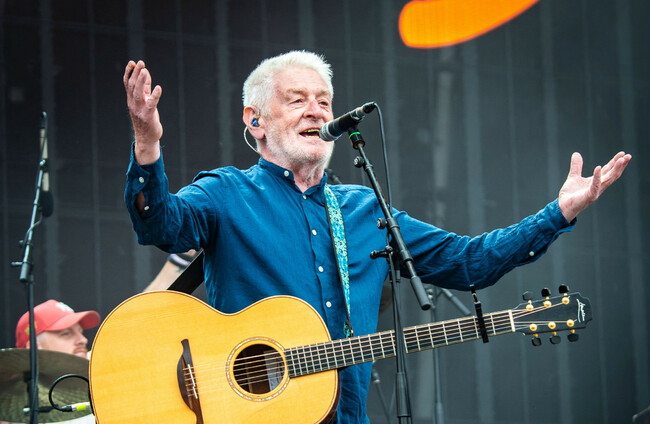
This is something which Ollie Jennings, the long-time manager of The Saw Doctors, emphasises. Remember we said that Green and Red of Mayo kicked off this interest in music earnings? We spoke to Jennings for his take.
Luckily for the Saw Doctors, the band has a rights arrangement which allows them to keep a large chunk of their earnings from their music. But even at that, Jennings says the real benefit from the song’s surge to the top of the charts is publicity.
‘We’ve gotten offers from two festivals next summer just because everyone now knows who the Saw Doctors are. We’ve become a much more valuable band now compared to last year,’ he says.
Jennings declines to give any figures about how much the band generates via streaming, beyond saying that they do ‘ok’ from online platforms.
However, he said it pales in comparison to the days of physical media.
“Our peak was in 1996, when we released an album which got to number 6 in the UK charts”, he said.
In those days, a CD cost about £12 – £14, and we would make a profit of about £5 on each sale. We sold about 60,000 albums, so we made a profit of about £300,000.
“We’ve kept re-using that money over time, that windfall from 96, which we could never repeat. It’s what kept us alive over the years. You would never make anything like that out of streaming. That was the golden era.”
It’s also worth noting that even physical media is worth less now than in the past.
He adds: “We don’t sell CDs anymore. You can go to the Saw Doctors website and buy the Greatest Hits for a fiver plus postage, we sell maybe five per week. The only game in town for earning money from music [plays] is streaming.’
Jennings is keen to emphasise that the Saw Doctors have always done well in terms of percentages from profit sharing, as the band has retained most the rights to its own catalogue.
But the massive drop-off compared to what bands could make during the days of physical media again reiterates the same point.
Previously, mid-level artists that could do well in Ireland with some decent success abroad had a chance at making some real money.
Nowadays, it is much more likely that they will struggle to earn the minimum wage – at least via streaming alone.

To embed this post, copy the code below on your site













have your say