Sign in. It’s quick, free and it’s up to you.
An account is an optional way to support the work we do. Find out more.
Sign in. It’s quick, free and it’s up to you.
An account is an optional way to support the work we do. Find out more.
LAST UPDATE | 4 Feb 2025
ESB NETWORKS HAS ruled out offering compensation for customers impacted by power outages following Storm Éowyn, arguing that any such payments would “ultimately be paid for by all customers”.
Around 25,000 premises remain without power following Storm Éowyn and Paddy Hayes, the chief executive of ESB, said it’s expected that 10,000 customers will remain without power by tomorrow night.
The worst impacted areas are Galway, Mayo, Roscommon and Leitrim.
Counties Cavan, Longford, Sligo, Monaghan and Donegal are also impacted.
At the peak of the power outages on Friday 24 January, around 768,000 customers were without power.
Hayes told RTÉ’s Today with Claire Byrne that the “vast majority” of premises will have power stored by the weekend.
However, Hayes added that “it’s likely there will be a handful of customers whose restoration times go into the weekend”.
Hayes was asked if ESB customers in Ireland who have been impacted by power outages might be able to avail of compensation schemes like those in Scotland.
Customers are then entitled to a further £40 (€48) for every complete 6-hour period after 48 hours, to a maximum amount of £2,000 (€2,405).
When asked if similar compensation might be offered here, Hayes remarked that while the ESB’s customer charter offers payments for outages due to issues with the network, this doesn’t apply to storms.
“The government has stepped forward and offered a humanitarian assistance scheme for customers who are out of power, and I think that’s the appropriate way to do it,” said Hayes.
The government’s Humanitarian Assistance Scheme offers varying levels of support, including emergency support payments for food, clothing and personal items in the immediate aftermath, which is not income tested.
The first stage of this scheme is for those without power and/or water
In addition, a number of people in what the Department of Social Protection describes as “very challenging circumstances” have been supported with the cost of alternative accommodation under this first stage.
The scheme has also supported the purchase of necessary items such as gas heaters and for people without power.
Hayes added that in the UK, the cost of compensation schemes “is ultimately recovered by the networks company and ultimately paid for by all customers, so it’s a socialisation”.
He added that “those costs would be recovered from customers generally, and would increase the cost base”.
“Therefore, I think the most appropriate place for this, which the government has taken on, is the humanitarian assistance,” said Hayes.
Meanwhile, Hayes said the disruption from Storm Éowyn will be “significant” and cost “tens of millions”.
As a result, ESB prices will likely rise.
“In 2026, it’s likely those charges will find their way back into the overall cost of our distribution system network,” said Hayes.
“There is a cost associated with this that will ultimately be borne across the electricity network as a whole.”
It was also put to Hayes that in some instances, estimated restoration times have moved out by several days.
Hayes said he can “understand the frustration for people when our estimated restoration times move”.
He described Storm Éowyn as a “weather event that we haven’t experienced before in Ireland”.
“We’re seeing two or three times as much damage to our network as we’ve ever seen in storms like Storm Ophelia or Storm Darwin in the past.
“It’s that extent of damage, particularly in some of the areas which are more remote from the network, that’s caused the time taken to restore power.”
He explained that electricity runs from the larger areas of the grid into the more remote areas.
“What we find when we’re restoring power is, it’s absolutely critical to get the large backbone lines back first, because that can feed everybody.
“In some cases, as we’re getting to the numbers where you’ve got smaller people fed off smaller parts of the grid, we can find more damage that hasn’t previously been discovered until we’ve restored power to the backbone, and that’s why the date moves,” said Hayes.
“Even though we’re moving resources into the most badly affected areas all the time, we can still be finding damage as we’re reconnecting supply to a backbone line.”
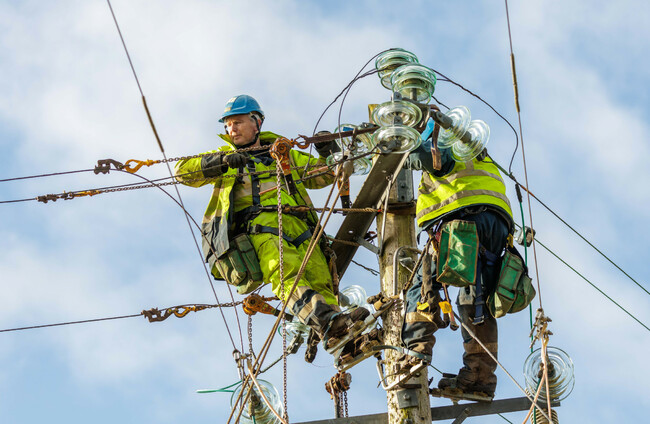
Skilled technicians from the ESB’s counterparts in Austria, Finland, France, Britain, Germany, Netherlands and Norway are on the ground in the worst impacted areas, and additional crews arrived this morning from Northern Ireland’s NIE Networks.
Hayes said there are currently 1,500 network technicians working on the outages, in addition to more than 1,000 of ESB’s permanent contractors and over 400 international crew members.
Hayes said ESB “needs to take stock” following the outages and remarked that “our crews are devastated with the damage that’s been done”.
“They’re disappointed that because of the extent of the damage, we haven’t been able to get customers back quicker.
“We are absolutely determined to get every single customer back.”
He added that as “part of taking stock”, the ESB will be looking at three things.
“We’re going to be looking at the resilience of the network itself and whether that’s sufficient and whether we need to do things with the existing network,” said Hayes.
“We will be sitting down with the stakeholders in the space of trees and forestry, which is a complicated area, to make sure we can find a way of minimising the potential damage if these wind speeds increase in the future.
“And we will also be sitting down with the other utilities, like Irish water and telecoms, to try and understand how we can build more resilience into the system.”
Meanwhile, there are more than 300 Emergency Response Hubs currently operational, down from a high of 380.
Local authorities established these hubs to assist people with basic needs such as water, hot food, phone charging, broadband access, shower and clothes washing facilities.
Further details on the above hubs are available at www.gov.ie/stormresponse and an interactive map of hubs is available here.

To embed this post, copy the code below on your site











have your say