Sign in. It’s quick, free and it’s up to you.
An account is an optional way to support the work we do. Find out more.
Sign in. It’s quick, free and it’s up to you.
An account is an optional way to support the work we do. Find out more.
LAST UPDATE | 26 Jun 2025
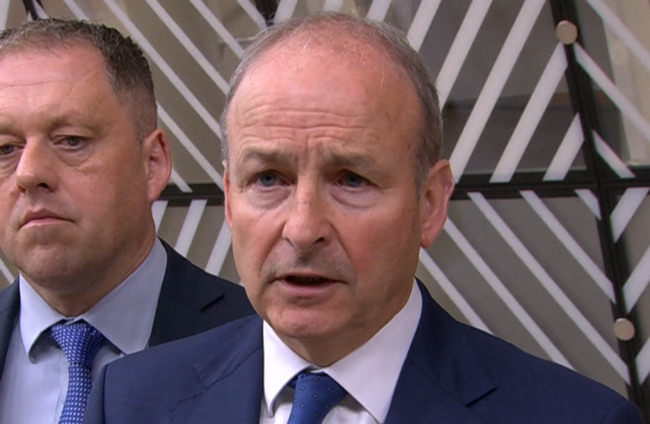
ISRAEL MUST STOP “denouncing every report that comes out using objective criteria to describe the situation in Gaza”, Taoiseach Micheál Martin has said.
Martin spoke to reporters in Brussels this morning ahead of a European leaders’ summit taking place after foreign ministers failed to reach an agreement on a review of Israel’s trade agreement, which said that Israel has breached its human rights obligations.
Israel has denounced the report and labelled it a “rush job”. Martin, asked about the Israeli response to the review today, said the pattern of undermining reports and world leaders by the government needs to stop.
“Israel needs to stop denouncing every report that comes out using objective criteria to describe the situation in Gaza. It’s not an outrage, the review.
“The review, in some respects, is quite a modest document that seeks to objectively present the facts in relation to Gaza, but avoids emotional language and so on.
“I think that this kind of tactic and pattern of undermining those who would even question what’s happening in Gaza has to stop,” he added.
It comes as hope is dwindling in Brussels for a decision to be made to allow the commission to take action on Israel for its war in Gaza.
Pressure has been mounting on European leaders to take more action against Israel’s war in Gaza, which has killed almost 56,000 people – mostly civilians – since October 2023, and the European Commission has been accused of inaction.
The Taoiseach has called for concrete action in response, but countries proceeded cautiously at a meeting of foreign affairs ministers on Monday.
Martin said he is going to be pushing for the EU to put more pressure on Israel over its actions in Gaza at the leaders’ summit today. He denounced the lack of consensus amount European leaders over the issue.
“I will be saying to my European colleagues that the people of Europe find it incomprehensible that Europe does not seek to be in a position to put pressure on Israel and leverage on Israel to stop this war in Gaza.
“To stop the continuing slaughter of children and innocent civilians. The war must stop. There must be a humanitarian response and a surge of humanitarian aid into Gaza, an end to the blockade.
“I understand there are historical reasons why some member states have a particular perspective on this, in terms of the Middle East issue, but from a humanitarian perspective, it is incomprehensible what is going on, what continues to go on.
“Europe needs to really articulate that in the strongest possible way, and we will be seeking to pursue mechanisms to entire that this war stops, and that humanitarian aid gets into Gaza.”
Speaking to reporters yesterday, Justice Commissioner Michael McGrath said Brussels cannot take stronger action unless leaders at the European Council reach a consensus, which he said is not possible in the current climate.
A third of Israel’s imports come from the EU, valued at over €23bn annually, while Europe imports less than 1% of its goods from Israel.
Suspending trade ties would require a unanimous decision, which is likely impossible as countries like Austria, Germany and Hungary, that tend to more supportive of Israel’s government.
The EU has started to engage with Israel’s government to outline the recent review’s findings.
Ireland was among ten member states who requested that a review take place in the context of the EU’s compliance with the Advisory Opinion of the International Court of Justice.
The non-binding advisory opinion found that “Israel’s continued presence in the Occupied Palestinian Territory is unlawful and needs to be brought to an end as rapidly as possible”.
McGrath, referencing the council of leaders’ role in setting the EU’s foreign policy agenda, said: “Ultimately, any proposal by the Commission is subject to agreement from the European Council.
“At this point in time, based on discussions of the public positions of the member states, consensus is not there in relation to action being taken, arising from the provisions of the [trade deal].”
McGrath said the commission cannot change EU foreign policy unless given directions for government leaders and ministers from member states.
“Article 24 of the Treaty of Europe is quite clear, the primary actor in relation to foreign policy is the European Council, and it acts on the basis of unanimity,” he said. “It isn’t open for the European Commission to set any new position on Israel and Gaza.”

To embed this post, copy the code below on your site












have your say