Sign in. It’s quick, free and it’s up to you.
An account is an optional way to support the work we do. Find out more.
Sign in. It’s quick, free and it’s up to you.
An account is an optional way to support the work we do. Find out more.
LAST UPDATE | 5 Apr 2022
HERE ARE THE latest developments in the war in Ukraine today:
Good afternoon. Lauren Boland here – let’s look at what’s happened in the war in Ukraine today:
European Commission President Ursula von der Leyen and the EU’s foreign affairs chief Josep Borrell are due to travel to Kyiv this week to meet Ukrainian President Volodymyr Zelenskyy.
A spokesperson said the pair “will travel to Kyiv this week to meet with President Zelenskyy ahead of the #StandUpForUkraine event in Warsaw on Saturday”.
The “Stand Up For Ukraine” event in Warsaw referred to in the tweet is to mark global donation drive jointly organised by the EU and Canada to raise money for refugees.
Last Friday, the speaker of the European Parliament, Roberta Metsola visited Ukraine, — the first trip by the head of an EU institution since the war began.
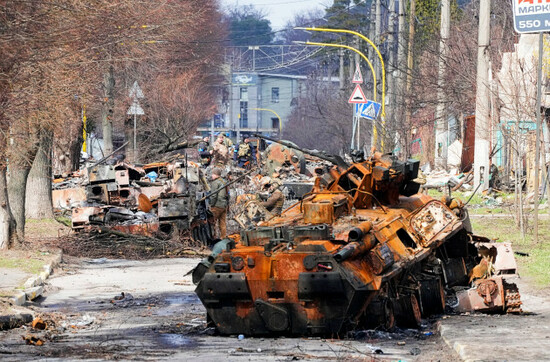
Pictured: Destroyed Russian military vehicles following the fighting in Bucha
Italy, Denmark, Sweden and Spain have joined other EU allies today in expelling Russian diplomats, with well more than 100 expelled in the last two days.
In Italy:
In Denmark:
In Sweden:
The announcements follow similar moves by EU allies France, which yesterday expelled 35 Russian diplomats, and Germany, where officials said 40 diplomats had been sent home.
Also yesterday, Lithuania said it was expelling the Russian ambassador in response to “Russia’s military aggression” and what it called the “horrific massacre in Bucha”.
Zlata Filipovic, a documentary maker in Ireland who escaped Sarajevo as a teenager when the city was under siege, has described the heartbreak for anyone fleeing home during a war.
France’s foreign minister has said that a new sanctions package from the EU against Russia is set to include oil and coal.
“France and Germany are working together to define this new package which is set to include oil and coal,” the minister, Jean-Yves Le Drian, today.
“The modalities of its implementation are the object of discussions today,” he said, referring to EU talks in Luxembourg.
Meanwhile, the US is barring Russia from making debt payments using funds held in American banks starting today.
A spokesperson for the US Treasury told AFP:
Today is the deadline for Russia to make another debt payment.
Beginning today, the US Treasury will not permit any dollar debt payments to be made from Russian government accounts at US financial institutions.
Russia must choose between draining remaining valuable dollar reserves or new revenue coming in, or default.”
Debt payments previously had been exempt from the near-complete lockdown that severed Russia from the global financial system.
Russia had made several payments to foreign creditors through major US banks and had been been allowed to receive payments for oil and gas sales even though the US has banned imports from Russia.
However, the White House warned yesterday that more sanctions were coming on Russian President Vladimir Putin over the alleged atrocities in Ukraine.
The move “will further deplete the resources Putin is using to continue his war against Ukraine and will cause more uncertainty and challenges for their financial system,” the Treasury official said in a statement.
Speaking to EuroParlRadio, Irish MEP Billy Kelleher said today that current sanctions are not having the desired effect and that Europe needs to target the Russian energy sector.
“The sanctions that are in place simply are not having the effect that we had hoped in terms of sanctions on oligarchs, sanctions on some Russian banks, and sanctions on the broader Russian economy,” Kelleher said.
“Until such time as we stop purchasing oil, coal, and particularly gas from Russia, we will be continuing to underpin the Russian economy.”
The MEP said:
Bear in mind, the Russian ruble collapsed three days after the invasion of Ukraine. It is now back to where it was and has increased in strength.
The sanctions are not having the effect of crippling Putin’s ability to fund his war machine in Ukraine, so we have to take it to another stage.
We have a resolution before the parliament. I certainly am of the view that we have to bring forward very stringent sanctions on coal and oil and we also have to reduce our absolute dependency on Russian gas.
Otherwise, we will continue to fund Putin and he will continue to be able to fund his war crimes in the Ukraine.”
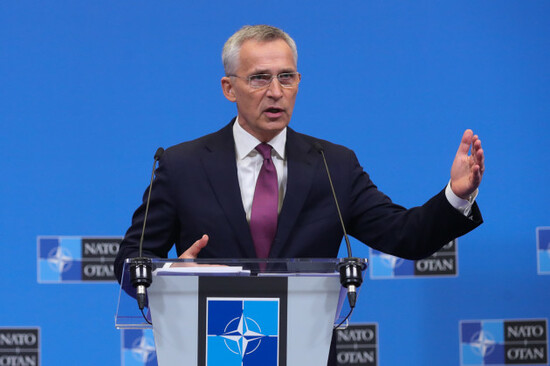
NATO chief Jens Stoltenberg fears there are still “more atrocities” to be discovered in areas of Ukraine that were occupied by Russian troops.
Speaking to a media conference today, Stoltenberg said: “When and if they withdraw the troops and Ukrainian troops take over, I’m afraid they will see more mass graves, more atrocities and more examples of war crimes.”
He believes Russia plans to militarily take the entire Donbas region in eastern Ukraine with the aim of creating a corridor from Russia to annexed Crimea.
Russian forces are moving away from Kyiv to “regroup, re-arm and resupply and they shift their focus to the east,” he said.
“In the coming weeks, we expect a further Russian push in the eastern and southern Ukraine to try to take the entire Donbas and to create a land bridge to occupied Crimea.”
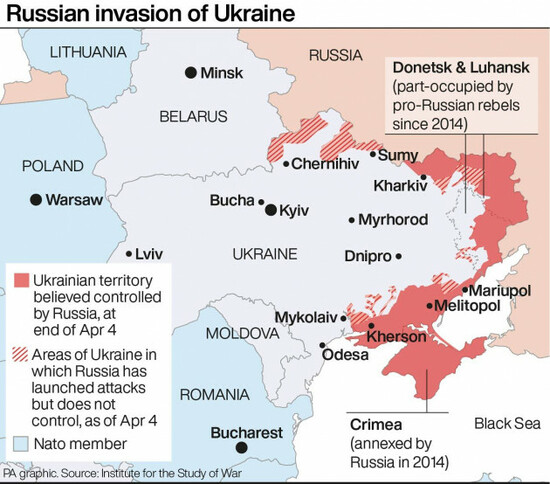
Here’s the UK’s latest intelligence update on Russia’s attacks and troop locations in Ukraine
And here is a similar map by the Press Association:
European Commission President Ursula von der Leyen has confirmed that the EU wants to implement a new set of sanctions against Russia.
The EU executive has proposed a fresh wave of sanctions that would include a ban on coal imports and blocking Russian ships from entering European ports.
It will need to be approved unanimously by the EU’s 27 member states.
“Russia is waging a cruel, ruthless war, also against Ukraine’s civilian population. We need to sustain utmost pressure at this critical point,” von der Leyen said in a video address.
The EU is also proposing a total ban on transactions of four large banks that represent a quarter of the Russian banking sector and wants to expand the list of Russian products banned in the EU, including vodka.
Countries that are particularly dependent on Russia for energy, such as Germany, Austria and Italy, have resisted expanding the measures to gas or oil.
Yesterday, Germany said gas was still off-limits for now given its continued importance to the European economy but that it could target gas and oil later.
Von der Leyen said additional sanctions, including on oil imports, were being worked on.
EU foreign ministers could adopt the latest package either on the sidelines of NATO and G7 meetings happening this week tomorrow and Thursday or at their regular meeting early next week.
Taoiseach Micheál Martin has said the EU must keep adding pressure on Russia to stop its “appalling and immoral war”.
Speaking before the proposed EU ban on Russian oil and coal, the Taoiseach said Ireland is pressing other memeber states for the strongest possible sanctions.
“We would favour the inclusion of oil and coal in this latest round of sanctions given the indiscriminate murder of civilians in Ukraine,” he said.
“We have to do everything we possibly can to keep the pressure as a deterrent in this appalling, immoral war on the people of Ukraine.”
I’m signing off now for the day. Here’s Gráinne Ní Aodha to keep you up-to-date for the next while.
Hello, Gráinne here taking over the Liveblog.
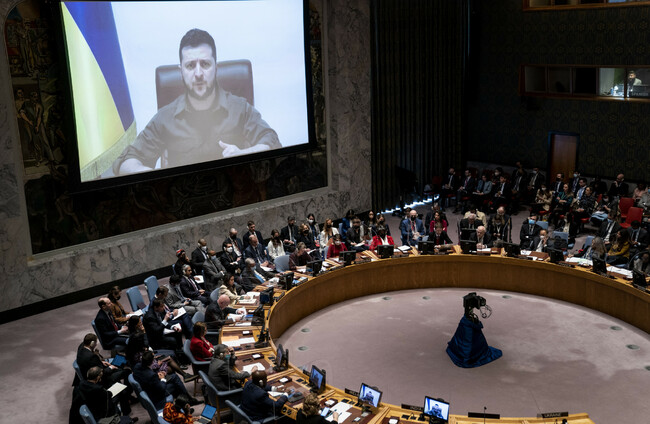
Zelenskyy is addressing the UN at the moment.
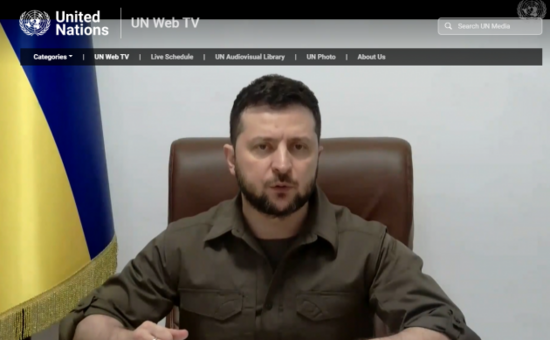
He has listed the atrocities that have been reported to have been committed by Russian soldiers against civilians in the areas of Ukraine they have occupied for weeks.
He says that ordinary civilians were shot outside their homes for calling out to people to see if they were still alive, and that women were raped in front of their children.
He’s asking the United Nations where are the guarantees from the body in the face of a world aggressor.
“The world has yet to see what they have done in other cities,” Zelenskyy says. “Accountability must be inevitable.”
Russia has violated Article 1 of the UN Charter, he says, so what is the point of the rest of the articles.
Bucha is only one example of what the occupiers have been doing on our land for the last 41 days.
“I know and you know perfectly well what Russia will say after these crimes,” he says, mentioning the shooting down of a MH17 plane in 2014 and chemical weapons being used against civilians in Syria.
Zelenskyy said that Russians are looting food, gold earrings and other items from Ukrainian villages.
He said that allowing Russians to do this unpunished undermines the world order.
“Ladies and gentlemen, are you ready to close the UN? Do you think the time for international order is gone?” he said, adding that if the answer was ‘no’, then action should be taken against Russia.
“The aggressor must be brought to peace immediately. From Somalia to Syria, that should have been stopped a long time ago.
“If it had been stopped a long time ago… perhaps there would not be a war against my people. But the world watched and did not want to see the occupation of Crimea or the war in Georgia.”
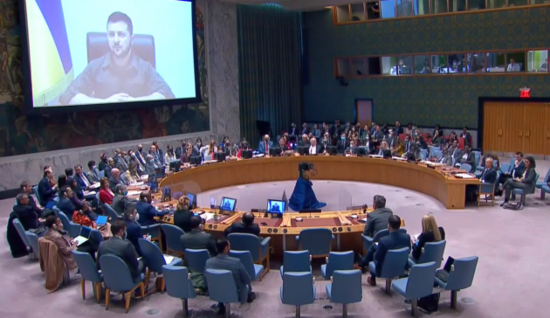
“Remove Russia as an aggressor [from the UN Security Council] and a source of war, so it cannot block decisions about its own war, and then do everything we can to promote peace; or please show how we can resolve for peace; or if there is no alternative, dissolve yourself altogether.
“Ukraine needs peace, Europe needs peace, the world needs peace.”
The Slovenian government is to expel 33 Russian diplomats after bodies were found in the Ukrainian town of Bucha, where Kyiv has accused Russian forces of a massacre.
The foreign ministry said earlier that it had summoned the Russian ambassador Timur Ejvazov to express Slovenia’s “shock over the killing of Ukranian civilians in Bucha and other towns that were liberated from the Russian aggressor forces” and to inform him that the number of Russian diplomats in the country would be reduced.
Russian Ambassador to the United Nations Vassily Nebenzia reacts during a United Nations Security Council meeting, amid Russia's invasion of Ukraine, at the United Nations Headquarters in Manhattan, New York City, New York, U.S., April 5, 2022. REUTERS/Andrew Kelly pic.twitter.com/vdkSbWSXTn
— Phil Stewart (@phildstewart) April 5, 2022
Ireland is addressing the UN Security Council after Zelenskyy’s address.
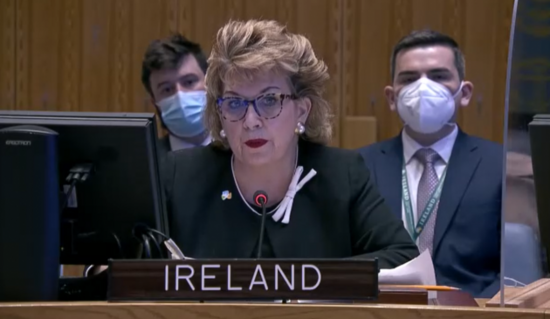
Ireland’s permanent representative to the UN Geraldine Byrne Nason told the Security Council that Ukrainian cities have been “pounded”, bodies have been piled into mass graves, and citizens seek refuge from Russian aggression.
“So many innocent lives lost on our watch,” she said. “The attempts here to deny Russian culpability are frankly appalling in their cynicism.”
“We here cannot suspend our humanity.
“The Russian authorities are responsible for these atrocities [in Bucha], committed while they were in control of the region.”
“We call on the Russian Federation to stop this war. To stop destabilising the democratic foundations of the Ukrainian state. It gets harder and harder to say this, but it is not to late to do the right thing.”
The UN Security Council were shown a graphic video of dead women, children and men including burned bodies and victims in mass graves, in shocking images of atrocities committed during Russia’s invasion.
The 90-second clip – which showed partially uncovered dead in shallow graves, several bodies in a courtyard and dead people with hands tied behind their back slumped towards a wall – played minutes after Zelenskyy addressed the 15-member Council.
Russia’s ambassador to the UN said 600,000 people had been brought ‘voluntarily’ into Russia during the conflict in Ukraine, denying Kyiv’s claim of mass deportations.
“Now overall, since the beginning of the special military operation, over 600,000 people have been evacuated to Russia, including over 119,000 children,” Vassily Nebenzia told the UN Security Council.
“And we’re not talking about any kind of coercion or abduction, as our Western partners like to present this, but rather the voluntary decision by these people as testified by many of these videos that are accessible in social media.”
Earlier today, Zelenskyy compared Russia’s invasion of Ukraine to the Nazis’ 1937 bombing of the Spanish town of Guernica in an address to Spain’s parliament.
“It’s April 2022 but it seems like April 1937 when the whole world heard about one of your cities, Guernica,” he said of the carpet-bombing of the northern town by Nazi aircraft during Spain’s 1936-1939 civil war in support of Francisco Franco’s nationalist forces.
Hundreds of people were killed, many of whom were at a weekly market in the town centre, in an atrocity that shocked the world and was immortalised in Picasso’s haunting anti-war painting.
Historians give an estimated death toll of between 150 and 300 people, while the Basque authorities give a much higher figure of 1,654.
He compared the Guernica assault to the situation in the southeastern port city of Mariupol which has been under siege by Russian forces for over a month.
“Just imagine more than 100,000 residents are living without water, food or medicine because the Russian army has cut off the city of Mariupol,” he told lawmakers
“They are destroying the city, there’s nothing, it’s all in ruins… the people are dead, buried in their own gardens. The Russians were bombing Mariupol knowing people and children were hiding there.”
Some photos of the address by Zelenskyy to Spain’s parliament.
Tomorrow at 10am, Zelenskyy will address Dáil Éireann and the Seanad.
España, la Unión Europea y muchos otros países apoyamos a Ucrania y vamos a seguir haciéndolo. Nuestro compromiso es firme. Estoy convencido de que al final de este período oscuro y amargo, la razón y la democracia prevalecerán sobre la lógica de la fuerza y el autoritarismo. pic.twitter.com/me3SoGvrVY
— Pedro Sánchez (@sanchezcastejon) April 5, 2022
Imprisoned opposition leader Alexei Navalny gives an insight into the quality of information being broadcast on Russian TV.
The television anchor falsely claimed that NATO has been preparing for a provocation in Bucha for a long time.
To ‘prove’ this claim, it cited US President Joe Biden’s criticism of Putin weeks ago, where he said the Russian President was a “butcher”, and noted how the English word sounded like Bucha. “This is how the Western audience was subconsciously prepared for this provocation,” the anchor said.
1/14 How an ordinary Russian TV viewer (one of whom I currently am) sees it.
— Alexey Navalny (@navalny) April 5, 2022
I learned about the monstrous events in Bucha yesterday morning from the news that Russia was convening the UN Security Council in connection with the massacre by Ukrainian Nazis in Bucha.
In the last 40 days, #Ukraine has suffered a level of destruction not seen in Europe in many years.
— Ireland at UN (@irishmissionun) April 5, 2022
The images from #Bucha & other occupied towns are harrowing.
As Amb. Byrne Nason said in #UNSC today, there can be no impunity for such crimes. @dfatirl pic.twitter.com/YczcAwACrU
Images of the massacre of civilians in #Bucha and the Russian war crimes in Ukraine are truly heartbreaking.
— Seán Kelly MEP (@SeanKellyMEP) April 5, 2022
Along with 207 MEPs, the @FineGael Delegation is calling for an embargo on Russian energy imports, exclusion of ALL Russian banks from SWIFT + ban Russia from EU ports. pic.twitter.com/C6ODyQCztw
The United States is sanctioning the world’s largest darknet market for Russian speakers, Hydra, and the virtual currency exchange Garantex. Today’s action, coordinated with 🇩🇪, demonstrates our commitment to continue disrupting ransomware infrastructure and actors.
— Secretary Antony Blinken (@SecBlinken) April 5, 2022
Contains additional reporting by AFP and Press Association

To embed this post, copy the code below on your site











have your say