Sign in. It’s quick, free and it’s up to you.
An account is an optional way to support the work we do. Find out more.
Sign in. It’s quick, free and it’s up to you.
An account is an optional way to support the work we do. Find out more.
LAST UPDATE | 24 May
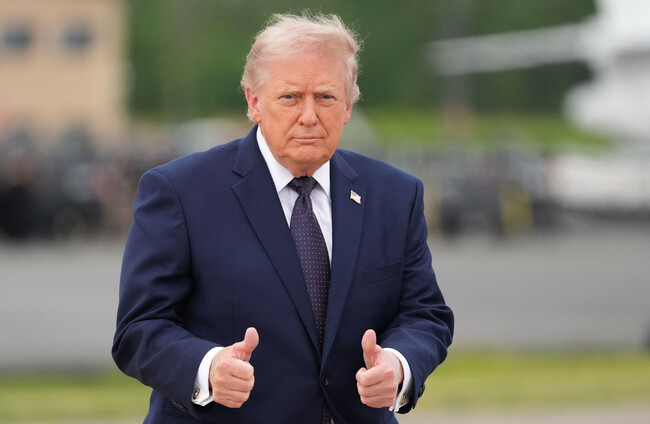
US PRESIDENT DONALD Trump has said that he has told US negotiators “not to rush into a deal” with Iran, amid anticipation that an agreement to end the war in the Middle East was close.
It comes after he posted on his Truth Social platform on Sunday that a deal ”has been largely negotiated, subject to finalisation between the United States of America, the Islamic Republic of Iran, and the various other Countries”.
In a post this afternoon, he wrote that negotiations with Iran “are proceeding in an orderly and constructive manner”, adding: “I have informed my representatives not to rush into a deal in that time is on our side.”
“The Blockade will remain in full force and effect until an agreement is reached, certified, and signed.”
Washington and Tehran have observed a ceasefire since 8 April while mediators push for a negotiated settlement, although Iran has imposed controls on Gulf shipping and the US has blockaded Iran’s ports.
On Sunday, during a visit to India, US Secretary of State Marco Rubio said the two countries could strike a deal as early as today.
“I do think perhaps there is the possibility that in the next few hours the world will get some good news,” Rubio said.
He said the agreement would start a “process that can ultimately leave us where the president wants us to be, and that is a world that no longer has to fear or worry about an Iranian nuclear weapon”.
Trump’s post on Sunday stressed that the Strait of Hormuz would be reopened, a development that would bring relief to energy markets after a long Iranian blockade of a crucial waterway that in peacetime carries a fifth of world oil exports.
European leaders, keen to see Hormuz open and energy prices fall, have welcomed the optimism.
European Commission President Ursula von der Leyen hailed “progress towards an agreement”, while Britain’s prime minister, Keir Starmer, vowed to work with “international partners to seize this moment”.
Iranian officials confirmed the existence of a draft agreement, but stressed that – despite the long-standing US demand for an end to its uranium enrichment – talks on the issue of Iran’s contested nuclear programme have been deferred for 60 days after any deal.
According to Iran’s Fars news agency, Washington has agreed to release part of Tehran’s funds frozen abroad under international sanctions and to end its naval blockade of ships travelling to and from Iranian ports.
In exchange, “according to this draft, passage through the Strait of Hormuz would return to pre-war levels under Iranian management”.
And Fars said, “sanctions on oil, gas, petrochemicals and their derivatives would be temporarily lifted during the negotiation period so that Iran can freely sell its products”.
Other Iranian media signalled that the negotiations were on a knife edge, with the hardline Javan newspaper saying the two sides were “just one step away from ending hostilities, and one step away from war”.
Leaders from Saudi Arabia, the United Arab Emirates, Qatar, Egypt, Jordan and Bahrain, as well as representatives from Turkey and Pakistan, joined a call with Trump to discuss the deal on Saturday.
Pakistan, which mediated historic face-to-face negotiations between US and Iranian delegations in April, hopes to host another round of talks “very soon”, prime minister Shehbaz Sharif said.
He said Pakistan’s powerful army chief Asim Munir, who visited Tehran on Friday and Saturday, also joined the call, which “provided a useful opportunity… to move the ongoing peace efforts forward to bring lasting peace in the region”.
Trump said a separate call with Israeli Prime Minister Benjamin Netanyahu “went very well”. US strikes on Iran have been carried out together with Israel since the war began on 28 February.
Iran’s chief negotiator Mohammad Bagher Ghalibaf had warned earlier that Washington would face a tough response if it resumed hostilities, as Trump has often threatened.
“Our armed forces have rebuilt themselves during the ceasefire period in such a way that if Trump commits another act of folly and restarts the war, it will certainly be more crushing and bitter for the United States than on the first day of the war,” Ghalibaf said.
On the war’s other main front in Lebanon, state media reported that Israel struck the country’s south on Saturday, where fighting has continued despite an 17 April ceasefire.
Lebanon’s military said a strike targeted an army barracks and wounded a soldier, while Israel said one of its soldiers was killed on Friday near the border.
On Sunday, Lebanon’s civil defence agency said its regional facility in the city of Nabatieh had been destroyed by an Israeli strike.

To embed this post, copy the code below on your site












have your say