Sign in. It’s quick, free and it’s up to you.
An account is an optional way to support the work we do. Find out more.
Sign in. It’s quick, free and it’s up to you.
An account is an optional way to support the work we do. Find out more.

META’S CEO HAS spent the past few weeks bigging up his company’s approach to Artificial intelligence.
In an op-ed in the Wall Street Journal he said his company was committed to AI that would empower individuals, drive invention and improve the balance of power:
“If superintelligence is widely distributed, then I believe we will see more jobs in the future, not fewer,” Mark Zuckerberg wrote.
“It will be significantly easier to start businesses without raising large amounts of capital. I expect the economy will become more entrepreneurial with a greater number of people working at small businesses rather than larger companies.”
Nice vision, but how much will this sort of thing cost Meta?
The answer is around $145 billion this year. Investors weren’t thrilled with this, and Meta stock fell by nearly 8%.
There are other reasons for these jitters of course; Meta missed earning expectations, has racked up $2.4 billion in legal charges, and spent over $1billion in restructuring and severance costs following layoffs announced earlier this year.
But Meta isn’t the only big tech giant feeling the pressure. Shares in Google’s parent company Alphabet fell after it revealed another enormous increase in spending on AI infrastructure.
Shares in major chip firms like Nvidia Samsung Electronics and SK Hynix have also fallen sharply in the US and Asia as a sell-off in artificial intelligence-related stocks deepened.
In total, the share price of Magnificent Seven (Nvidia, Microsoft, Alphabet, Amazon, Meta, Apple, and Tesla) tanked by $797 billion last week as AI skeptics dumped their stocks.

The AI mood music is changing – for investors at least. The question is no longer whether AI will transform the economy, but whether the companies spending hundreds of billions of dollars building it can afford to pay the bill.
History is littered with technologies that transformed society while disappointing the investors who financed them.
The current AI investment boom bears remarkable similarity to the overinvestment in railways prior to the panic of 1873, when over-speculation on the industry let to a stock market collapse and a subsequent depression that lasted decades in Europe and North America.
Artificial intelligence has also developed an unusual and risky financial structure. The same handful of technology companies are investing in AI start-ups, selling them cloud computing services, providing them with chips, buying stakes in one another and then using the resulting revenues to justify building even more data centres.
Again, there’s a parallel with railways here. Victorian railway companies became financially intertwined through mergers, leases, guarantees and overlapping ownership structures.
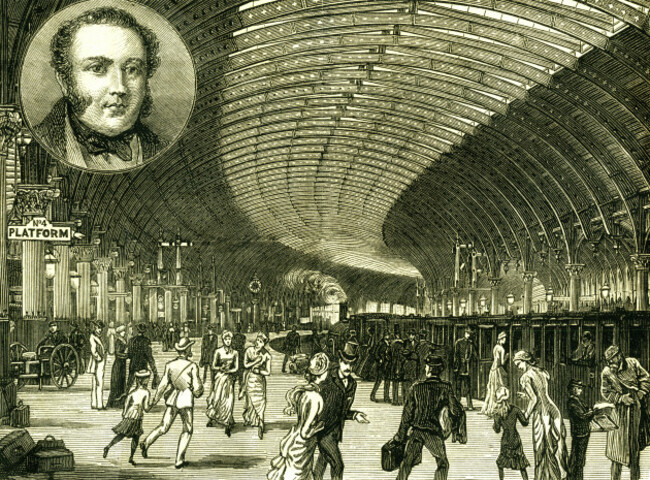
George Hudson, the Sam Altman of his day, was celebrated as the Railway King. But his real genius—and ultimately his downfall—was designing financial structures that kept investment circulating through the railway system, even when commercial returns couldn’t keep pace.
So it’s no surprise that investors are looking for more than a good narrative from Silicon Valley. It’s a Jerry Maguire moment where they’re channelling Cuba Gooding Junior and shouting “show me the money!”
There’s plenty of money going into AI infrastructure. According to Bloomberg, Amazon, Microsoft, Alphabet and Meta are expected to spend around $725 billion this year building AI infrastructure.
Those investments are supporting construction jobs, electricity companies, chip manufacturers and cloud providers. In fact, some economic commentators argue that AI infrastructure spending is now responsible for much of America’s economic growth. Remove it, and the US economy would suddenly seem worryingly anaemic.
Even Open AI’s Sam Altman said last year that investors are over excited in the AI market, comparing it to the .com bubble of the late 90s. “Are we in a phase where investors as a whole are overexcited about AI? My opinion is yes,” he said. “Is AI the most important thing to happen in a very long time? My opinion is also yes.”
But this bubble differs from other recent bubbles – the risk is institutional not personal. Most speculative bubbles have day to day evangelists. We’ve all met taxi drivers who dispensed stock tips, colleagues who boast about crypto wallets, or distant relatives that bought apartments off the plans in some place like Bulgaria.
This AI boom has no queue of ordinary investors scrambling to buy shares in OpenAI. Cheap money is not the accelerant this time. Corporate FOMO is.
Perhaps the reason for stock price jitters is that investors are now questioning the techno optimist narrative from Silicon Valley. They’ve heard the promises of a boom in productivity, and been impressed by the frontier models, now they want to interrogate accounting. They know that changing the world and making money from changing the world aren’t always the same thing.
Meanwhile, Mark Zuckerberg is still spinning his great vision. “The arc of human history has bent toward putting more power in people’s hands,” he expounded in his Wall Street Journal piece.
“If these values lead the way, then I am optimistic that we can build a positive future for everyone.”
That’s all very well, Mark. But don’t forget to show your investors the money.
Steve Dempsey is a media and technology expert and commentator.

To embed this post, copy the code below on your site













have your say