Sign in. It’s quick, free and it’s up to you.
An account is an optional way to support the work we do. Find out more.
Sign in. It’s quick, free and it’s up to you.
An account is an optional way to support the work we do. Find out more.
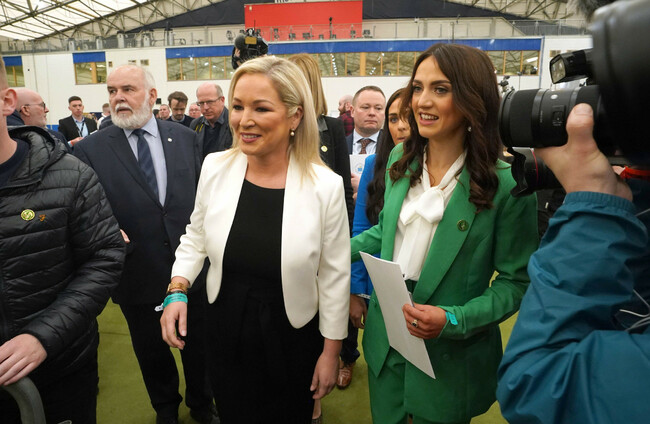
COUNTING IS UNDERWAY in Northern Ireland following yesterday’s Stormont Assembly election, but once the count is done and dusted, the real work of forming a Government starts.
This election could see Sinn Féin become the largest party in the North for the first time ever, while Alliance appears to be making significant gains today at the expense of the DUP.
The First Minister for Northern Ireland has always been a unionist.
Under the rules, the first minister and deputy first minister are the joint heads of Government of the Northern Ireland Executive.
While Sinn Féin would gain no more authority if it displaces the DUP as the largest party and its Stormont leader Michelle O’Neill assumes the first minister’s job, it would symbolically signify a big change of order.
There has been speculation that the DUP might refuse to accept the prospect of Sinn Féin taking the First Minister role.
Sinn Féin Vice President Michelle O’Neill said it would be “absolutely unfathomable” to tell the electorate that a new Executive would not be formed following the election.
Sticking point
While there is much focus on who takes the two top jobs, the real sticking point for DUP leader Jeffrey Donaldson, and perhaps for the formation of any Government, is the Northern Ireland Protocol.
Donaldson has said he will turn up on day one after the election, but will not form an Executive until concerns around the Northern Ireland Protocol are dealt with.
When asked this morning if he was optimistic that a Government could be formed, Minister for Foreign Affairs Simon Coveney replied “it can be difficult”.
He told RTÉ’s Morning Ireland that he will be working with all the parties in Northern Ireland to address the issues around the protocol, acknowledging that more flexibilities are needed.
What happens after today?
Despite the issues around the first ministerial role and the protocol, the newly elected Assembly that emerges today must meet within eight days and will be asked to nominate a first and deputy first minister.
However, there’s unlikely to be agreement, meaning we are probably in for long and protracted talks over the coming weeks and perhaps even months.
If the DUP refuses to nominate a Sinn Féin deputy first minister, the Stormont ministers from the last Executive will continue in their jobs for another six months.
If there is no Executive formed after six months, a new election could potentially be triggered.
If there is no agreement on Government formation, the Assembly and the Executive cannot function, which could ultimately result in a return to direct rule from London.
If no Executive is formed, it effectively leaves the North in limbo, with the Assembly having no power to sign off on key decisions such as budgetary matters or create new laws.
Stormont has been out of action of sorts on a number of occasions. The “cash for ash” scandal resulted in a three-year hiatus in 2017.
The formation of a Government in Northern Ireland could be painstakingly slow after today’s count, but with everyday issues like the cost of living up front as one of the big election issues this time around, the hope is it will get off the ground sooner rather than later, for everyone’s sake.
Speaking this afternoon, after being elected on the first count to his constituency, Donaldson was asked about leaving Westminster behind him.
“Well, I’ve made my position clear on that. I’ve been deemed elected. Let’s wait for the final declaration and as I’ve said, my party officers will meet, we’ll discuss the next steps in this process as to how we can most effectively apply pressure to bring about the objectives that we need, which is a stable Northern Ireland, a stable economy and our political institutions up and running, provided the Protocol is dealt with,” he said.

To embed this post, copy the code below on your site






have your say