Sign in. It’s quick, free and it’s up to you.
An account is an optional way to support the work we do. Find out more.
Sign in. It’s quick, free and it’s up to you.
An account is an optional way to support the work we do. Find out more.
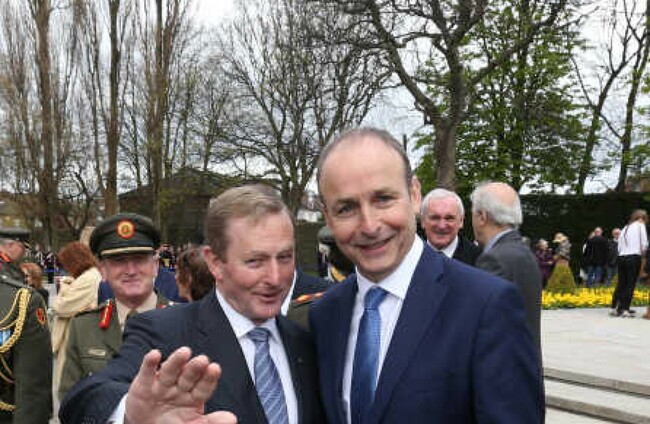
ENDA KENNY AND Micheál Martin are merely playing politics when they talk about a border poll for a united Ireland, according to Martin Mansergh.
The former historian, diplomat and minister helped to negotiate the Good Friday Agreement for Taoiseach Bertie Ahern. He also previously acted as a back-channel to the republican movement under Taoiseach Albert Reynolds.
Mansergh told TheJournal.ie that it’s a complete misrepresentation to say that a border poll is now more viable than before the Brexit result.
Speaking about remarks by Enda Kenny and Micheál Martin about a possible referendum on the status of Northern Ireland, Mansergh said:
“I think you need to read those remarks…
“I think there’s a certain amount of defining, stroking and refining positions in order to not make it look as if Sinn Féin is the only party that has an interest in this.
I think the Taoiseach’s remarks were exceptionally hypothetical, Micheál Martin’s likewise.
“I think they both recognise that the conditions don’t exist [for a border poll].”
The Good Friday Agreement also provides for a united Ireland if a majority of people, north and south of the border, each vote in favour of it – but such a border poll would only happen if there was a clear demand from a majority north of the border.
Complete misrepresentation
Mansergh said it’s a complete misinterpretation to suggest a border poll is now suddenly more viable.
“Although I don’t think Sinn Féin are misinterpreting it, I think they are using it to push an agenda for a united Ireland.
They have long wanted a border poll, fully realising it would be lost, but to set up momentum for the future – but I’m not sure it works like that to be honest.
“I also think it’s very disruptive and destabilising to get people going back into the trenches in a fundamentalist sort of way, unionism versus a united Ireland.”
A new Good Friday Agreement?
Former TD and editor Geraldine Kennedy recently said the Good Friday Agreement hinges on the EU and would need to be renegotiated following Brexit.
Mansergh believes another agreement is necessary – but to amplify, rather than to replace the historic 1998 accord.
“I think she is overstating the role of the EU in the Good Friday Agreement,” he said.
You could say the EU aspect is involved in some of the North-South bodies, and you might have to look at aspects of that again.”
“No, I don’t take the view that the entire GFA has to be renegotiated, I think that would be unwise for a whole lots of points of view.
It was very difficult to achieve and arrive at an agreement.
Mansergh said there might be a further amplificatory agreement, similar to the St Andrew’s agreement:
But renegotiation of the whole agreement? Definitely not. Essentially, you read the agreements together.
I suppose it would be an agreement that would take account of the fact that Britain was no longer part of the EU.
He added that while the peace process is largely funded from London, there is an EU element.
“Public opinion doesn’t fully grasp the reality that British Westminster subsidies of Northern Ireland are many times over the level of subsidies from the EU.
The main subsidies from the EU, and they are mediated through the British Treasury, is the Peace and Reconciliation Fund, and I do think that will be at considerable at risk.
“Some of it may survive possibly under another name, but some of it would certainly be at risk.”
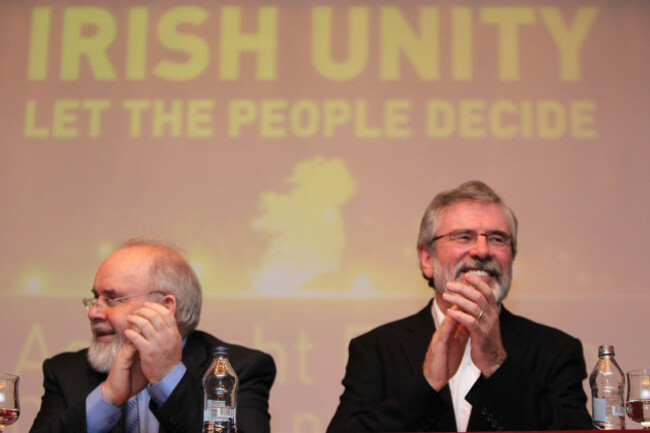
“A real opportunity has not arisen,” Mansergh said.
That’s not to suggest the situation has not evolved at all.
He said the fact that nationalists and a large minority of unionists coalesced during the Good Friday Agreement and Brexit referendum was progress, however.
“My preference certainly would be, even in the changed situation, building on that type of progress, rather than use it as an opportunity to send people scurrying back into their fundamentalist trenches.”
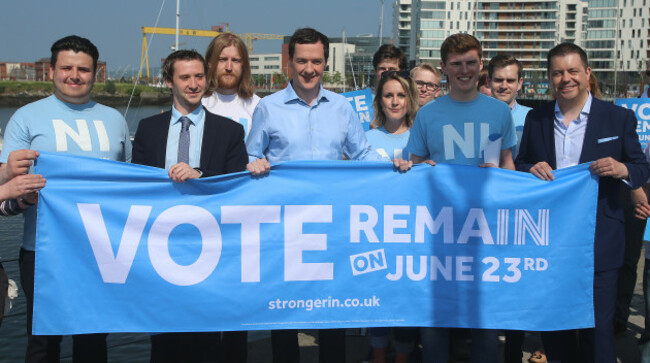
Physical border
Mansergh says that the vote by unionists – including the UUP – to remain in the EU had more to do with opposing a physical border.
I mean, not by any stretch of the imagination were they saying that if the decision goes the other way, we’d prefer a united Ireland.
Mansergh also questioned whether the Republic could afford the North, given the £10 billion subsidy it receives from the British exchequer.
He cited the 2004 Cyprus referendum, in which the Greek Cypriots turned down the offer of their long-cherished dream of unification because of the conditions attached.
People like David McWilliams argue that now that Ireland’s economy is much more successful than Northern Ireland’s… but there’s a large British subsidy, and the population of Northern Ireland is fairly inconsequential in British budgetary terms.

To embed this post, copy the code below on your site













have your say