Sign in. It’s quick, free and it’s up to you.
An account is an optional way to support the work we do. Find out more.
Sign in. It’s quick, free and it’s up to you.
An account is an optional way to support the work we do. Find out more.
WOMEN WHO SUFFER infertility due to endometriosis will be eligible under the publicly funded assisted human reproduction service, the health minister has said.
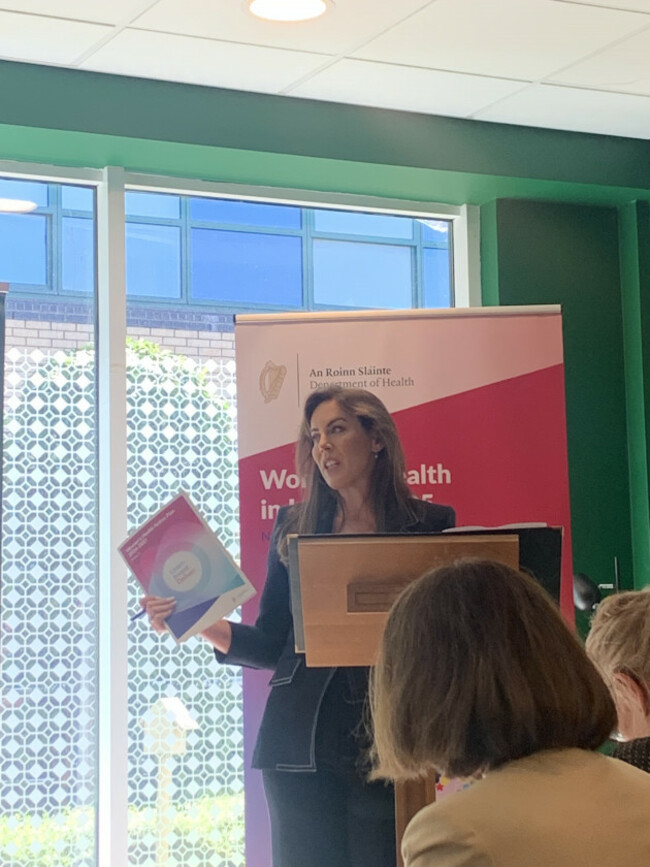
Launching the Women’s Health Action Plan 2026-2027, Jennifer Carroll MacNeill said the publicly funded assisted human reproduction service has been extended, most recently to parents who would like a sibling for their child.
“I’ve said very clearly that our next round of focus on that will be for patients with endometriosis who have really, really struggled with infertility,” she said.
Speaking to The Journal at Tallaght University Hospital today, the minister said:
“We’d like to continue to expand that as funding allows, and I think it’s really important to make a particular focus on women who are experiencing infertility because of endometriosis, because there have been so many of them, and because endometriosis has been, it’s fair to say, overlooked by the Irish health system.”
She said the condition has been overlooked for too long, and “I think it’s important that we try to rebalance that in every way that we can”.
Under the state-funded scheme, which was launched by former Health Minister Stephen Donnelly, women can get one free IVF or ICSI cycle through the HSE.
Patients must first be referred by their GP to a Regional Fertility Hub. To avail of the scheme, women must be aged between 18 and 41 years old.
The male partner must be under 60. Women must have been referred to a fertility hub before the 41st birthday, but do not need to be under that age for treatment.
Nationally, the six regional fertility hubs receive approximately 500 referrals per month for fertility assessments.
The state-funded scheme, much of which is currently outsourced to private clinics, can save couples thousands of Euros in treatment.
The Journal also asked the minister if a new saliva test for endometriosis approved for use in England and Wales will be approved for use in Ireland.
It often takes women years to be diagnosed with the condition, but the new test, which has been described as a “game-changer” has been approved for use in the GP surgery.
The National Institute for Health and Care Excellence (NICE) has approved the test on the NHS as of Tuesday.
For the new test, women give a saliva sample which is then sent off to the lab to check for biological markers that indicate the presence of endometriosis.
Describing the new test as “very exciting” and “wonderful to see”, the minister did not confirm that the test would be available for use in Ireland in the immediate future.
“The UK is doing a three-year test of its efficacy and its cost-effectiveness… we are always looking at things like that in Ireland, and of course the company has to make an application [to sell and use the test in Ireland] but we’ll be watching very keenly what happens in the UK,” she said.
The minister said she is open to all new technology that helps diagnose any condition
Improving endometriosis services to women is a key focus for the next year, said Carroll MacNeill.
Under the women’s health plan, the government will fund a ‘women’s health research programme’ through the Health Research Board with a particular focus on research on endometriosis; menstruation, and postpartum mental health with a spotlight on traumatic births.
The minister said there two endometriosis specialist centres in Tallaght Hospital and Cork University Hospital, alongside five regional hubs, stating there has been significant investment over the last five year.
Over the last 12 months, additional posts have been allocated with 65 posts to be recruited 2026 and 2027. However, the minister said women can still avail of treatment abroad, if needed, and that will continue until the Irish system can meet demand.
Carroll MacNeill said there has been a lot of silence around endometriosis, menstruation and menopause but those conversations are “becoming much more normalised”.
“I really think we have an opportunity to continue to drive ahead now for women’s health in a way that is much more balanced and reflective, the way that it should be.

The minister was also asked about the expansion of the free contraception scheme, which currently applies to women aged 17-35.
As reported by The Journal, while expanding it to older women is contained in the new action plan launched today, the minister was reluctant to give a commitment to any announcement in this year’s budget, stating “we would like to try to do everything today, and we just have to make choices between funding”.
“There is a finite amount of money, and we just have to try and get the best cost-effectiveness across the board. The contraception scheme was originally targeted at much younger women on the basis that it was less likely that they could afford [contraception]…
“We will expand as we can afford it, but we have to make those choices and trade-offs, as against all of the other things… these are the choices and balances that we have to make, and they’re real choices,” concluded Carroll MacNeill.

To embed this post, copy the code below on your site













have your say