Sign in. It’s quick, free and it’s up to you.
An account is an optional way to support the work we do. Find out more.
Sign in. It’s quick, free and it’s up to you.
An account is an optional way to support the work we do. Find out more.
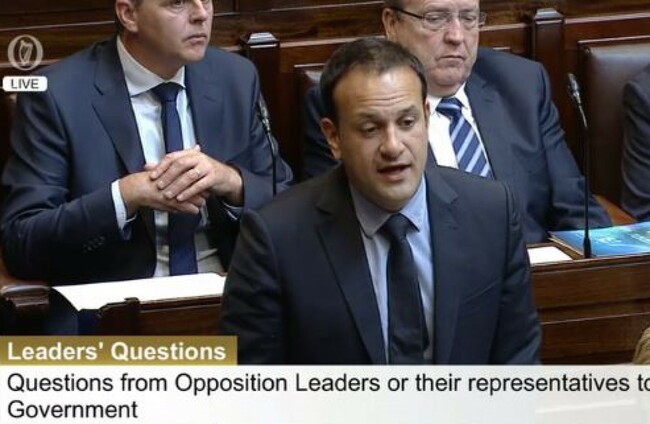
TDs are wrapping up the last of their business before they head on their summer break this Friday.
Taoiseach Leo Varadkar took his last round of Leaders’ Questions this afternoon before the break.
Here’s how it went…
Leaders’ Questions proved to be fairly mundane yesterday, with no major debates breaking out.
Sinn Féin’s Mary Lou McDonald questioned Varadkar on the provision of home care grants.
McDonald today told the chamber of the story of Olivia Harte, a 41-year-old mother of two.
Olivia has been on delayed discharge for the last six months as she was refused an intensive homecare grant despite medical advice saying she should be at home with 24-hour nursing care.
Here we go with today’s round…
Micheál Martin is up first.
He’s talking about the difficulties people face in rural Ireland when it comes to broadband connection.
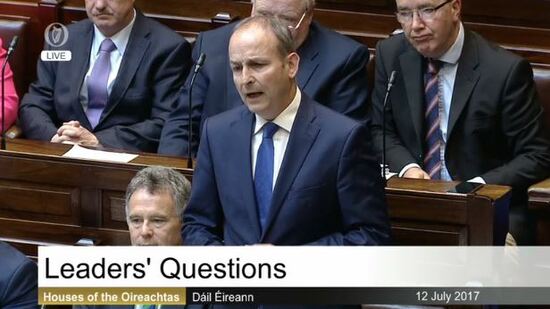
He tells Taoiseach Varadkar that Eir needs to be far more transparent.
He asks Varadkar why the Government won’t give a date to when rural Ireland will receive better broadband coverage.
Varadkar says we are seeing economic growth across Ireland.
“However we need to accelerate the recovery in rural Ireland,” he says.
Just over 50% of premises in Ireland have high-speed broadband, Varadkar says.
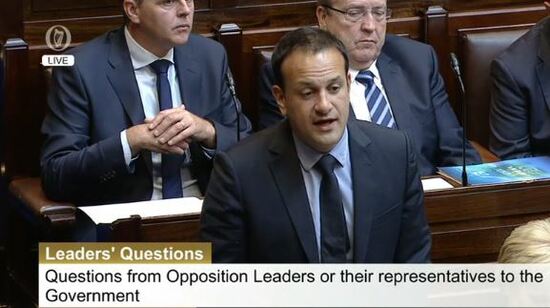
He says the government are ready to back plans to overcome difficulties in relation to broadband roll out.
Martin says the government has missed “deadline, after deadline, after deadline”.
He’s not happy with Varadkar’s response.
He doesn’t believe the government will be able to roll out a new high-speed broadband plan by next year.
It’s scandalous.
Eir is a private firm and have found premises that it can provide high-speed broadband to in rural Ireland without recourses to the taxpayer. Varadkar is welcoming this.
For the homes Eir cannot get to, Varadkar claims the government will work towards providing the services for broadband implementation.
Gerry Adams is up now.
He’s talking about Moore Street.
He’s not happy that it has never been declared a 1916 rising heritage site.
Last year, various buildings on Moore Street have been declared a ‘battlefield site’ by the High Court, forcing the government to reconsider a decision not to classify them as a national monument.
The government subsequently appealed this decision.
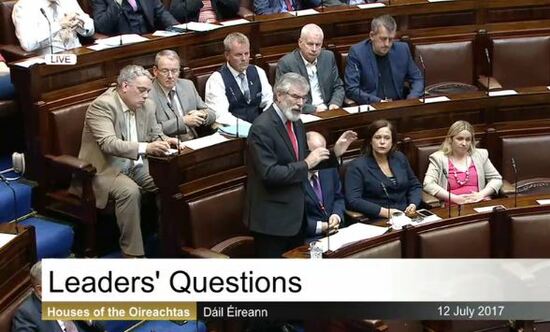
Adams is asking Taoiseach Varadkar to stop the appeal.
Varadkar says he “had the pleasure of visiting Moore Street recently”.
He says a new advisory group is to engage with stakeholders to secure an outcome that provides an agreed framework on the future of Moore Street.
He says it’s not appropriate to discuss it further because it is currently before the High Court.
Adams asks Varadkar if he had an ‘Love Actually’ moment when he walked down Moore Street.
Adams continues to grill Varadkar and asks him to drop the appeal.
Varadkar says the government is appealing the case because of the implication it could have on other heritage sites around the country.
Paul Murphy is up.
He’s talking about the Jobstown case.
He criticises Varadkar for comparing the infamous Jobstown protest in November 2014 to the book Lord of the Flies.
Speaking in the Dáil yesterday, the Fine Gael leader said that the scenes at the Jobstown protest were “ugly” and “violent”.
Things are getting heated up in the chamber.
Murphy is asking Varadkar if he accepts an independent trial needs to be had.
“You’re not the victim here,” Varadkar tells Murphy.
You were acquitted but that doesn’t mean your behaviour was right
Varadkar says Murphy’s actions were “thuggery”.
“Instead of trying to present yourself as a victim … what you should do is offer an apology,” Varadkar tells Murphy.
Varadkar tells Murphy he is being threatening.
He reiterates that he thinks Murphy owes a public apology.
Joan Collins is up now and says she supports Murphy’s call for a public inquiry.
She is talking about the housing crisis.
She asks if the Taoiseach agrees that families should spend no longer than three months in emergency accommodation, including family hubs.
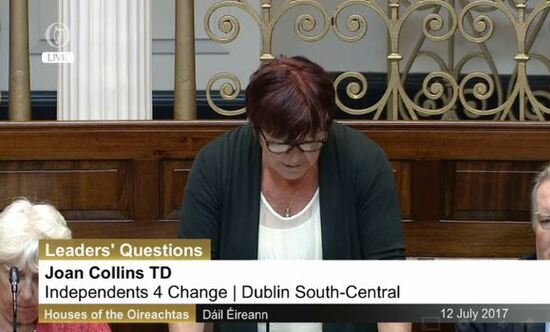
She’s referring to the Irish Human Rights and Equality Commission (IHREC) call for a change in law to ensure homeless families don’t spend long periods in group home ‘family hubs’.
IHREC released a detailed report today outlining its concerns about the new family hub model of homeless accommodation.
Varadkar says staying in B&Bs and hotels is not a suitable situation.
He says family hubs are a better option.
Family hubs are group homes for homeless families which were first announced by Government earlier this year.
The hubs are being rolled out in Dublin in order to end the widespread use of commercial hotels and B&Bs for housing homeless families.
600 social housing projects are in the pipeline, according to Varadkar.
Here’s more information about family hubs:

To embed this post, copy the code below on your site












have your say