Sign in. It’s quick, free and it’s up to you.
An account is an optional way to support the work we do. Find out more.
Sign in. It’s quick, free and it’s up to you.
An account is an optional way to support the work we do. Find out more.
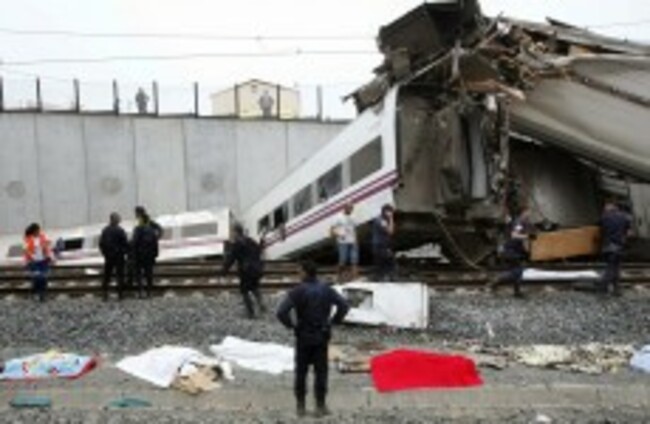
A TRAIN HURTLED off the tracks in northwest Spain killing at least 77 passengers and injuring more than 140, an official said Thursday.
Four carriages overturned in the smash late Wednesday, smoke billowing from the wreckage, as bodies were lain out under blankets along the tracks.
The wagons piled into each other and folded up like an accordion. One was ripped apart by the force of the crash, one of its ends pushed up into the air.
Several witnesses spoke of a loud explosion.
“I was at home and I heard something like a clap of thunder, It was very loud and there was lots of smoke,” said 62-year-old Maria Teresa Ramos, who lived just metres from where the accident happened.
The accident happened at 8.42pm as the train carrying 218 passengers and four staff was about to enter Santiago de Compostela station in the northwestern region of Galicia.
Rescue workers recovered 73 bodies from the train’s wreckage and four more victims died later in hospital, said a spokesman for the Galicia high court, increasing an earlier toll figure.
A total of 143 people were said to have various injuries.
Francisco Otero, 39, who was inside his parents’ home just beside the section of the track where the accident happened, said he “heard a huge bang. As if there had been an earthquake.”
“The first thing I saw was the body of a woman. I had never seen a corpse before. But above all what caught my attention was that there was a lot of silence, some smoke and a small fire,” he said.
“My neighbours tried to pull out people who were trapped inside the carriages with the help of pickaxes and sledgehammers and they eventually got them out with a hand saw. It was unreal.”
The train had left Madrid and was heading for the town of Ferrol as the Galicia region was preparing celebrations in honour of its patron saint James.
- AFP, 2013

To embed this post, copy the code below on your site











have your say