Sign in. It’s quick, free and it’s up to you.
An account is an optional way to support the work we do. Find out more.
Sign in. It’s quick, free and it’s up to you.
An account is an optional way to support the work we do. Find out more.
HARRIS IS RUMMAGING through his tent in the Mount Street area of Dublin city, looking for the blue card that evidences that he is an international protection applicant in Ireland.
“There is a man who has come out of the International Protection Office who is checking them, we are hoping that maybe he is going to help us,” the 21-year-old from Afghanistan explained.
He has been living in a tent for the last 30 days, as he is one of over 1,100 asylum seekers that the state has been unable to offer accommodation.
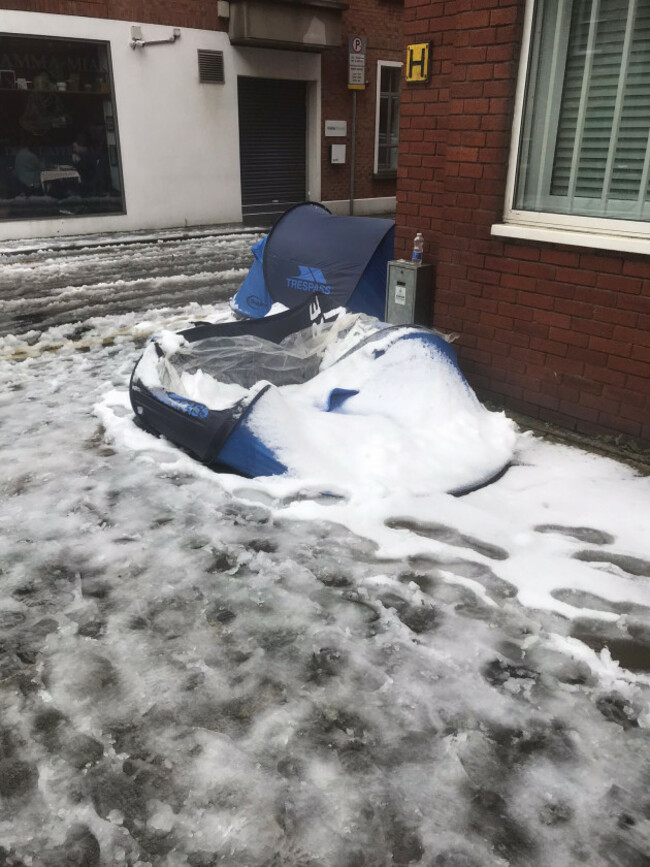
There are tens of tents housing asylum seekers on the streets nearby the International Protection Office. Since heavy snow started falling early this morning, some of the tents have collapsed, and the belongings of some people have been drenched.
“I was in my tent trying to sleep in the cold earlier, and I hear my friend shouting my name from outside “Harris, Harris!”, his tent had collapsed on him under the snow, and he was trapped inside. I did not know till then it was snowing. He is soaked, all of his things are in my tent now. He was very upset,” Harris said.
“We came here for a better life, but we have a very difficult life. I came here to flee the Taliban, you don’t understand, they are killing everybody. For example, if you don’t have a beard, your life is at risk,” the 21-year-old further said.
I have been speaking to Palestinian and Afghan asylum seekers in Dublin whose tents have collapsed in the snow. During two interviews the guys, in their early twenties, broke down in tears. People are soaked through and freezing. Report soon on @thejournal_ie pic.twitter.com/zHkgqxlIlZ
— Eimer McAuley (@eimer_mcauley) March 1, 2024
Harris said that in the last three days he has become sick: “My chest is bad, I feel like I have the flu, now I am soaked through, but I am not the only one.”
He rushes from his tent to the back of a building, where more than 50 other men are congregated, and a queue has formed.
“We have to show our blue card to the man, maybe then he will help,” Harris says.
At the end of the queue , a group of Palestinian men are standing together. They are all roughly 20 years of age (some appear to be slightly younger), and are mostly from Jenin in the north of the West Bank – an area that has been a focal point for Israeli military operations outside of Gaza.
They search for an English speaker amongst the group who can explain what they have been through, two young men called Zooz and Mohmmad step forward.
“I have not slept in three days, I cannot sleep here. Since last night, we are soaked through. My tent is collapsed, my clothes are in a puddle,” Zooz says.
“We are mostly from Jenin, some have come from Gaza. His father has died, but he cannot speak English very well,” he says, gesturing to his friend.
“Genocide, it is genocide,” the other man says.
Zooz leads the group around the corner to show some tents that have collapsed in the snow.
“The last six days have been very very hard, can you see this, ” he says, gesturing to his tent.
Zooz takes off his shoe to show that his socks are sodden with water.
Mohmmad says: “We came here to get away from the death and the war, we come here to the cold and the freezing. No one has been here today to talk to us.
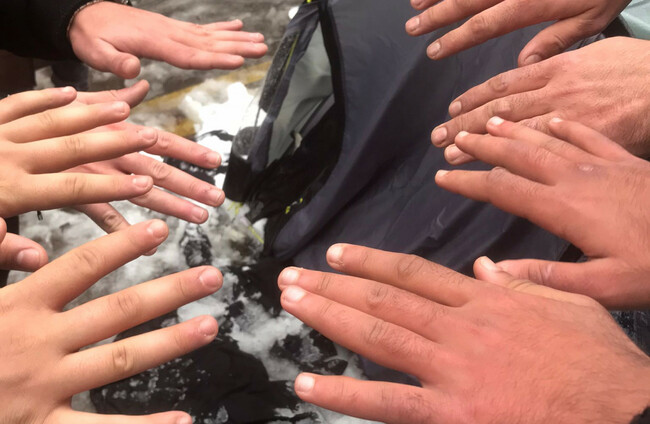
“We cannot sleep here, it is freezing,” he says, holding up his red hands.
Zooz holds up a message that he has translated into English using Google, it says: “You are people before you are citizens. Please help”.
“People need to see this, because by god, this is very hard, it is very very hard,” he says, before breaking down in tears.
Zooz’s friends place their hands on his shoulders to comfort him, and the man from Jenin who has lost his father turns away in tears too.
On the fringes of the group crowding outside the International Protection Office, there are some men who have been without accommodation for the last two months.
Eddie is one of them. “It’s tough for those who have just arrived, to be coming into this. They don’t know where to go yet, how to get through. We’ve been here longer, we’ve had other days like this,” he says.
Government response
The Irish Refugee Council today said that the conditions facing these asylum seekers are “terrible and distressing”.
“We are deeply concerned by this situation. [The] Government and Council response is completely inadequate to respond and resolve this escalating crisis,” it said in a statement.
The number of asylum seekers without accommodation in Ireland stands at 1,103, as of today.
The Irish Refugee Council has labelled the situation an “emerging humanitarian crisis”.
Asylum seekers cannot access emergency homeless accommodation in Ireland as they are dealt with in a separate system.
The Department of Integration said it was “experiencing increasing numbers of international protection applicants requiring accommodation with all efforts being made to ensure sufficient capacity is maintained for arriving families including those with children”.
In an updated statement, the Department this evening said that “due to the current extreme weather” temporary emergency accommodation
It said this “system” was a crucial part of its response to the problem in cold weather.
Dublin City Council, which operates the Dublin Regional Homeless Executive, said the remit for the accommodation of asylum seekers lies with the Department.
To embed this post, copy the code below on your site












have your say