Sign in. It’s quick, free and it’s up to you.
An account is an optional way to support the work we do. Find out more.
Sign in. It’s quick, free and it’s up to you.
An account is an optional way to support the work we do. Find out more.
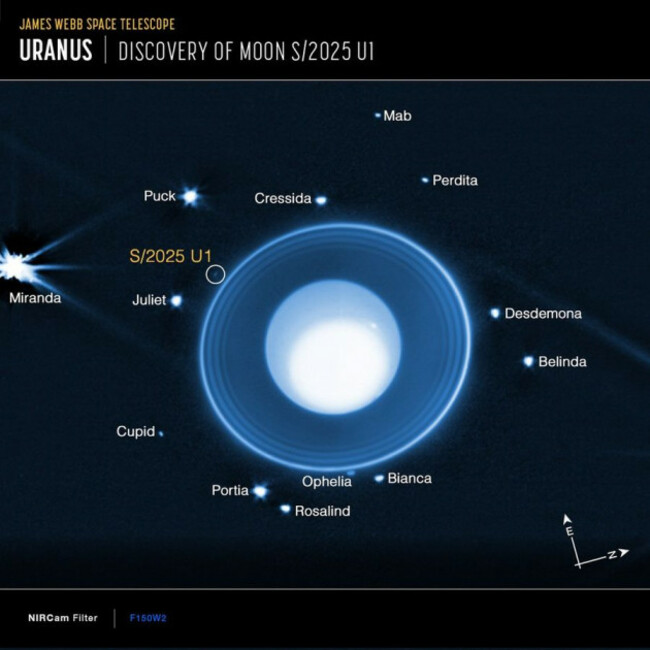
NASA HAS SPOTTED a new tiny moon orbiting Uranus using the James Webb Space Telescope.
The newly discovered moon is estimated to be just 10 kilometres in diameter.
Nasa said its ‘tiny’ size likely made it invisible to Voyager 2 spacecraft during its flyby about 40 years ago and other telescopes.
“No other planet has as many small inner moons as Uranus,” explained Matthew Tiscareno, a member of the research team.
“Their complex inter-relationships with the rings hint at a chaotic history that blurs the boundary between a ring system and a system of moons.
“Moreover, the new moon is smaller and much fainter than the smallest of the previously known inner moons, making it likely that even more complexity remains to be discovered.”
Uranus has 28 known moons that are named after characters from Shakespeare and Alexander Pope.
About half are smaller and orbit the planet at closer range.
This newest addition, still nameless, ups the planet’s total moon count to 29.
A name for the newly found moon, located about 56,000 kilometres from Uranus’ centre, will need to be approved by the International Astronomical Union, the leading authority in assigning official names and designations to astronomical objects.
Maryame El Moutamid, lead scientist at the Southwest Research Institute, said the discovery of this moon “underscores how modern astronomy continues to build upon the legacy of missions like Voyager 2, which flew past Uranus on 24 January, 1986, and gave humanity its first close-up look at this mysterious world”.
“Now, nearly four decades later, the James Webb Space Telescope is pushing that frontier even farther.”

To embed this post, copy the code below on your site















have your say