Sign in. It’s quick, free and it’s up to you.
An account is an optional way to support the work we do. Find out more.
Sign in. It’s quick, free and it’s up to you.
An account is an optional way to support the work we do. Find out more.
FOUR OUT OF every five artists who applied for the government’s Basic Income for the Arts scheme will miss out on funding, according to the Department of Culture.
The Basic Income for the Arts (BIA) scheme was approved by the cabinet earlier this year.
It provides for 2,000 applicants to receive €325 per week for three years to mitigate the inconsistent financial nature of the arts.
The scheme operates in three-year cycles with artists being eligible for every three out of six years.
Payments will be made monthly at a rate of €1,413.21.
The first tranche of 750 successful applicants will be notified this week.
In a statement today the Department of culture announced that it had received over 10,000 applications for the scheme.
However, only 2,000 applicants were successful.
That means approximately four in every five applicants will miss out on the €325 weekly payment.
The scheme uses random selection followed by eligibility checks.
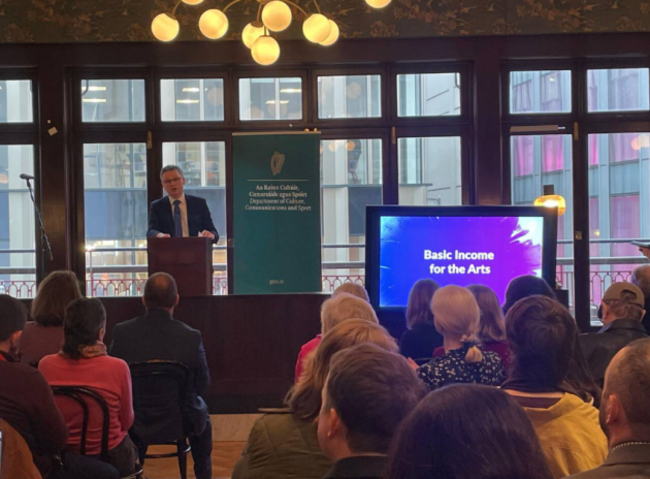
Speaking ahead of the roll-out, Minister for Culture Patrick O’Donovan said, “The arts are fundamental to our lives in Ireland where we have a deep love of storytelling in all its forms, a deep love of music.
“My number one objective in the recent Budget Estimates process was to ensure that this scheme was fully funded for 2027, and I am delighted that the first group of successful candidates, up to 750 of them, will be notified this week.”
O’Donovan maintained that the Basic Income for the Arts is “a game changer, and now it is here to stay.”
In response to Budget 2027, the national campaign for the arts said the scheme’s “impact is transformative, but its reach is small.”
“Without adequate support for the infrastructure of the sector, this investment in artists is undermined. Sustained and appropriate funding for the Arts Council is an essential means of supporting artists, arts workers and arts organisations”, it added.
To embed this post, copy the code below on your site











have your say