Sign in. It’s quick, free and it’s up to you.
An account is an optional way to support the work we do. Find out more.
Sign in. It’s quick, free and it’s up to you.
An account is an optional way to support the work we do. Find out more.

I AM A public servant, a teacher, and I will be on strike tomorrow. Like many of my colleagues, I’m doing so reluctantly.
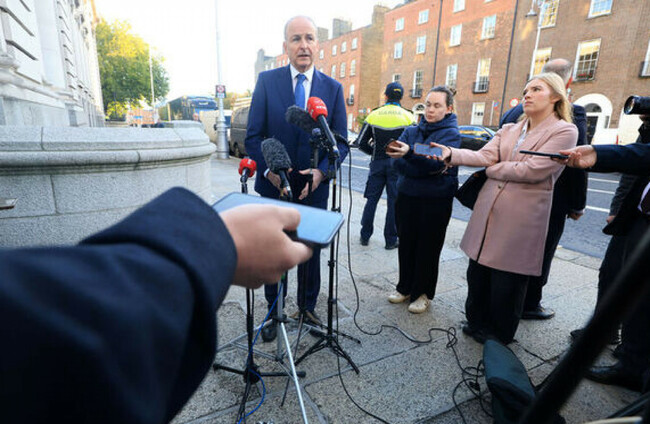
This is why I found Taoiseach Micheál Martin’s suggestion in recent days that public servants seem to want industrial action, no matter what happens, to be extraordinarily unfortunate and inflammatory.
The last nationwide public service strike on anything like this scale was in November 2009, when Ireland was in the depths of the worst financial crisis in its modern history. That’s almost 17 years ago. Hardly the record of a workforce itching to get out on the picket line at every opportunity, Taoiseach, is it?
I was equally incensed when I heard Mary Hanafin on with Brendan O’Connor on RTÉ as a former government minister lecturing teachers about whether we have considered the implications of strike action for the “ordinary people” of this country.
As though we ourselves are not ordinary people. As though teachers and SNAs are some entirely separate class of citizen, immune to the cost of living, the pressures of raising families, paying mortgages, managing childcare and trying to make ends meet. As though we don’t have children in schools ourselves, or families who will be affected by this industrial action.
And coming from a former teacher, no less. Someone who should understand precisely how seriously people in education take their responsibilities, and how reluctant they are to disrupt the lives of the children and families they work with every single day. The suggestion that public servants are somehow separate from the public is as insulting as it is revealing. We are the ordinary people of this country. We live in the same communities, pay the same bills and face the same pressures as everyone else.
Industrial action is supposed to be disruptive. It is a messy business, but that is rather the point. Nobody wants to be doing this. But the idea that we should be shamed into silence by people who once held the very reins of power to improve the conditions in which we work is absolutely galling.
I’m completely committed to my job, and love being a teacher. I have had a varied career in education, and I know there are other things I could do, some of which would pay double or even triple what I earn now. But I’m delighted to be where I am. I love the work, love the children, and for all its challenges, teaching gives me enormous personal and professional satisfaction. I am also good at it.
However, none of that means I should be expected to accept my salary being worth less and less every year. Happiness and fulfilment don’t pay a bill.
So yes, I feel the need to explain this week’s strike, because not everyone gets ‘the why’ of it all. And that’s understandable. So let me give the context of being a real person in the real world as to why I feel this strike action is justified. Some of my colleagues may feel frustrated that people like me write pieces like this because there’s a sense we have already justified this action enough, that this just must be done. However, reading and listening to the usual coverage on radio on Sunday, something jumped out at me.
In the vox pops, the public seemed remarkably understanding about the industrial action (even about schools, and teachers!). But the media take, and that of whichever conservative commentator they’ve chosen on the day, seemed to have lost sight of one simple fact: public servants are workers. Ordinary workers, with ordinary bills, who happen to be employed by the State.
We’re not suggesting that every private sector worker is now ‘rolling in it’ with pay rises in the cost of living crisis, not at all. But when someone in the private sector looks for a pay rise, they have the autonomy, they go to a manager, they have a voice… and we tend to call them ambitious for it. They know their worth. They’re backing themselves and taking responsibility for their financial future. Fair play to them.
But public servants must act collectively, that’s the system they’re in, there is no autonomy. So when they look for better pay, and are eventually pushed to industrial action because talks on the next agreement haven’t even been properly set up, suddenly we’re selfish, inconsiderate and completely unreasonable.
Last week, the CSO confirmed that inflation hit 4.1% in September. Housing, energy and related costs rose by 9.5% over the year, and transport went up by 7.5%. Put simply, our public sector pay is not keeping pace. We’re asking not to be worse off. Nobody is getting rich here.
The ongoing cost of living crisis hits us as hard as anyone else, and it doesn’t hurt any less because our employer is the government. I’m also losing a day’s pay for every day I strike. I don’t want to lose that money, nobody does. But I’m willing to lose it if it helps get a new agreement over the line.
Right now we have no public service pay agreement at all. The last one expired at the end of June. It’s now October. That’s three months past its expiry, with no successor agreement and no agreed schedule of future increases. Would you let your employer ghost you like that without response? Of course, you wouldn’t. We’re striking because those pay talks have been allowed to drift this far. That is on the government, whether it was an intentional approach or they were just sleepwalking. It’s their move, now.
There will be those who think public servants should just be grateful for secure jobs and “good pensions” and deal with our inability to climb financially. I am grateful for my job. I’m grateful to have a career I enjoy. But gratitude is no substitute for collective bargaining, and long-term job security doesn’t pay the electricity bill. I am also still on a temporary contract, and therefore don’t enjoy the so-called security of others. That’s four academic degrees in, by the way. Still temporary, and my time in academia isn’t reflected in my pay scale.
We also know tomorrow’s action (and indeed, potential future picket days) will inconvenience people. Of course, it will. I too am a mother, and yes I am also inconvenienced. I will be paying for a childminder for the full day tomorrow (bar the time she herself is striking, as an SNA). Schools will close, appointments will be put back, and people who rely on public services will feel it. I am sorry about that. Nobody wants this. No public sector worker actively seeks to bring this disruption.
We are the ordinary. We’re parents, patients, carers, mortgage holders and taxpayers too. We’re all of those things, we just happen to work for the government. So I would urge you to support us tomorrow, to help us earn a wage that allows us to live in this country.
I’d much rather be teaching tomorrow. I really would. But I can love my job, be deeply committed to the people I serve, and still understand that my work has a financial value that deserves protecting. I am not a martyr. The days of jobs as a vocation are over. We’ve earned the right to be valued by our employers.
Striking will cost me money. Doing nothing could cost me far more over the course of my working life. And that is why I’ll be on the picket line.
Ciara Reilly is a teacher living in Dublin. More on Ciara’s Substack.
To embed this post, copy the code below on your site















have your say