Sign in. It’s quick, free and it’s up to you.
An account is an optional way to support the work we do. Find out more.
Sign in. It’s quick, free and it’s up to you.
An account is an optional way to support the work we do. Find out more.

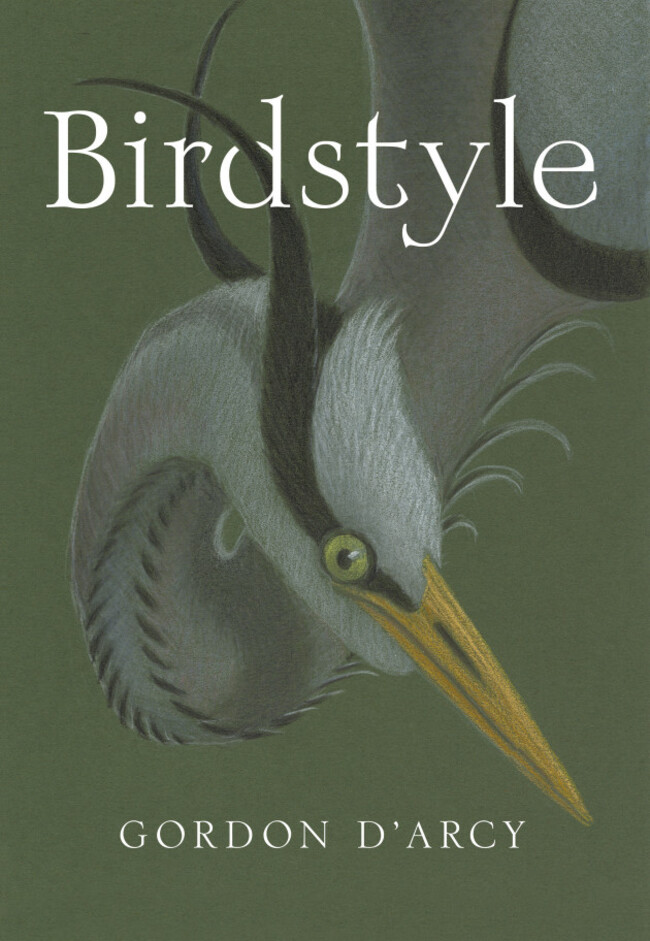
‘Birdstyle’ is a new book by Irish environmental artist, author and educator, Gordon D’Arcy. It presents the details of 100 familiar Irish birds, combining D’Arcy’s knowledge of science with his art.
Each bird is presented, curated and celebrated with imagination and flair. Birdstyle is D’Arcy’s tribute to the beautiful nature on display in Ireland.
The book is nominated for Best Irish-Published Book, a category sponsored by The Journal in the An Post Irish Book Awards. Here is the foreword by Fintan O ‘Toole and the introduction by D’Arcy himself…
WE ARE USED to thinking of survival and wonder as opposites. Survival engages our most basic instincts; wonder is animated by our highest aspirations. And yet we are at a point in our evolution where we cannot survive without wonder. If we lose our sense of the extraordinary, our capacity to be amazed and uplifted by the natural world we are so blessed to inhabit, we will fail to preserve our own life-support systems.
Birds have always been seen in diverse cultures as mediators between the ordinary and the extraordinary, the natural and the supernatural. They are always with us, always within earshot and eyeline. Yet they are also elusive and mysterious. They rise above and beyond the mundane. They come and go according to their own rhythms and drives.
Gordon D’Arcy has been paying very close attention to bird life for over 60 years, using the double lenses of science and art.
He brings to bear a rigorous precision of observation and understanding but matches it with the imaginative and creative power of his artwork. His work is testament to the way nature and culture do not have to be in opposition to each other but can be encompassed in a single vision. He both captures the facts of the living world and celebrates their mystery.
Birdstyle is a delightful bringing-together of Gordon D’Arcy’s deep experience as a
naturalist and ornithologist with his ingenuity as both a visual and a verbal artist. He gives us 112 birds, not as specimens or objects but as varieties of life itself, each one situated with vibrant succinctness within its own particular mode of inhabiting its environment, and each also evoked as a source of inspiration.
He gets his impressions, sharpened by decades of scrutiny and insight, down on the page but then lets them leap off the page into the reader’s imagination. These birds come alive and lift us into the realms of air when we can breathe in the wonder of what is around us.
Birdstyle differs intrinsically from other bird books. It is not an identification guide, an ornithological manual or a natural history, though it contains elements of all three. In juxtaposing natural science with imaginative art, this book seeks to break the mould.
Since early childhood, I have been fascinated with birds. I was known as ‘Birdy’ at school, all matters ornithological being referred to me. It came as quite a surprise that not everyone was likewise besotted. Like birdwatching, my preoccupation with drawing and art started in childhood. My first illustrated article about birds was published in 1961, in the school magazine.
Bird books have had many iterations down the years. Birdstyle came about through the unique combination of all these influences, and in particular the oeuvre of American bird artist John James Audubon and the nature poetry of Gerard Manley Hopkins. In juxtaposing natural science with a reversion to the bird art of old, Birdstyle features 112 Irish birds from a wider cohort, chosen specifically for their familiarity and their artistic suitability.
They are portrayed according to lifestyle, highlighting aspects such as habitat preference, breeding and migration, and illustrated, realistically, with an ink-and-wash vignette. The stylised art depiction, created using coloured pencil and oil pastel on tinted paper, is accompanied by a five-line free verse designed to encapsulate the intrinsic character or ‘jizz’ of each bird.
After seven decades of ‘birding’, I am not actually sure where I stand in my relationship with the avian world. Perhaps this book is a manifestation of the healthy ongoing struggle between the rivalrous expressions of art and science, or even of an indication of something that is beyond expression?
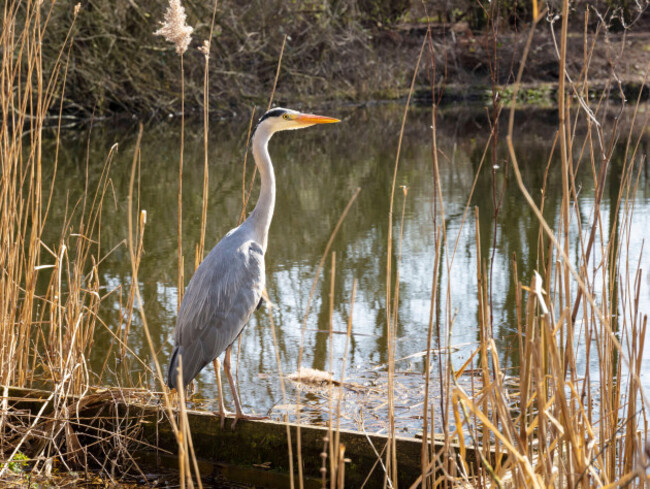
One of our largest and most distinctive birds, the Grey Heron needs no introduction. It is most often seen standing motionless at the water’s edge or flying with ponderous wingbeats and tucked-in neck over a wetland.
When in pursuit of food – mainly fish but also frogs and even young birds – it is invariably alone, relying on stillness and stealth.
Surprisingly, herons nest colonially, usually on the tops of high trees, though occasionally low down on islands.
The stick nest is a large, untidy affair. The four or five eggs are laid early (usually in February) and the chicks stay in the nest for several weeks. Quaint-looking creatures with professorial head tufts, the young are noisy and demanding, constantly clattering their beaks for attention.
The adult is predominantly grey on the upper parts and white on the head, neck and underparts. It is beautifully marked with black ‘stitching’ down the front of the neck and has black patches on the flanks. A black stripe behind the eye terminates in a wispy plume. Other plumes decorate the base of the neck and the back. The dagger-shaped beak is bright yellow and the legs are brownish. The young Heron is greyish overall and lacks the black markings of the adult.
The solitary behaviour of the Heron has spawned a rich folklore. Its monikers include Joany or Nan of the Bog, and in Irish Judy fhada. It is also widely known as ‘crane’, an even taller grey bird that became extinct in Ireland several centuries ago.
Birdstyle, written by Gordon D’Arcy, is nominated for Best Irish-Published Book, a category sponsored by The Journal in the An Post Irish Book Awards 2026.
To embed this post, copy the code below on your site












have your say