Sign in. It’s quick, free and it’s up to you.
An account is an optional way to support the work we do. Find out more.
Sign in. It’s quick, free and it’s up to you.
An account is an optional way to support the work we do. Find out more.

IRISH CONSUMER SENTIMENT suffered a substantial fall in March, reaching its weakest level in three years.
A survey by the Irish League of Credit Unions between 4 and 17 March paints a picture of a nervous Irish consumer whose thinking has become materially more negative.
With motor fuel and heating oil rising rapidly through the March 2026 survey period and global developments suggesting the prospect of substantial increases in electricity and gas prices, Irish consumers appear to be bracing themselves for a major hit to their spending power as 2026 progresses.
In turn, these threats of expensive energy and the spillover from this into higher prices in most other areas, coupled with the risk of a notable hit to Irish economic growth, meant Irish consumers became altogether more cautious in their spending plans in March.
In March, a consumer sentiment rating of 56.7 was well below the thirty-year survey average of 83.4. It was also lower than the latest five-year average of 66.1, a period of significant geopolitical shocks.
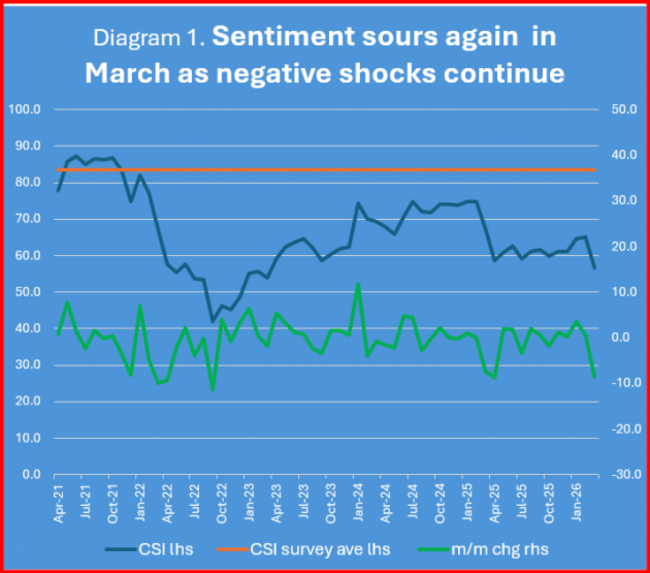
The weakest element of the sentiment survey in March was buying plans, suggesting a notably more cautious and constrained approach to consumer spending in coming months.
The month-on-month decline in Irish consumer confidence is the largest since that seen in April 2025, when the announcement of far-reaching US trade tariffs suggested a markedly poorer outlook for the Irish economy.
The report’s author, economist Austin Hughes, said that we are likely to see a clear slowdown rather than a complete stop in Irish consumer spending if energy prices remain elevated and the current temporary government supports are withdrawn.
The full picture will only become clear as the autumn months roll in and heating becomes a much more important element in household spending.
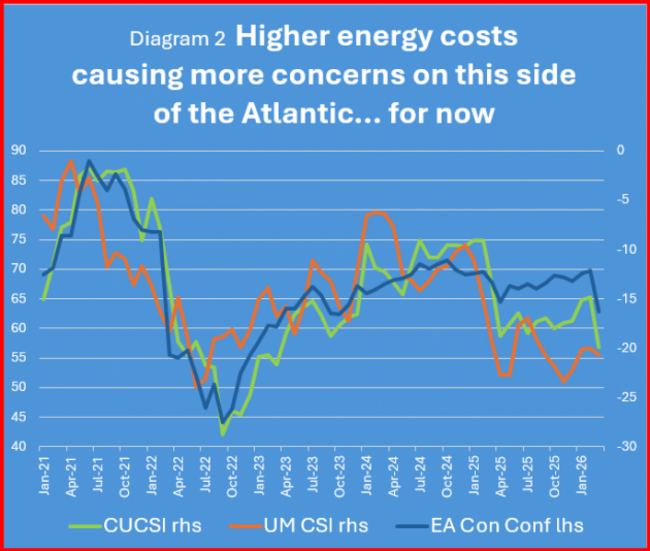
Given that official forecasts prior to the attack on Iran had envisaged Irish consumer spending increasing by a little over 2% per annum in coming years, the survey shows that there is a significant prospect of a marked weakening in the trajectory of Irish consumer spending as 2026 develops unless the recent rise in energy costs is completely reversed.
Hughes said the Irish economy has proven remarkably resilient in recent years in the face of a range of adverse shocks.
That might suggest a healthy capacity to cope with the latest energy shock and the report’s authors suggested this may inform some forecasts, suggesting relatively limited fallout from recent developments in the Middle East.
However, Hughes said continuing restrictions on shipping through the Strait of Hormuz pose a serious risk to economic activity and prices.
To embed this post, copy the code below on your site











have your say