Sign in. It’s quick, free and it’s up to you.
An account is an optional way to support the work we do. Find out more.
Sign in. It’s quick, free and it’s up to you.
An account is an optional way to support the work we do. Find out more.
AN IRISH FACEBOOK account has claimed that a leaflet has been circulated in schools here encouraging children to make friends with strangers.
However, the leaflet is a hoax and the supposed pictures of it that were shared on Facebook are the same ones used in a years-old debunked claim made about leaflets at British schools.
In other words, the same false claim had circulated about England before being recycled for an Irish context.
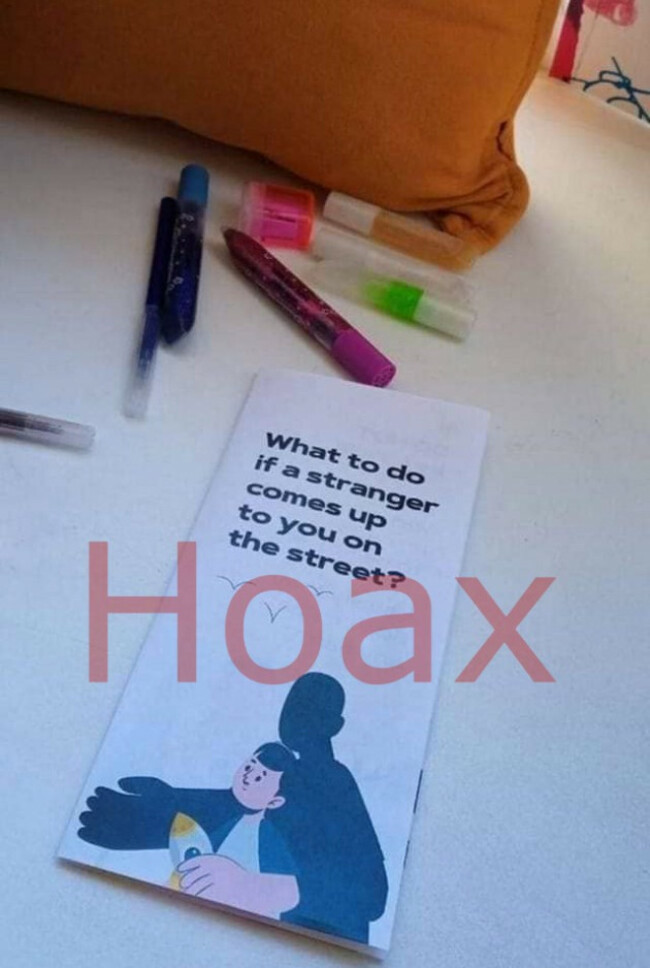
An Irish user, who regularly posts fringe content such as conspiracy theories, posted supposed photos of the leaflet, which also show a desk and colouring markers in frame, on 5 September.
“Been handed around schools,” the post reads. “PM or leave in comments if your kids /neighbours etc have been given them, areas needed to make parents aware.” [sic]
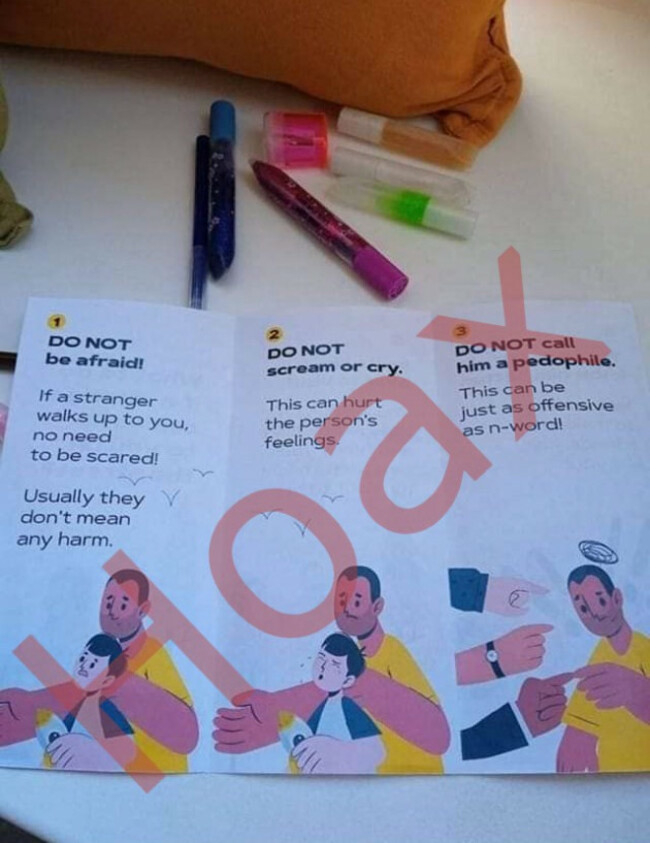
The post includes three photos of the leaflet.
“What to do if a stranger comes up to you on the street?” the leaflet’s front page reads, along with an illustration of a shadowy figure hugging a child from behind.
“Do not scream or cry,” it advises. “This can hurt the person’s feelings.”
“DO NOT call him a pedophile,” it goes on.
Instead, the leaflet encourages children to try and get to know strangers better.
However, the claim about the leaflets is old, as are the photos which accompany the Facebook post. The exact same photos, including the desk and markers, were shared on social media in the UK two years ago, alongside now-debunked claims that they were also shared outside schools there.
Ireland is not the only other country where people have made the same claim about these types of leaflets.
One post on mumsnet, a parenting message board, claims that the pamphlets, which do not contain a logo, contact details, or any other indication of who created them, were from Australia.
An American Facebook user claimed that the leaflets were being distributed to what she calls “our children” in a TikTok video.
So, where are the leaflets actually from?
The earliest known versions of the story and photos were from Russia.
Factcheckers who debunked the claim when it first spread two years ago showed that all the early appearances of the photos were on Russian sites.
A Google reverse image search to find other uses of the same pictures shows that many of the results for the photos are from still Russian news sites, blogs and social media accounts. And, on many of the Russian posts, they include an additional picture showing another page of the leaflet.
“Invite him over to visit,” the leaflet’s last page reads. “You wouldn’t believe how kind and funny your new friend might turn out to be!”
Polish factcheckers noted that the images of the leaflet spread widely after a post on Russian social media claimed that a Russian on vacation in the UK “stumbled upon” the brochures.
Long before any English-language iterations of the claims were made, the claim had been repeatedly posted on Russian sites and social media accounts.
It has also been noted that the leaflets use the US-spelling “pedophile” instead of ”Paedophile”, the more-common English spelling, indicating that the leaflet was produced outside the UK (and Ireland, for that matter).
Similarly, some of the lines are ungrammatical, including one which omits the word “the” — a common mistake in people who primarily speak a language that does not use grammatical articles, such as Russian.
One Russian news article claimed that the leaflet was evidence that the west was legalising paedophilia, just one of many common claims made both by Russian propagandists and fringe commentators in Ireland and the EU.
The Journal has previously debunked claims that Germany has decriminalised “child porn possession”; that a new Irish SPHE curriculum will show children pornography and encourage them to have sex “as young as possible”; that a UN report called to decriminalise sex ‘between adults and children’; and that the European commission had renamed pedophiles as “Minor Attracted People” in an effort to normalise child abuse.
The Journal has also debunked a different hoax leaflet, supposedly distributed in Dublin by the Irish government, telling ‘girls to stay indoors’ due to immigrants.
The Journal’s FactCheck is a signatory to the International Fact-Checking Network’s Code of Principles. You can read it here. For information on how FactCheck works, what the verdicts mean, and how you can take part, check out our Reader’s Guide here. You can read about the team of editors and reporters who work on the factchecks here.

To embed this post, copy the code below on your site










have your say