Sign in. It’s quick, free and it’s up to you.
An account is an optional way to support the work we do. Find out more.
Sign in. It’s quick, free and it’s up to you.
An account is an optional way to support the work we do. Find out more.

The Housing Essay is a new weekly deep dive from a rotating variety of voices into issues impacting the property crisis in Ireland. Are there potential solutions that may be currently overlooked or traditionally ignored by policymakers?
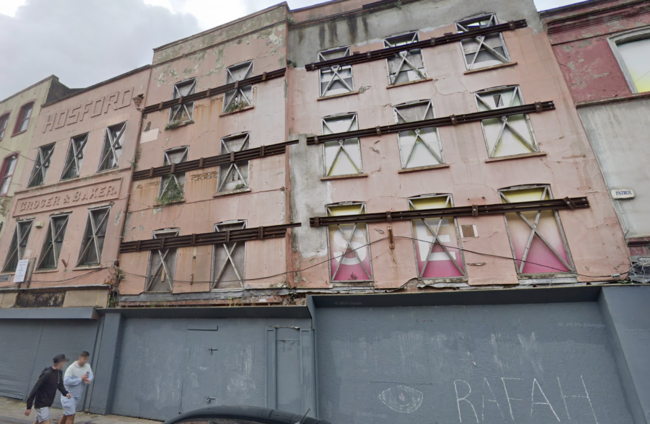
WRITING THIS FEELS like we are writing the obituary for the oldest street in Cork city. This week started with the announcement of the disgraceful demolition of four beautiful historic buildings on North Main Street. Four buildings that stood proud for 200 to 250 years, surviving the British burning of Cork in 1920, before being destroyed by greed and neglect.
Ironically at a time when Cork City is awash with wealth, we fail to value its uniqueness and its heritage value. Both of which are vital for our health, wellbeing, sense of place as well as the local economy, tourism and much more.
We should never have got to this point.
This is a story of disgusting property hoarding and deliberate vandalism of heritage, with total disregard for our beautiful city and its people, who rest, play and work here. Not only should these buildings have provided much needed homes over the last two decades, they should have also contained thriving local businesses, enhancing the local economy.
Ironically (again) these historic buildings are in an area locally know as Paradise Place, but it’s a long time since this area could be considered anything close to paradise. It is absolutely marred with vacancy and dereliction. It’s so bad that it has led to the entire area feeling less safe and attractive to live or work in, or even to visit.
This is why we chose Paradise Place as both a start or end point for at least two of the many walking tours (with a dereliction twist) we do in the city. This location is a bridge between our lost past, derelict present and future possibilities. Our next tour here will be even more depressing, not just pointing out all the empty buildings on every street radiating from Paradise Place, but also the ongoing demolition of these four.
What other European cities would allow their historic core to be deliberately vandalised like this. What should be the golden jewel in the city’s historic medieval core is an eye sore that’s putting the city on the map for all the wrong reasons, with even the New York Times featuring these buildings and the #DerelictIreland campaign in a full-page spread in 2024.
When we say all this dereliction is making the city feel unsafe, it’s important to remember that it’s also literally making the city unsafe for people walking on its the streets. Number 63 North Main Street originally collapsed in 2019 causing a gas explosion, which made its neighbouring buildings structurally dangerous, so they were demolished, aside from their facades. It’s extremely lucky no one was hurt.
After numerous minor scares with debris and rubble landing on the streets, these facades and the rest of number 65 are now at serious risk of full collapse. Because both the former owners and now the council have failed to maintain our built heritage, the only solution left is the irreversible demolition. A loss of an historic city streetscape that has defined Paradise Place for centuries.
Sadly, this is not new for Cork city. A building collapsed just up the road from Paradise Place in 1999, when a young woman was killed and eight others were injured on Washington Street. Another building collapsed just across the road on Castle Street in 2009, and then these North Main Street buildings collapsed in 2019.

Let’s repeat those dates, 1999, 2009 and 2019, are you starting to see the pattern, we’re only three years away from 2029 and unfortunately, we have not seen any changes to how the city is maintained by its property owners or governed by the council to give us confidence that we will not see another major building collapse.
Since the 2019 North Main Street collapse there have been multiple near collapses in Cork city. Tuckey Street, St Patrick’s Street, Barrack Street, twice, Marlborough Street, Pine Street and, just last month, on Cook Street, to name but a few places that needed emergency works to save them from imminent collapse.
When walking the streets of Cork, you not only have to worry about a building collapsing, but there is also a risk of debris falling onto your head from unkempt buildings. As recently as August the fire brigade were called upon again to make the Catholic Young Men’s Society Hall (again at Paradise Place) safe. Where ironically (for the third time) just a month earlier the debris that had fallen from 61 North Main Street was finally removed (a building that is also owned by some of the O’Connor Brothers). There have been so many near misses from bits falling off empty buildings in the city centre that we have ended up wearing hard hats on our tours and while doing street art.
For a city that claims to be rising, there sure is a lot falling down. What’s most depressing of all is that no lessons have been learned from this utter failure. There is still nothing stopping owners hoarding properties until they collapse, the council is still failing to fully enforce the Derelict Sites Act and the Government have delayed any meaningful policy changes to disincentivise dereliction such as the new Derelict Property Tax, which has been designed to fail.
One common trait many of these collapsing and decaying buildings have in common is a lack of use. Either the whole building is lying empty, or as is often the case on main streets all over the country, the rooms above the shop are not being used. If these rooms were used as homes, someone would very quickly notice a leak in the roof, helping to avoid long-term structural damage.
Many of the historic buildings on our main streets were originally built for living above the shop and were probably in use as homes within living lifetimes.
If they had been kept in use, we would have many more spaces for young couples to rent or even raise their families.
The challenge lies in bringing these now long-term empty rooms back into use as homes. To compensate for these challenges the government has generously brought in more free money grants ranging from €115k to €135k and a €5k advice grant, just six months ago. Time will tell how successful these grants will be.
A report last year from the Hardware Association estimate that 20,000 homes can be provided above shops. However, their survey of owners and estate agents found a shocking “22% of property owners would prefer to leave the property as is, as it is increasing in value” rather than selling it or renovating it and renting it out. When landlords are unwilling to use their buildings for the common good, we need to enact our constitutional right to social justice by bringing in ‘Use It or Lose It’ policies.
These buildings on North Main Street make a great case study if you really want to understand the challenges with ending the damaging culture and practice of #DerelictIreland, which is costing us our built heritage, traumatising generations and denying many of a much needed home. Because of the urgent need to demolish these buildings, Cork City Council will now have to cancel their current tender process to build homes here. Delaying any chance of new homes for a number of more years.
We understand that the local authorities are underfunded and have less power devolved in comparison to many of their European neighbours. But there is still so much more they could be doing with their current powers. So much, yet they chose not to, over a sustained period, which has brought us to this point.
It’s a system failure, combined with a culture of normalisation and acceptance of hoarding and dereliction. This just one of several examples of demolition by dereliction that occurs regularly across the country. In this case of North Main Street, the owners and council are responsible, they both had power to do things differently, they chose not to. They should be held accountable.
We have to stop this rot and destruction of our heritage, local economies and communities. This latest outcome is a harsh reminder we need a total shift of mindset and activity to ensure our urban areas function for everyone, not just the few.
Based on decades of working on resources and economies, we argue that we need to move to localised cooperative structures, with decentralised participatory decision-making, based on local needs, with full transparency and accountability. We live with Dóchas that this can happen. Otherwise we will continue to get more of the same, to the point there will be no heritage remaining.
Jude Sherry and Dr Frank O’Connor are founders of anois.org, ffud.art and #DerelictIreland. They are part of a series of writers, academics and economists penning a weekly essay delving into the housing crisis and potential solutions.
To embed this post, copy the code below on your site












have your say