Sign in. It’s quick, free and it’s up to you.
An account is an optional way to support the work we do. Find out more.
Sign in. It’s quick, free and it’s up to you.
An account is an optional way to support the work we do. Find out more.
MEN WORKING FOR Dublin City Council are earning around 5% more on average than women.
Employers with more than 50 employees in Ireland are required to publish their gender pay gap data and the data from Dublin City Council captures the 12-month period leading to 30 June, 2025.
In the local government sector, all employees are paid equally for work of equal value.
Dublin City Council noted that the Gender Pay Gap is not the same as equal pay.
“The Gender Pay Gap is not concerned with equal pay but looks at the percentage difference between average earnings of males and females irrespective of their role,” said a spokesperson.
Its Gender Pay Gap report found that on average, men are paid 5.13% more than women.
The average hourly rate of pay for men is €31.55 versus €30.22 for women.
The median gender pay gap meanwhile is 3.2%, with an average median hourly rate of €30.08 for men and €29.12 for women.
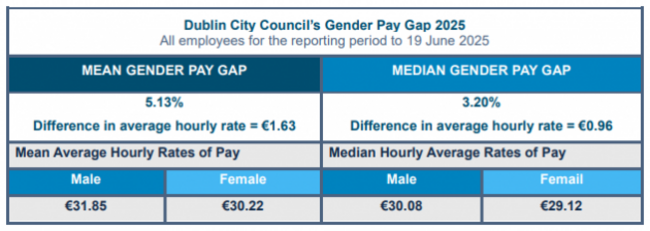
The median is the figure that falls in the middle of a range, from the lowest to the highest, and Dublin City Council said this can “provide a more accurate representation of the ‘typical’ differences in pay”.
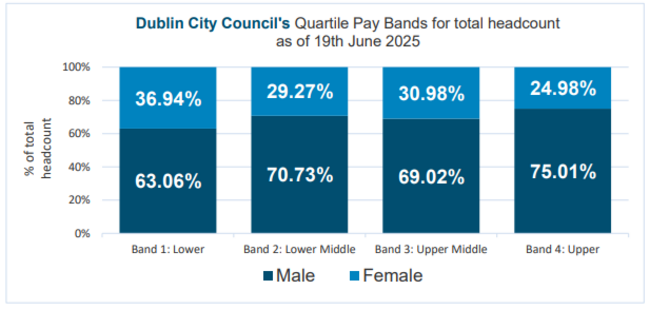
The gender breakdown of all employees in Dublin City Council as of 19 June was 70% male and 30% female.
Dublin City Council remarked that a number of factors can impact on the gender pay gap, such as occupational segregation, working patterns, and the gender breakdown of higher and lower paid roles.
For example, 75% of those in the upper pay band are men and this drops to 63% in the lowest band.
Women are also most represented in the lowest pay band and least represented in the highest pay band.
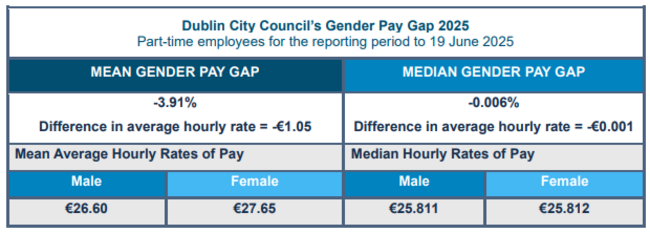
Meanwhile, when only part-time or temporary employees are accounted for, women earn more on average.
Around 10% of Dublin City Council employees are part-time and 81% of these are female.
In this instance, there is a “negative pay gap” with part-time female workers paid 3.91% more than men, though the median gap is a tiny 0.006% more than women than for men.
Dublin City Council stated that “it may be that more females than males seek part-time work or career breaks and although this does not impact on their hourly rate of pay, it may impact on choices around career progression”.
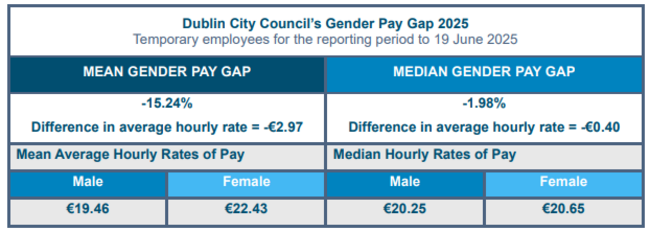
There is also a marked difference between men and women in temporary roles.
Some 4% of employees are on temporary contracts, with 67% of these being men and 33% female.
Temporary female workers are paid 15.24% more than the average temporary male worker, though the median gap is just 1.98%.
Richard Shakespeare, chief executive of Dublin City Council, remarked that the Council is “committed to providing a culture of equality of opportunity for our employees”.
“We will continue to work in this area to reduce the gap and to achieve genuine equality in the workplace, for all our employees,” he added.

To embed this post, copy the code below on your site












have your say