Sign in. It’s quick, free and it’s up to you.
An account is an optional way to support the work we do. Find out more.
Sign in. It’s quick, free and it’s up to you.
An account is an optional way to support the work we do. Find out more.
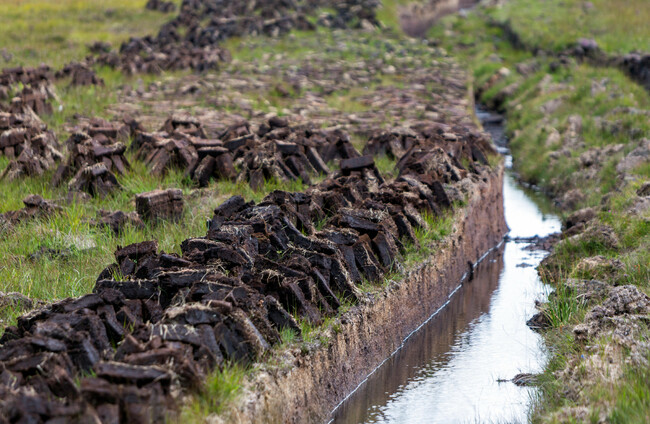
A FACEBOOK GROUP promoting the harvesting of peat as fuel to burn has made misleading claims implying that it is environmentally friendly.
In particular, posts claim that turf is not a fossil fuel, has no carbon footprint, or that it gives a “healthy heat”.
The term turf is sometimes used exclusively to refer to peat that has been cut into blocks and dried in the air, ready for burning. Extracted peat is also burnt as briquettes, which are mechanically compressed.
False claims that burning turf is healthy have been debunked in previous factchecks.
However, other claims about the environmental effects of harvesting peat appear to be gaining traction.
“Turf is not a fossil fuel” seems to have become something of a slogan, being used in multiple posts on different Facebook groups since 22 September. These posts have been shared more than 575 times.
The claim that turf has “no carbon footprint” has also been shared more than 500 times since being posted that same date in a Facebook group that promotes the use of turf.
The first claim is debatable, though most authorities categorise peat as a fossil fuel.
Peat certainly matches many common dictionary definitions for fossil fuel and the Geological Survey Ireland, Eurostat, and the Intergovernmental Panel on Climate Change all describe peat as a fossil fuel or as a source of fossil carbon.
Peat is formed from the ancient remains of organic matter, as is coal, petroleum, and natural gas. It takes about 1,000 years under the right conditions for a metre of peat to form, meaning it is not renewable in any practical sense.
In drained bogs, which are used to dig turf, peat ceases to form at all. There are ongoing government efforts to restore bogs so that they can become carbon sinks again.
Nevertheless, peat is sometimes not categorised among fossil fuels, as it is much geologically younger than other fuels such as coal and petroleum.
What is less contentious is whether burning turf has a carbon footprint. It does. Quite a significant one.
Some of this occurs before the peat is even taken from the ground. When a bog is drained, the upper layers of vegetation start to die and there is increased decomposition, releasing CO2 and other greenhouses gases.
However, 90% of the carbon emissions likely come from burning the dry peat itself.
A study using 2006 data showed that, for turf burnt in Ireland, 102.2 tonnes of CO2 were released for every Terajoule of energy created.
To put this in more human terms: a standard electric radiator on full might put out 2500–3000 watts of heat.
For turf to put out that same amount of heat, it would have to emit more than a kilogram of carbon dioxide an hour.
This is higher than the rates for coal, oil and diesel, and almost double the CO2 output of natural gas.
Peat briquettes released even more CO2, 10% more than turf.
Renewable fuels, such as wood, are also sometimes referred to as carbon-neutral.
The CO2 released by burning wood initially came from the air, but so too did it for turf, oil and coal.
Wood fuel is sometimes described as carbon-neutral when it comes from sustainable forests where the CO2 emitted by burning wood equals the CO2 extracted by the next batch of trees. However, unless the wood comes from an area that has been reforested to grow firewood, this still increases CO2 in the atmosphere until the forest regrows.
Whether you consider sustainable firewood to be carbon-neutral, the same argument used does not apply to turf, the production of which involves draining bogs and stopping the growth of new peat.
The burning of peat had been used to generate electricity in Ireland until about 2023.
SEAI stats show that this is no longer the case, and rates of peat burning have dropped to less than a sixth of what it had been in 2010.
Families who have traditionally been able to extract peat from bogs are still legally able to do so for their own personal use.
However, there are restrictions on the retail sale of turf, and there has been an effort to protect some bogs.
Bord na Móna (now branded BnM), which was originally established to help drain bogs and develop the peat industry, has shifted its focus and now encourages bog preservation and restoration.
The Journal’s FactCheck is a signatory to the International Fact-Checking Network’s Code of Principles. You can read it here. For information on how FactCheck works, what the verdicts mean, and how you can take part, check out our Reader’s Guide here. You can read about the team of editors and reporters who work on the factchecks here.

To embed this post, copy the code below on your site













have your say