Sign in. It’s quick, free and it’s up to you.
An account is an optional way to support the work we do. Find out more.
Sign in. It’s quick, free and it’s up to you.
An account is an optional way to support the work we do. Find out more.
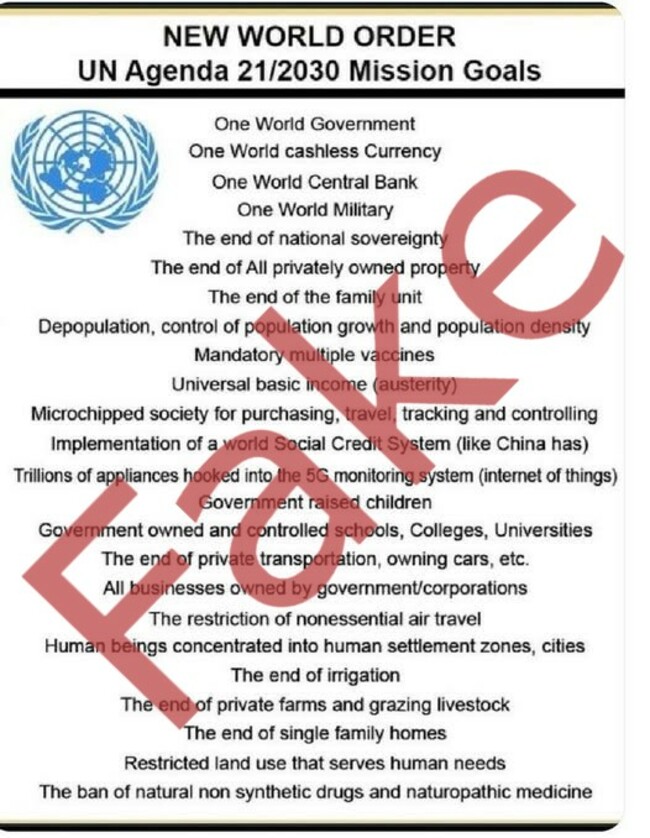
A YEARS-OLD list that purports to show the UN’s sustainable development goals for 2030 and includes items such as “the end of the family unit” and a ban on “non-synthetic drugs” continues to spread widely on the internet, despite being fake.
The list being shared online refers to the UN’s 2030 Agenda. The UN does have a plan called the 2030 Agenda for Sustainable Development, which includes 17 goals. However, the actual goals are very different from those on the fake list shared on social media.
The real list includes items such as “no poverty” and “good health and wellbeing”.
Versions of the fake list have been spread for years, with one from 2020 still being shared on social media.
Posts featuring the fake list have been posted to Facebook hundreds of times, and to Instagram scores of times, and have often been reshared thousands or tens of thousands of times.
More recently, Irish conspiracy theorist Ivor Cummins posted a version of the fake list on 26 September. His Facebook post was shared hundreds of times.
While there are minor variations in the wording of the fake lists, a typical version reads as follows:
New World Order — UN Agenda 21/2030 Mission Goals
The list goes on to mention “depopulation”, “microchipped society”, a “social credit system”, the “end of private transportation”, and a ban on “natural non-synthetic drugs and naturopathic medicine”.
None of these align with the real goals of the UN’s Agenda 21 or Agenda 2030.
UN Agenda 21 was a non-binding plan to protect the environment adopted by more than 178 governments in 1992. The 21 in the name refers to the 21st century.
The plan, along with many of the UN’s initiatives, was quickly condemned by conspiracy theorists as a sinister plot. The actual goals of the plan, which are freely available, are about combatting poverty, protecting health, and preventing deforestation.
Agenda 30 was adopted by all UN member states in 2015 and is intended to work as a “shared blueprint for peace and prosperity for people and the planet”.
These include 17 goals that countries are expected to aim to achieve by 2030, though these are not legally binding.
The full goals can be read here, and include items such as quality education, gender equality, and clean energy.
The UN is regularly the target of conspiracy theories, often in far-right groups. These have included false claims that the UN called for sex ‘between adults and children’ to be decriminalised, as well as that a secret UN army was amassing in Louth to suppress the Irish population.
The Journal’s FactCheck is a signatory to the International Fact-Checking Network’s Code of Principles. You can read it here. For information on how FactCheck works, what the verdicts mean, and how you can take part, check out our Reader’s Guide here. You can read about the team of editors and reporters who work on the factchecks here.

To embed this post, copy the code below on your site













have your say