Sign in. It’s quick, free and it’s up to you.
An account is an optional way to support the work we do. Find out more.
Sign in. It’s quick, free and it’s up to you.
An account is an optional way to support the work we do. Find out more.
AN IMAGE FEATURING three false claims about the Minister for Children Roderic O’Gorman has been shared online over the past few months.
The image claims Ireland’s ‘mainstream’ media “don’t want you to know” that O’Gorman allegedly shares Satanic images, posts admiration for Peter Tatchell and alludes to ‘map porn’ which the post says is a euphemism for pedophilia.
These claims are false and relate to other false posts sent by conspiracy theorists online since O’Gorman took up his ministerial position in June.
One Facebook post containing this particular image published on 4 July has been shared over 300 times, as of publication.
The image alleges that O’Gorman:
Let’s break down these claims one by one.
Satanic images
The first claim about ‘satanic images’ refers to a tweet O’Gorman retweeted in October last year.
This tweet has over 3,600 other retweets and 22,400 likes. It was sent by an Irish actor and comedian in which she re-enacted a painting called Saturn Devouring His Son by Spanish artist Francisco Goya.
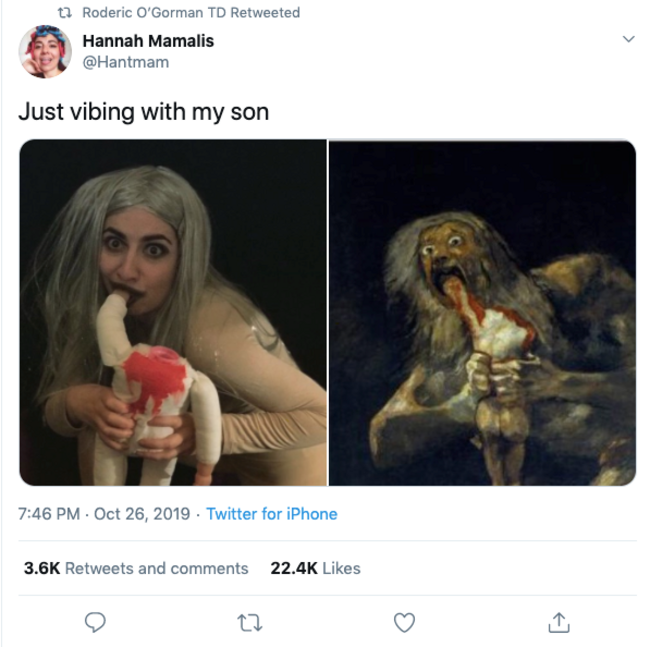
This is not a satanic image. It depicts the Greek myth of Cronus who allegedly feared he would be overthrown by one of his children, so he ate them all once they were born.
The image was painted onto the walls of the artist’s house at first before it was transferred to canvas after he died.
The tweet containing this image was focused on a person dressed in a Halloween costume based on the painting, posted on 26 October last year.
From searching the minister’s Tweets using Tweetdeck, he did retweet this image last year. However, it is misleading to say this equates to him sharing “satanic images online” when the tweet is focused on a Halloween re-enactment of a Spanish painting.
Peter Tatchell
O’Gorman has already spoken out against “homophobic” posts online linking him to the views of Peter Tatchell.
Tatchell, who has been a human rights and LGBT rights campaigner since the 1970s, has been criticised for a 1997 letter to the Guardian newspaper about sex between adults and children.
In a statement posted on Twitter in July, O’Gorman said he would not allow the claims linking him to Tatchell to stand uncorrected, saying they were “rooted in homophobia, stoked by anonymous, far-right Twitter accounts”.
“I knew of [Tatchell] as someone who stood up for LGBT people in countries where their rights were threatened. I was surprised to read some quotes from the 90s, which I had not read before,” O’Gorman said.
“Any of those views would be completely abhorrent to me. I’m glad to see he’s clarified and explained that what is being alleged isn’t his view.”
O’Gorman was photographed with Tatchell at Dublin’s Pride festival in 2018.
Numerous social media posts online made claims about O’Gorman and a protest was held outside the Dáil calling for his resignation from the ministerial position.
Aside from the picture, there is no evidence on O’Gorman’s Twitter or Facebook page of liking to “gush admiration” for Tatchell.
Map porn
Lastly, the ‘map porn’ aspect of this claim appears to refer to a tweet sent by the minister in 2017.
In this, O’Gorman says ‘map porn’ referring to an image of an intricate looking map shared by a Twitter user.
Terms including ‘porn’ at the end such as ‘food porn’ are commonly used online to refer to extravagant or interesting things.
However, this image claims O’Gorman was actually alluding to an acronym of ‘minor attracted person’.
This is is not an “LGBT acronym” as the post claims.
According to the BBC, the term is used by some people who dislike the word pedophile.
The minister’s tweet in which he uses the word ‘map’ is referring to a colourful map showcasing CSO data about workplaces in Ireland.
Therefore, it is misleading to say the minister was using this acronym when his tweet was related to a colourful, literal map of Ireland.
********
There is a lot of false news and scaremongering being spread in Ireland at the moment about coronavirus. Here are some practical ways for you to assess whether the messages that you’re seeing – especially on WhatsApp – are true or not.
STOP, THINK AND CHECK
Look at where it’s coming from. Is it someone you know? Do they have a source for the information (e.g. the HSE website) or are they just saying that the information comes from someone they know? A lot of the false news being spread right now is from people claiming that messages from ‘a friend’ of theirs. Have a look yourself – do a quick Google search and see if the information is being reported elsewhere.
Secondly, get the whole story, not just a headline. A lot of these messages have got vague information (“all the doctors at this hospital are panicking”) and don’t mention specific details. This is often – but not always a sign – that it may not be accurate.
Finally, see how you feel after reading it. A lot of these false messages are designed to make people feel panicked. They’re deliberately manipulating your feelings to make you more likely to share it. If you feel panicked after reading something, check it out and see if it really is true.
TheJournal.ie’s FactCheck is a signatory to the International Fact-Checking Network’s Code of Principles. You can read it here. For information on how FactCheck works, what the verdicts mean, and how you can take part, check out our Reader’s Guide here. You can read about the team of editors and reporters who work on the factchecks here
Have you gotten a message on WhatsApp or Facebook or Twitter about coronavirus that you’re not sure about and want us to check it out? Message or mail us and we’ll look into debunking it. WhatsApp: 085 221 4696 or Email: answers@thejournal.ie

To embed this post, copy the code below on your site














have your say