Sign in. It’s quick, free and it’s up to you.
An account is an optional way to support the work we do. Find out more.
Sign in. It’s quick, free and it’s up to you.
An account is an optional way to support the work we do. Find out more.
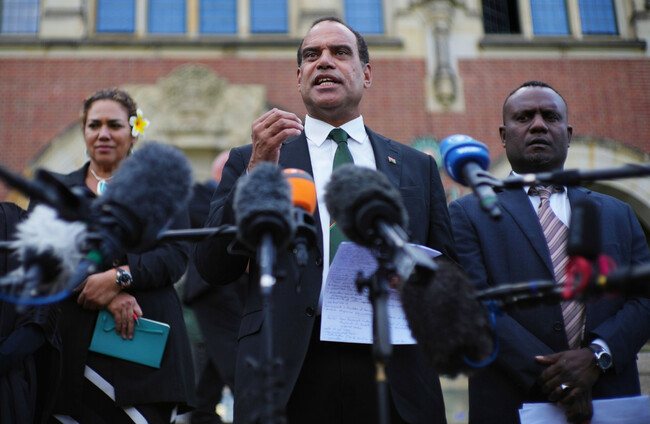
COUNTRIES RESPONSIBLE FOR causing harms linked to climate change could be held legally accountable for paying reparations, according to a landmark statement by the highest court of the United Nations.
As people and places around the world have been hit by more and more impacts of the escalating climate crisis in recent years, the judges of the International Court of Justice have been working on the largest case the court has ever handled.
What responsibility do countries bear for actions – or failures-to-act – that contribute to climate change? And what legal consequences can they face for harm that occurs as a result?
Those were the questions put to the court two years ago by the United Nations General Assembly. Since then, climate activists have been waiting to hear the ICJ set out its legal opinion, which could hold huge influence over how future cases taken against big emitters and polluters play out in courts.
Releasing its highly anticipated conclusion from its seat The Hague this afternoon, the ICJ declared that states have a legal responsibility to fight climate change.
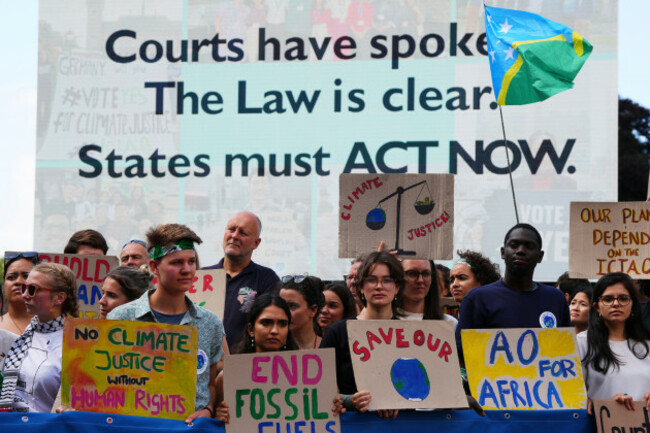
Delivering the court’s legal opinion – a 140-page document – ICJ President Yuji Iwasawa said the earth’s climate system is an “integral and vitally important part of the environment” and that it “must be protected for present and future generations”.
He outlined that climate change is an “urgent and existential threat” and described its consequences as “severe and far-reaching”, with effects for “both natural ecosystems and human populations”.
The court unanimously found that countries have a duty to prevent significant harm to the environment by acting with “due diligence” and using all means at their disposal to prevent activities in their jurisdiction that could cause harm to the climate or environment.
Additionally, countries have a duty to co-operate with each other in good faith to prevent climate or environmental harm.
Really significant legal opinion set out by the International Court of Justice this afternoon on countries' climate obligations
— Lauren Boland (@laurenanna_1) July 23, 2025
Full doc is here: https://t.co/RWIkq1N2Cz
And here are the conclusions: https://t.co/wkr09rnY74 pic.twitter.com/18j7HWObNi
The court was also unanimously of the opinion that a breach by a State of those obligations constitutes an “internationally wrongful act”.
The legal consequences of committing an internationally wrongful act may include obligations to end that wrongful act, to provide guarantees it would not be repeated, and to make “full reparation to injured States in the form of restitution, compensation and satisfaction”.
Cases would need to prove that the damage was “factually and legally” caused by the State in question.
One example of an internationally wrongful act in the court’s opinion may be the failure of a State to take appropriate action to protect the climate system from greenhouse gas emissions, including through fossil fuel production, fossil fuel consumption, the granting of fossil fuel exploration licences or the provision of fossil fuel subsidies.
The court also affirmed that having a clean, healthy and sustainable environment is a human right – and that not only is it a right in itself, but it is one that is essential in order for other human rights to be fulfilled.

The court’s opinion will have implications for future court cases taken against climate polluters, providing a basis for climate justice activists or people adversely impacted by climate change to try to hold those responsible to account, as well as potentially closing some previous legal loopholes.
The case has been the largest ever handled by the ICJ; it involved judges reading tens of thousands of pages of submissions made by countries and organisations from around the world and referring to dozens of international laws, treaties and agreements that have a stake in human rights, climate and nature.
The United Nations General Assembly had asked the ICJ to set out its legal opinion on two key questions:
The types of harm referred to in the second question related to present and future generations of people and to countries – especially small island developing states – that are especially impacted by climate change.
The process of calling for the ICJ to give a legal opinion on the questions was led by Vanuatu, an island nation in the Pacific Ocean that is roughly the same size as Cork and Kerry put together.
Vanuatu is one of several Pacific island nations on the frontline of the climate crisis. As rising sea levels eat away at its shoreline, it pushed for the United Nations to seek the ICJ’s opinion.
Vanuatu’s climate change minister Ralph Regenvanu said that the court’s opinion was a “landmark milestone for climate action”.

To embed this post, copy the code below on your site













have your say