Sign in. It’s quick, free and it’s up to you.
An account is an optional way to support the work we do. Find out more.
Sign in. It’s quick, free and it’s up to you.
An account is an optional way to support the work we do. Find out more.

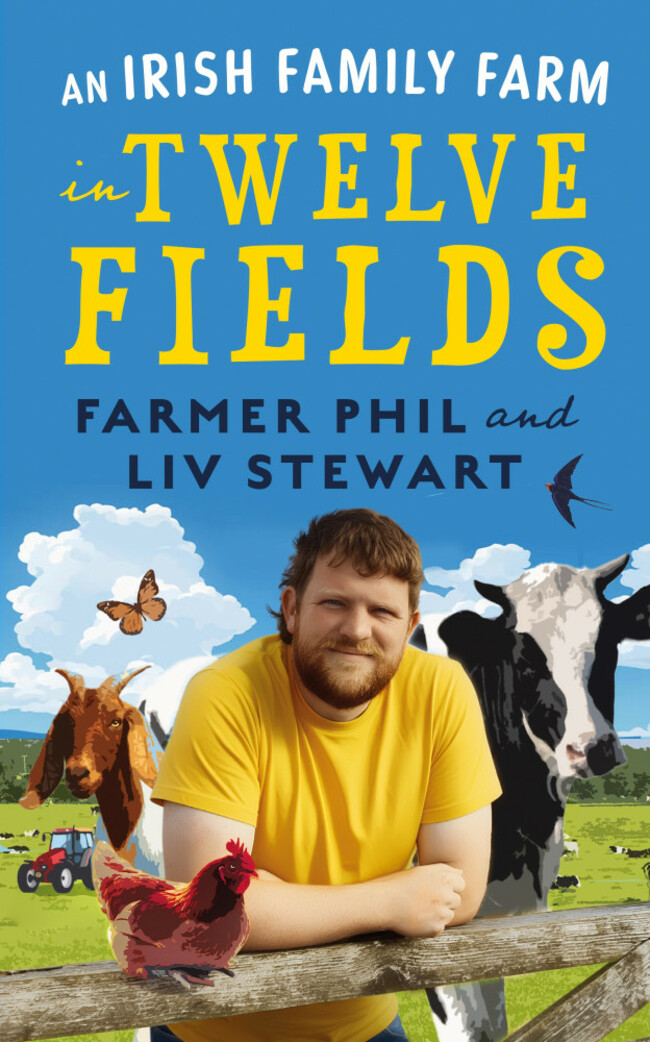
Every field has a story. For the Stewart family, who have farmed their Co Longford land since 1938, 12 fields, from Julia’s Bottoms to the Big Field, reveal the characters, history and daily dramas of a working family farm.
Their new book offers a glimpse into the life of Farmers Phil and Liv Stewart and their 500-acre farm, that some are calling ‘Ireland’s Clarkson’s Farm’…
PETS ALWAYS END up with a name – over the years we’ve had:
- Cliff, a Friesian heifer with a cleft lip
- Flower, a Friesian heifer who refused to drink for three days and has a flower pattern on her side
- Tripod, a Friesian bull who hurt his leg and hopped around
- Michelle, an Angus heifer, determined to escape at all costs but loved a good scratch
- Hobbly, a Friesian bull who broke his leg
- Phoenix, a Friesian bull who hurt his back and didn’t get up for a week before rising from the ashes like nothing had ever happened
- Necklace, a Hereford calf who arrived with a tag around her neck as she had an ear infection
- Bambi, a small Jersey heifer
- Virgil, a Friesian bull, named by Liv’s brother, an avid Liverpool supporter
- Chunkosaurus, a solid lump of a Friesian bull
- Blind Mary, an Angus heifer who lost her eyesight to meningitis
And many, many more!
Two pets in particular stand out more than others: Friendly was a Friesian bull calf, overzealous and attention-seeking in every way. We couldn’t enter a shed or field without him seeking us out for a scratch or a play.
One day I went out to the Clump with a bucket of meal to bring in the calves – a tried-and-tested method of getting a batch of calves’ attention in order to move them. After moving them, I emptied out the meal and left the bucket down while I counted the calves. Friendly tried his luck to see if there was anything left in the bucket.
Unfortunately for him, this particular bucket had a stiff handle, so always stood upright. When Friendly lifted his head out of the bucket, the handle hooked behind his ears and lifted with his head. He started to shake his head to rid himself of the bucket, but when that didn’t work, he took off galloping around the field.
We laughed for a bit, then realised we’d better give him a hand as the bucket showed no sign of falling off. Then the fun began. After calling him didn’t work, we tried to catch him or at least get close enough to pull the bucket handle over his head. But anytime I touched him or tried to grab the bucket it spooked him and he’d take another fit of galloping around.
Half an hour later, red faced and panting (the calf, not me), the bucket dropped from his face and he came over for a scratch.
Having such a friendly calf seems like a great thing, but when they stay this friendly as they get older and bigger, it becomes a problem. Not knowing his own strength, Friendly, as a fully grown 500kg bull, would still expect his scratches and come barrelling over, whether in the field, the yard or to the barrier in the shed. It became particularly difficult to work a batch of cattle that he was a member of.
Once in the yard, he came over and was ‘pucking’ me – headbutting me for attention. Thankfully, he never caused me or anyone else any harm, but we always had to be extra mindful and cautious with him. Even though he didn’t mean to, he could very easily send you flying.
Bent Neck Lady is the other pet with a funny name and a good story. We named her after the ghost in The Haunting of Hill House – a show on Netflix at the time. She was a Friesian freemartin heifer with a slight crick in her neck that meant she always carried her head at an angle. We always split the heifers from the bulls when batching calves to prevent any ‘accidents’.
With Bent Neck Lady being a freemartin, though, we didn’t worry too much about her. On her second winter inside, when she was nearly two years old (the ideal age to calve at), we saw she was bagging up – her udder was filling with milk – a sign that she was in calf. We got the vet out to confirm, who was just as surprised as we were.
We decided to send her back to the original dairy farm we bought her from, where she could calve and live out her days as a dairy cow. The farmer grew quite fond of her as she was a great milker and friendly cow. I always kept an eye out for her when we were doing hire work on the farm.
To the right-hand side of the field lies the reed bed. This takes the water from the roofs of the sheds and the concrete yards through a system of pipes and gullies and then naturally filters it through bull rushes and sedge grasses.
It’s purpose built, with six individual beds, where the water flows from one end to the other and then into the next bed. Growing in all the beds are bull rushes, rushes and sedge grasses. In the final beds there are sally trees (willows).
These plants absorb the nutrients from the water from the yard, naturally filtering it. By the time the water reaches the last bed, it looks good enough to drink yourself. The reed bed has been installed for a number of years – before that the pipe just flowed out above the clump of trees, leaving all below it unimaginably wet.
We first saw a reed bed on one of our customers’ farms, where he had a pollution issue. He installed a reed bed to solve the problem. My father thought it looked a great job and decided that we’d pre-emptively install one ourselves.
In doing so, we gave back a full acre of the Clump to nature, for the purpose of treating the water run-off from the yard. We may have lost this acre, but we gained back four acres of the Bottoms that were previously untravellable with machinery due to the water.
Farmers Phil and Liv Stewart are the faces behind the ever-growing Farmer Phil brand. From their farm in Killashee, Co. Longford, their farm is now a popular destination, with customers travelling from near and far. Their new book, An Irish Family Farm in Twelve Fields is out now. More at @LivTheFarmer and @farmer_phil_135
To embed this post, copy the code below on your site















have your say