Sign in. It’s quick, free and it’s up to you.
An account is an optional way to support the work we do. Find out more.
Sign in. It’s quick, free and it’s up to you.
An account is an optional way to support the work we do. Find out more.
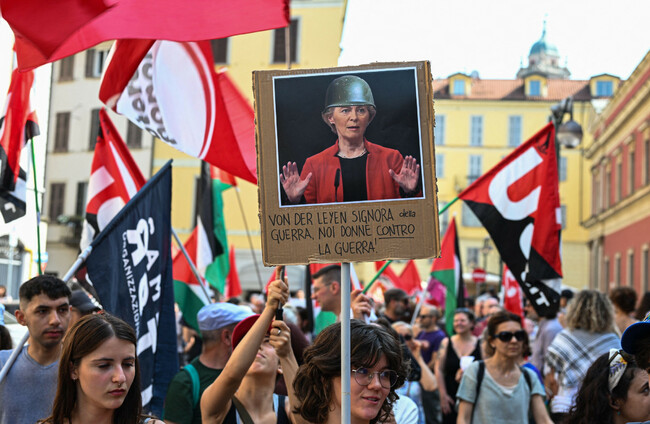

EUROPEAN LEADERS HAVE failed to use their leverage over Israel during their genocidal war on Gaza, Fianna Fáil MEP Barry Andrews has said, warning that the EU’s response has damaged its international reputation.
Speaking to The Journal in Strasbourg this week ahead of European Commission President Ursula von der Leyen’s annual State of the European Union address, Andrews criticised the failure to advance proposed sanctions and trade measures against Israel.
“It goes to show that we have leverage if we have a principled position, if we’re united,” Andrews said.
“But we choose not to exercise that, and this is what we’ve ended up with.”
Andrews said von der Leyen had demonstrated strong leadership on issues including the Covid-19 pandemic, Ukraine and European competitiveness, but argued that her approach to Gaza had damaged the EU’s standing.
“It’s damaged our reputation globally. It’s damaged Germany’s reputation,” he said.
Nearly three years on from October 2023, EU governments remain divided over how to respond to the mass killing of Palestinians and the destruction of the territory.
In her State of the Union address last year, von der Leyen announced that the Commission would propose sanctions against extremist Israeli ministers and violent settlers, alongside a partial suspension of the trade provisions of the EU-Israel Association Agreement.
The agreement governs the EU’s trade and broader relationship with Israel. Suspending its trade-related provisions would remove preferential treatment for certain Israeli imports, rather than amount to a complete ban on trade.
The European Union is Israel’s largest trading partner.
The Commission subsequently put forward proposals for sanctions and the partial suspension of the agreement’s trade provisions, but key measures have failed to secure sufficient support among member states.
Speaking before Wednesday’s address, Andrews said von der Leyen had made progress in last year’s speech but doubted she would announce another substantial proposal.
“She spoke about a man-made famine, spoke about sanctions and about a suspension of the trade agreement, but then couldn’t get any support for it,” Andrews said.
“So she’s just not going to go there again. I think that’s really where it’s at.”
Ireland, Spain and Belgium have pressed for action, while Germany, Austria and the Czech Republic have opposed suspending the agreement. Germany and Italy have also been identified by Amnesty International as obstacles to the proposed suspension.
Von der Leyen’s handling of Israel has attracted criticism from across Europe since the early weeks of the conflict.
Her October 2023 visit to Israel drew criticism from some EU member states and MEPs because she had not consulted them beforehand and expressed support for Israel’s right to defend itself without explicitly calling for compliance with international law.
There is no justification for Hamas’ heinous act of terror.
— Ursula von der Leyen (@vonderleyen) October 15, 2023
Israel has the right to defend itself.
At the same time civilians in Gaza are also victims of Hamas.
This is why we are tripling our humanitarian aid for Palestinians in need. pic.twitter.com/x0zlUOKdb8
Bas Eickhout, co-leader of the Greens in the European Parliament, accused the Commission last year of failing to show leadership, contrasting its reluctance to push measures on Gaza with von der Leyen’s approach to Ukraine. He argued that the Commission should put proposals forward even when agreement among member states was uncertain.
When von der Leyen subsequently announced sanctions and a partial suspension of trade provisions in September 2025, the European Free Alliance said the measures did not go far enough, calling instead for a full suspension of the EU-Israel Association Agreement and an arms embargo.
Amnesty International also criticised the timing of the proposals, describing them as “shamefully late”.
Andrews believes von der Leyen has been reluctant to risk another confrontation with her German conservative political allies.
The Commission president is a member of Germany’s Christian Democratic Union (CDU), which belongs to the European People’s Party (EPP), a centre-right European political family.
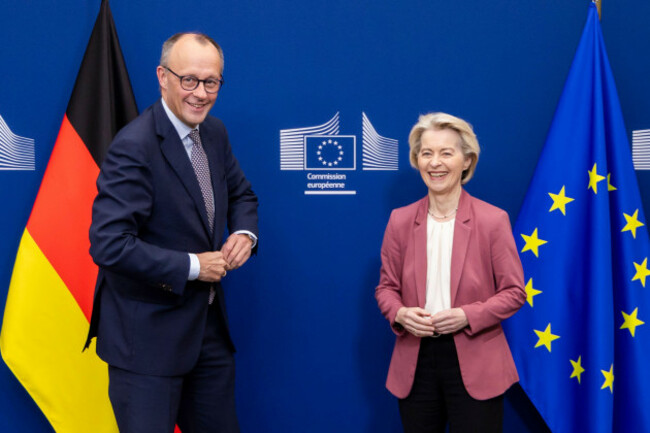
German Chancellor Friedrich Merz, also of the CDU, has maintained Germany’s support for Israel while calling on its government to improve the humanitarian situation in Gaza and allow aid to reach civilians.
Andrews said von der Leyen had faced a “huge backlash” from her German political family following last year’s State of the Union address.
“She’s obviously not willing to risk that again,” he said.
Andrews said he wanted the Commission president to recognise that she was “European first and German second”.
“So long as her German-ness is more prominent than her European-ness, well, then we’re going to be isolated, irrelevant, and divided.”
Andrews, who said he did not vote for von der Leyen when she sought a second term in 2024, also accused her of committing the EU to support Israel without first consulting member states or the European Parliament.
In Wednesday’s State of the Union address, von der Leyen acknowledged that the measures proposed last year had failed to secure sufficient support.
“Last year, I called for Europe to act, proposing a number of measures,” she told MEPs.
“It is painful for many Europeans that member states have been unable to build the necessary majorities for a unified response.”
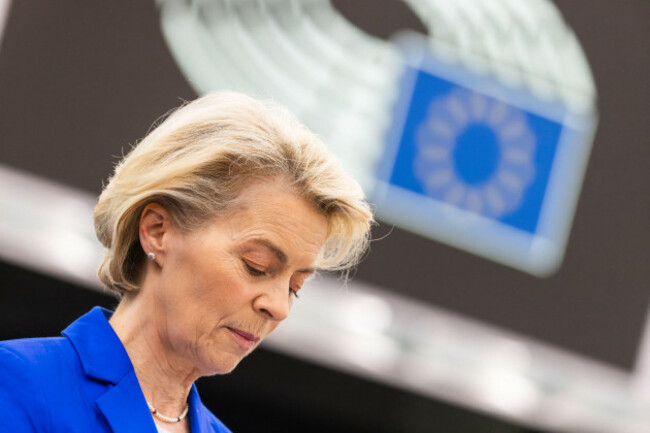
Unlike her 2025 address, when she unveiled proposals for sanctions and the partial suspension of the association agreement, this year’s speech did not contain a comparable new package of measures against Israel.
Andrews is also calling for an EU-wide ban on trade with illegal Israeli settlements, saying a letter he organised had secured the support of 114 MEPs (including all of Ireland’s MEPs).
Despite that backing, he said he did not expect von der Leyen to act.
“Am I expecting her to actually make a proposal for a ban? No, I don’t think so.”
He also called for Ireland’s Occupied Palestinian Territory Bill to be extended to services, arguing that fears of a US business backlash had not materialised.
“We have room to be a bit more aggressive and a bit more creative,” Andrews said.
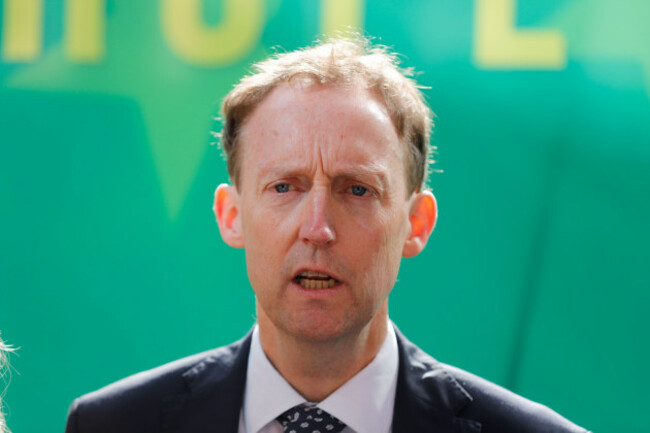
Andrews acknowledged that Ireland’s measures alone would have a limited economic impact on Israel, but argued that they could make a difference alongside action by other countries.
“Cumulatively, together with all the other initiatives in other member states, the bilateral effort has an impact.”
He said Ireland had taken political risks by pursuing measures targeting illegal settlements, but believed its position had gained wider acceptance.
“We were absolutely on the edge for three years. Now our position is mainstream.”

To embed this post, copy the code below on your site










have your say