Sign in. It’s quick, free and it’s up to you.
An account is an optional way to support the work we do. Find out more.
Sign in. It’s quick, free and it’s up to you.
An account is an optional way to support the work we do. Find out more.

In Calling 353, a new series for The Journal, bestselling Motherfoclóir author and podcaster Darach Ó Séaghdha casts a linguistic eye on how we talk about what it means to be Irish, the signs we post to each other about Irishness – and what really lies beneath it all.
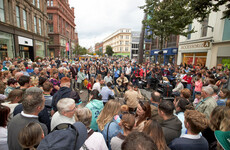
Tomorrow marks the end of the first ever Fleadh Cheoil to be held in Belfast, and the event has been hailed as a great success on a number of fronts.
If you weren’t there in person, you may have seen photos of people having double-helpings of the craic. It has practically doubled the footfall for city retailers, the temporary pedestrianisation of parts of the urban centre has given a hint of what life would be like in less car-obsessed community, and there has been music.
Planned events, spontaneous events, with opportunities not just to witness world class musicians but also to try certain instruments and dances for the first time.
You might be surprised at the amount of categories and instruments in the competition section of the Fleadh.
Did you know that whistling is one of the categories – not tin whistles (although that is also a category), but whistling a tune by putting your lips together and blowing?
How about the War Pipes? There are also storytelling competitions for different age groups, but don’t jump to conclusions about the over 18s category in that.
The Fleadh Cheoil has been an annual fixture since 1951, but one of the most popular and instantly recognisable Irish instruments was not included in the competition categories for the first 21 years.
Bad rap
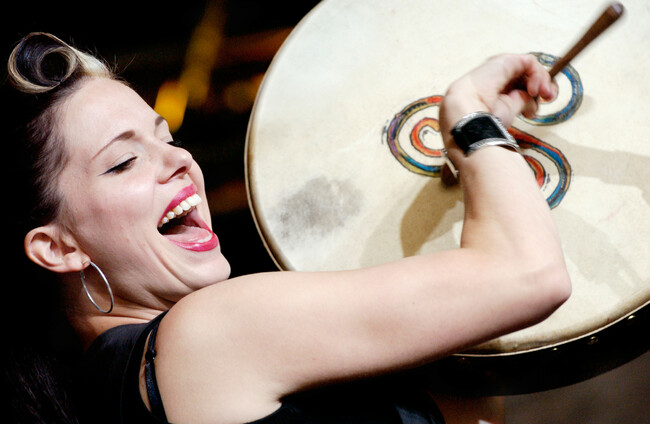
I refer to the bodhrán, the round handheld percussion instrument which signifies traditional Irish music all around the world. And yet, the bodhrán had to fight for recognition in the Irish musical scene.
Percussionists have always gotten a bad rap. For example the word “pariah”, meaning the very lowest caste, comes from the Tamil word for a drummer.
Perhaps you had the dishonour of being asked to play the triangle in the school band and your friends still remind you of this. And the bodhrán’s quest for respect has been a steep, uphill one.
bodharán, -áin, m., a sieve-like shallow wooden vessel with sheep-skin bottom; a dildurn. (Dinneen’s dictionary, 1904)
The entry from the 1904 foclóir above implies that the bodhrán wasn’t even considered a musical instrument at that moment in history, but rather a piece of farm equipment.
But just as a person might make a tune by blowing on bottles with different amounts of liquid in them or knock a beat out of some paint cans, this sieve-like vessel with a sheepskin bottom came in handy when a session kicked off.
And it was suitable for outings such as Wren Day excursions, which is where we get the earliest reference in the Folklore Archive to the bodhrán as a musical instrument.
If it’s good enough for Seán Ó Riada
An early champion of the bodhrán as a valuable musical instrument was Seán Ó Riada, who lent his substantial personal credibility to it by regularly featuring it on his radio show Fleadh Cheoil an Radió (not to be confused with the actual Fleadh Cheoil) in 1960.
Ó Riada made great claims for the instrument, describing it as a favourite of the ancient Celts. He was proud to be photographed with it, and who could be dismissive of the instrument if a musician and composer of his calibre was such an enthusiast?
The visual potential of the bodhrán – and the fact that it is relatively easy to learn the basics – did not escape the notice of John B Keane, who included bodhrán-playing sequences in his classic play Sive in 1959.
Keane might not have had as much luck getting actors to learn to play the harp or the fiddle along with their lines in time for opening night. But the impact of the bodhrán rhythms had in intensifying the drama made a huge impression on audiences.
As more people played the bodhrán, more musicians started customising the instrument to get the kind of sound they wanted. Masking tape and the shape of the internal frame could have an intentional effect on the sound.
The skin could be tightened in such a way that a different tone could be struck at different parts of the bodhrán, allowing the player to follow the melody when playing in accompaniment.
Traditional Irish music was having a moment as this was happening, and a bodhrán would always turn up onstage when The Dubliners, The Chieftans, the Wolfe Tones and their contemporaries would play. And by 1973 it was included as a category in the Fleadh Cheoil, the first winner being a John O’Dwyer from Leeds.
But even then, some of the coverage of the Fleadh treated the bodhrán as a novelty category.
In 2026, it’s hard to imagine Irish music without a bodhrán in there somewhere. In Beating Time: The Story of the Irish Bodhrán, Fintan Vallely notes that every Irish president in the last 30 years has at some point been photographed holding the instrument – this is especially remarkable when you compare it to uileann pipes, the fiddle or the harp.
And it has turned up on the Irish passport and many times on stamps.
Sometimes certain musicians are dismissive of the bodhrán and see it as a beginner’s instrument because it is easy to learn the basics – this is also true of chess, although in both cases achieving mastery is a very different story.
But this very accessibility is a huge part of what has won the bodhrán a place in our hearts – that a person who is curious about Irish music could wander into the Fleadh, try it and be playing an instrument that very day is an incredible promise that Irish traditional music makes, one that reminds us that everyone has a right to get on the stage.
Darach will be back next Sunday with more thoughts on the words and Irish cultural phenomena that unite us.
To embed this post, copy the code below on your site






have your say