Sign in. It’s quick, free and it’s up to you.
An account is an optional way to support the work we do. Find out more.
Sign in. It’s quick, free and it’s up to you.
An account is an optional way to support the work we do. Find out more.

In Calling 353, bestselling Motherfoclóir author and podcaster Darach Ó Séaghdha casts a linguistic eye on how we talk about what it means to be Irish, the signs we post to each other about Irishness – and what really lies beneath it all.
ON BBC’s NEWSNIGHT this past week, a Labour MP by the name of Jonathan Hinder – a headline writer’s dream, a guy with a name like that trying to delay a new policy – had some thoughts on the murmurs of the United Kingdom applying to re-enter the European Union.
Labour must not abandon its working-class roots, he warned, and asked if the party was to work “for Putney or for Pendle”. The alliterative binary, as frustratingly simplistic as it was catchy, got tongues wagging. If you are not up to speed with the geography of England, Putney is in London and Pendle is “up north” – the two genders, so to speak.
Making fetch happen – coining an expression and watching other people use it off their own bat – is a cost-effective way for a politician to get people to remember them. But this may have backfired on Hinder as Brits who had experienced 10 years of Brexit-related expert-phobia found fault with his quip.
The old “northern good” (gravy, mines, Yorkshire puds, not wearing a coat, and bands with singers called Ian) versus “London bad” (baristas with ringmaster moustaches, taking over a minute to order a coffee, people who claim to love recycling but leave little empty plastic coke bags everywhere, referring to a mental breakdown as a “menty b”) trope wasn’t going to cut it anymore.
Treating a place as an idea is not new – D4 and Galway are states of mind as well as physical locations. Maybe that’s simplistic. But adding a second place to the idea – taking two places and treating them as a yin and a yang – tends to be even more so, although it remains an effective rhetorical trope. American politicians in the wake of the 2008 banking disasters would often talk about “Main Street vs Wall Street” as a stand-in for ordinary Americans versus the despots of finance. And fans of Slow Horses will know all about Moscow Rules versus London Rules. There are a few Irish examples too.
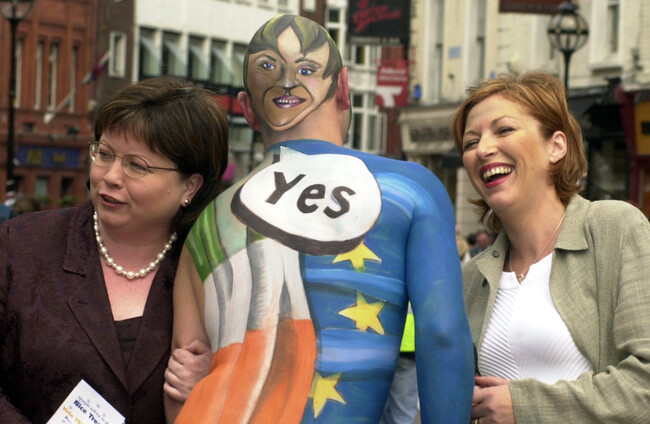
Ireland had an extremely positive view of the European Union until the economic boom in the ’90s threatened to switch us from net recipients to net contributors of funds. Referendums on European treaties had passed without breaking a sweat until 2001 when the Nice Treaty flopped at the ballot. The next day, Mary Harney (who was minister for enterprise, trade and employment at the time) suggested that Irish people felt spiritually closer to Boston than Berlin.
She could have said “closer to Boston than Brussels”, but she knew what she was doing. And sure you can’t walk down the street in Brussels without hearing a bit of Gaeilge spoken.
As with “Putney or Pendle”, this phase had a nice bit of alliteration in it (same last letters as well as first letters too). But more than that, Boston and Berlin are both cities with stories: the city in Massachusetts as the capital of Irish America, and the German capital as the front line of a Cold War that Ireland stayed neutral in. As a soundbite it worked well and was quoted by journalists and politicians frequently in the years to come, as well as featuring regularly in thesis titles.
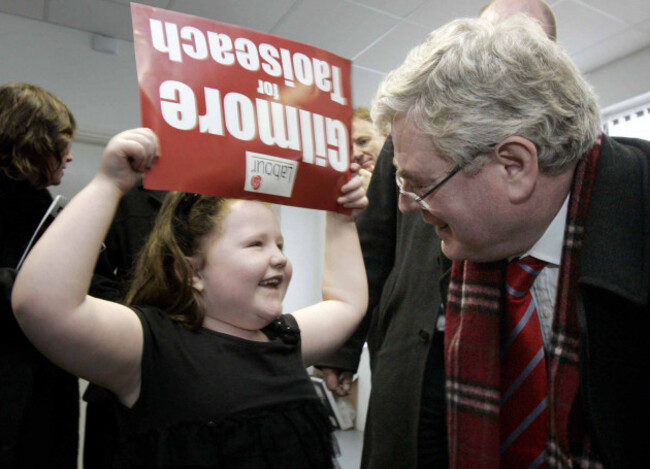
During the 2011 General Election in Ireland, Éamon Gilmore (ask your dad) suggested that Irish voters had a stark choice: Labour’s Way or Frankfurt’s Way. As with Mary Harney, Gilmore did not single out the seat of the European Parliament, and not just because it’s hard to say “Brussels’s way”. And he certainly wasn’t going to say Labour’s Way or the IMF’s way. Instead, he chose the throne of the European Central Bank as the nemesis.
Presenting the financial crisis as a failure of banking rather than one of politics didn’t leave a lasting impression on the Irish psyche, especially when compared to the “Angela Merkel Thinks We’re Working” banners at Irish football games at the time. For people who deal with the EU machine in their work, referring to bodies as different as the Commission, the Parliament, the ECB and the ECJ as “Brussels” is very frustrating and Gilmore deserves a little credit for trying to break that, even though it didn’t work.
Gilmore was (and still is, I’m sure) a Connacht man, which leads us to our next example.
Marie Antoinette never said “let them eat cake”, PT Barnum never said “never give a sucker an even break”, Ginger Rogers never said “everything Fred Astaire did I did backwards and in heels”, and apparently Oliver Cromwell never actually said “to Hell or to Connacht”.
It’s become a cliché for a famous person’s most famous quote to be an epigram attributed to them rather than something they actually said. But in all these cases, the quote that has endured has been an accurate reflection of their legacy. In Cromwell’s case, the line was a reference to the 1652 Act For The Settling of Ireland which offered Catholic landowners in Ireland a deal – exchange their property for inferior farmland in the West or be executed.
Cromwell was a Puritan and he would have believed that these executed Catholics would be sent to hell, so while he may not have said To Hell or Connacht verbatim, this is a succinct summary of what he thought on the matter.
Centuries later, Roscommon in Connacht was an outlier in the results of the Marriage Equality referendum of 2015, and people on different ends of the political spectrum toyed with the notion that the county represented socially conservative rural Ireland just as Dublin 4 represented shoneenism and middle-class decadence.
Thankfully this has not endured, because it isn’t true. Lots of Roscommon people voted for marriage equality, they just did so in other counties where they went to study or where they were able to get work. As with Putney or Pendle, people don’t always live where they grew up, and it’s trite to assume that a square mile of land can have opinions on things.
Darach will be back next Sunday with more thoughts on the words and Irish cultural phenomena that unite us.
To embed this post, copy the code below on your site












have your say